Review
. 2020 Jan;45(1):176-191.
doi: 10.1038/s41386-019-0431-7. Epub 2019 Jun 11.

Sleep in the United States Military

Affiliations
Review

Sleep in the United States Military

Cameron H Good et al. Neuropsychopharmacology. 2020 Jan.

Abstract

The military lifestyle often includes continuous operations whether in training or deployed environments. These stressful environments present unique challenges for service members attempting to achieve consolidated, restorative sleep. The significant mental and physical derangements caused by degraded metabolic, cardiovascular, skeletomuscular, and cognitive health often result from insufficient sleep and/or circadian misalignment. Insufficient sleep and resulting fatigue compromises personal safety, mission success, and even national security. In the long-term, chronic insufficient sleep and circadian rhythm disorders have been associated with other sleep disorders (e.g., insomnia, obstructive sleep apnea, and parasomnias). Other physiologic and psychologic diagnoses such as post-traumatic stress disorder, cardiovascular disease, and dementia have also been associated with chronic, insufficient sleep. Increased co-morbidity and mortality are compounded by traumatic brain injury resulting from blunt trauma, blast exposure, and highly physically demanding tasks under load. We present the current state of science in human and animal models specific to service members during- and post-military career. We focus on mission requirements of night shift work, sustained operations, and rapid re-entrainment to time zones. We then propose targeted pharmacological and non-pharmacological countermeasures to optimize performance that are mission- and symptom-specific. We recognize a critical gap in research involving service members, but provide tailored interventions for military health care providers based on the large body of research in health care and public service workers.


Figures
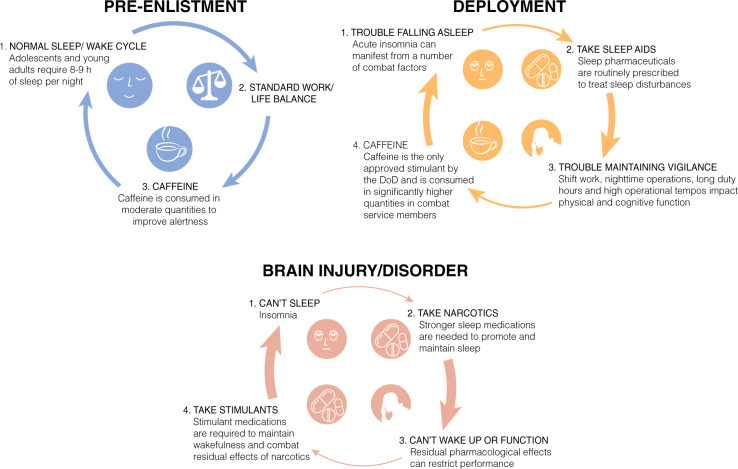
Fig. 1
Fig. 1
Three sleep/wake scenarios are represented based on discussion throughout the manuscript. 1. As illustrated in blue, enlistees generally join the military with normal sleep/wake habits that must rapidly transition to an environment where restricted and fragmented sleep is the norm. 2. Upon deployment, as shown in orange, a number of precipitating factors can cause acute insomnia that require prescription sleep aids to help service members fall asleep. Residual pharmaceutical effects, combined with long duty hours and irregular sleep schedules, result in statistically higher amounts of caffeine intake to maintain alertness and performance. If taken at the wrong time, the awake-promoting effects of caffeine can cause further sleep disruptions and prevent restorative sleep during an already limited sleep window. This feed-forward cycle can necessitate service members being prescribed an increasingly potent sleep aid to overcome the stimulant effects, further necessitating stimulants to transition to wakefulness and maintain vigilance throughout subsequent duty hours, as illustrated by the increasing thickness of the arrows in the cycle. 3. Following injury or diagnosis of neurological disorder, as shown in red, persistent insomnia occurs in a large number of service members. Stronger narcotic sleep aids are routinely prescribed to overcome insomnia, creating a stronger dependence on pharmacology to drive sleep/wake states, as depicted by the even thicker red arrows within the cycle
Fig. 2
Fig. 2
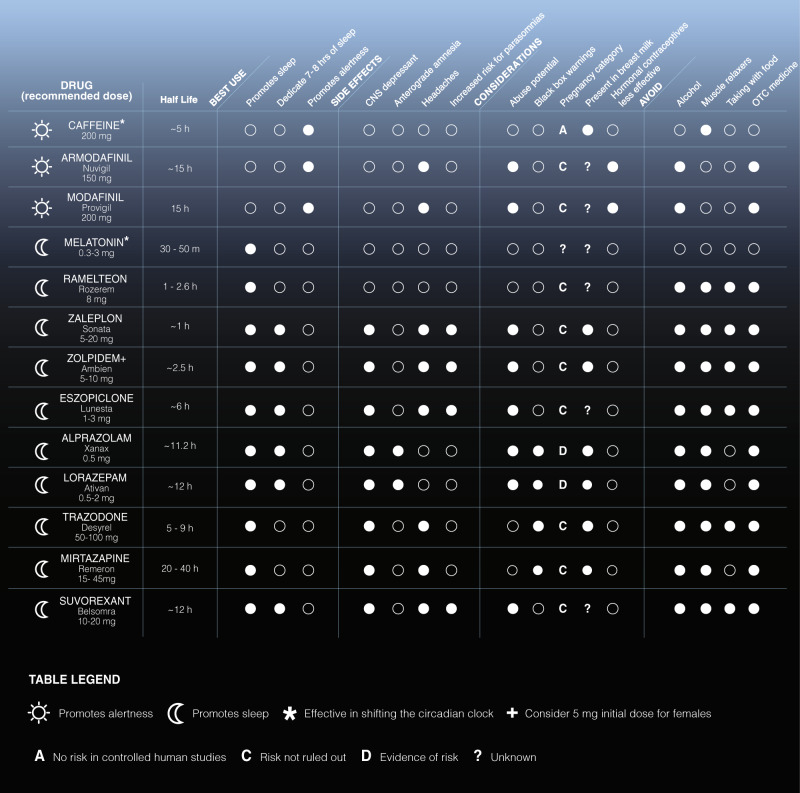
List of common wake (sun) and sleep (moon) medications prescribed to military personnel; all Food and Drug Administration (FDA) approved medications are available for prescription at military treatment facilities. In general, over-the-counter drugs (OTC; e.g. melatonin) are preferred first, followed by non-benzodiazepines. Benzodiazepines are least preferred given their pronounced side effects and deleterious impact on function and performance. Use of trademarked names does not imply endorsement by the U.S. Government and is intended only to assist in identification of specific medications
Fig. 3
Fig. 3
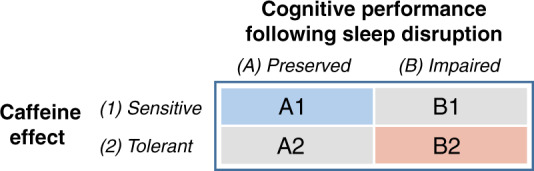
A working model of individual variation in the ability to perform in an operating environment under limited sleep conditions. The first principle is cognitive resilience to sleep disruption. Some individuals, due to biological modifiers, are able to preserve their level of vigilance and cognitive performance while sleep-deprived. The second principle is the degree of individual sensitivity to a caffeine countermeasure. This working model is thought to create a framework for group (unit-level) performance that can be optimized by stabilizing performance at the individual level and assigning duties accordingly

References

    1. Ulmer CS, et al. Associations between sleep difficulties and risk factors for cardiovascular disease in veterans and active duty military personnel of the iraq and afghanistan conflicts. J Behav Med. 2015;38:544–55. - PMC - PubMed
    1. Jacobson IG, et al. Alcohol use and alcohol-related problems before and after military combat deployment. JAMA. 2008;300:663–75. - PMC - PubMed
    1. Mysliwiec V, et al. Sleep disorders and associated medical comorbidities in active duty military personnel. Sleep. 2013;36:167–74. - PMC - PubMed
    1. Mysliwiec V, et al. Trauma associated sleep disorder: A proposed parasomnia encompassing disruptive nocturnal behaviors, nightmares, and rem without atonia in trauma survivors. J Clin Sleep Med. 2014;10:1143–8. - PMC - PubMed
    1. Capener DC, Brock MS, Hansen SL, Matsangas P, Mysliwiec V. An initial report of sleep disorders in women in the U.S. Military. Mil Med. 2018;183:e266–e271. - PubMed

Publication types

MeSH terms