Review
. 2019 Jun 10;20(11):2829.
doi: 10.3390/ijms20112829.

Insect ATP-Binding Cassette (ABC) Transporters: Roles in Xenobiotic Detoxification and Bt Insecticidal Activity

Affiliations
Review

Insect ATP-Binding Cassette (ABC) Transporters: Roles in Xenobiotic Detoxification and Bt Insecticidal Activity

Chao Wu et al. Int J Mol Sci. .

Abstract

ATP-binding cassette (ABC) transporters, a large class of transmembrane proteins, are widely found in organisms and play an important role in the transport of xenobiotics. Insect ABC transporters are involved in insecticide detoxification and Bacillus thuringiensis (Bt) toxin perforation. The complete ABC transporter is composed of two hydrophobic transmembrane domains (TMDs) and two nucleotide binding domains (NBDs). Conformational changes that are needed for their action are mediated by ATP hydrolysis. According to the similarity among their sequences and organization of conserved ATP-binding cassette domains, insect ABC transporters have been divided into eight subfamilies (ABCA-ABCH). This review describes the functions and mechanisms of ABC transporters in insecticide detoxification, plant toxic secondary metabolites transport and insecticidal activity of Bt toxin. With improved understanding of the role and mechanisms of ABC transporter in resistance to insecticides and Bt toxins, we can identify valuable target sites for developing new strategies to control pests and manage resistance and achieve green pest control.

Keywords: ABC transporters; Bt insecticidal activity; insect; xenobiotic detoxification.


Conflict of interest statement

The authors declare no conflicts of interest.

Figures
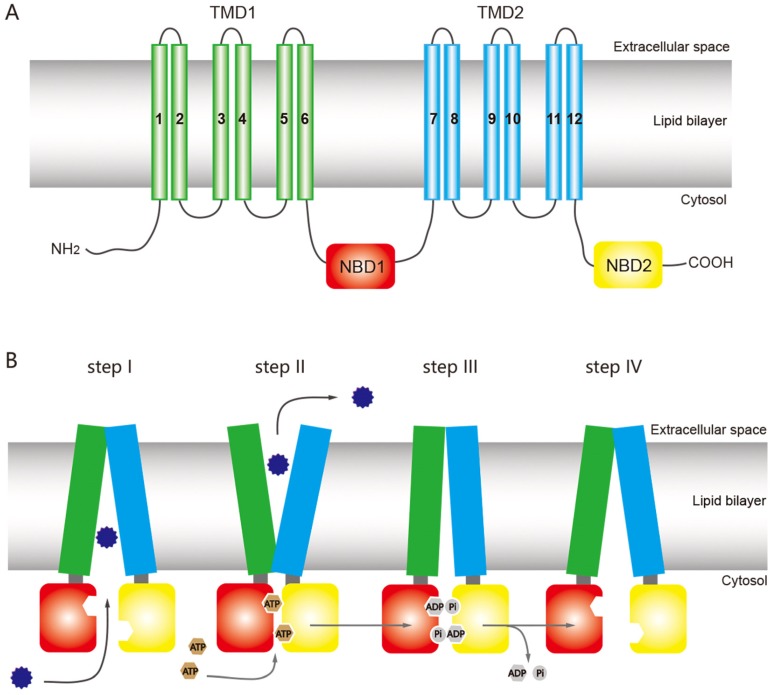
Figure 1
Figure 1
General structure of an ATP-binding cassette (ABC) full transporter (ABC exporter) and the ATP-switch model for the transport mechanism of ABC transporters. (A) Typical ABC full transporter with two transmembrane domains (TMDs), TMD1 (green) and TMD2 (sky blue), and two nucleotide-binding domains (NBDs), NBD1 (red) and NBD2 (yellow). Each transmembrane domain (TMD) contains six transmembrane helices. The “long” multidrug-resistance associated proteins (MRPs) of the ABCC subfamily contains an additional TMD (TMD0) at the N terminus [46]. (B) The ATP-switch model [14] includes (I) binding of the substrates (12-point blue circle) to the TMDs; (II) subsequent structural changes to the NBDs (red and yellow), hydrolysis of ATP (brown circles), followed by closed dimer formation of the NBDs and major conformational change in the TMDs, which initiates substrate translocation; (III) the ATP is hydrolyzed (gray circles), releasing ADP and Pi, and (IV) finally destabilization of the closed dimer restores its initial open dimer configuration for another new cycle. This figure is drawn by following the previous report of ABC transporter by Dermauw & Van Leeuwen [14].
Figure 2
Figure 2
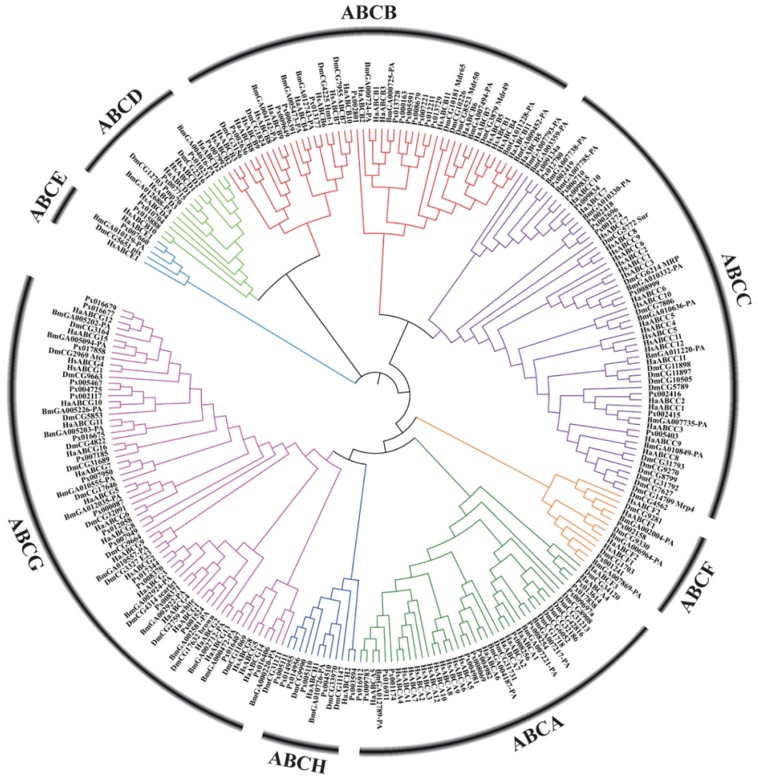
Phylogenetic tree based on amino acid sequences of 262 ABC transporters (Supplementary Material 1) from several insects and humans. The sequences were aligned using MUSCLE. The evolutionary history was inferred using the neighbor-joining method and MEGA-X with 1000 bootstrap replicates. All positions with less than 95% site coverage were eliminated. Species codes: Ha, Helicoverpa armigera; Bm, Bombyx mori; Px, Plutella xylostella; Hs, Homo sapiens; Dm, Drosophila melanogaster.

References

    1. Dean M., Rzhetsky A., Allikmets R. The human ATP-binding cassette (ABC) transporter superfamily. Genome Res. 2001;11:1156–1166. doi: 10.1101/gr.GR-1649R. - DOI - PubMed
    1. Dassa E., Bouige P. The ABC of ABCS: A phylogenetic and functional classification of ABC systems in living organisms. Res. Microbiol. 2001;152:211–229. doi: 10.1016/S0923-2508(01)01194-9. - DOI - PubMed
    1. Holland I.B., Cole S.P., Kuchler K., Higgins C.F. ABC Proteins—From Bacteria to Man. Academic Press; Cambridge, MA, USA: 2003. p. 647.
    1. Berger E.A. Different mechanisms of energy coupling for the active transport of proline and glutamine in Escherichia coli. Proc. Natl. Acad. Sci. USA. 1973;70:1514–1518. doi: 10.1073/pnas.70.5.1514. - DOI - PMC - PubMed
    1. Berger E.A., Heppel L.A. Different mechanisms of energy coupling for the shock-sensitive and shock-resistant amino acid permeases of Escherichia coli. J. Biol. Chem. 1974;249:7747–7755. - PubMed

MeSH terms

LinkOut - more resources