Review
. 2019 Jun 10;8(6):569.
doi: 10.3390/cells8060569.

MOB (Mps one Binder) Proteins in the Hippo Pathway and Cancer

Affiliations
Review

MOB (Mps one Binder) Proteins in the Hippo Pathway and Cancer

Ramazan Gundogdu et al. Cells. .

Abstract

The family of MOBs (monopolar spindle-one-binder proteins) is highly conserved in the eukaryotic kingdom. MOBs represent globular scaffold proteins without any known enzymatic activities. They can act as signal transducers in essential intracellular pathways. MOBs have diverse cancer-associated cellular functions through regulatory interactions with members of the NDR/LATS kinase family. By forming additional complexes with serine/threonine protein kinases of the germinal centre kinase families, other enzymes and scaffolding factors, MOBs appear to be linked to an even broader disease spectrum. Here, we review our current understanding of this emerging protein family, with emphases on post-translational modifications, protein-protein interactions, and cellular processes that are possibly linked to cancer and other diseases. In particular, we summarise the roles of MOBs as core components of the Hippo tissue growth and regeneration pathway.

Keywords: Hippo pathway; LATS; MST; Mps one binder; NDR; STK38; STRIPAK; phosphorylation; protein kinase; protein-protein interactions; signal transduction; structure biology.


Conflict of interest statement

The authors declare no conflict of interest.

Figures
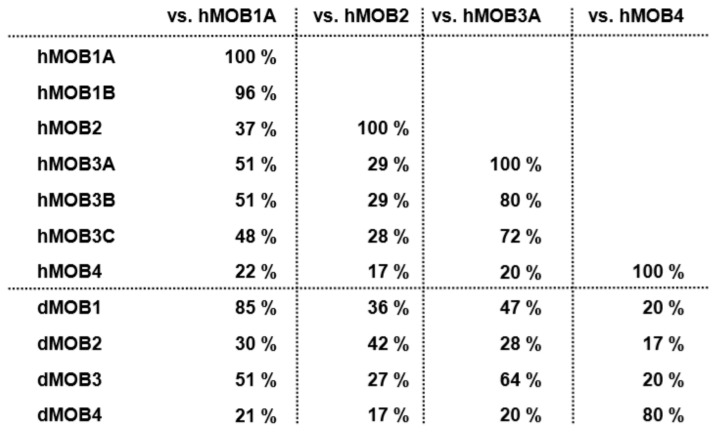
Figure 1
Figure 1
Primary sequence identities of the fly and human MOBs. The identities between primary sequences are displayed. Identities were defined using EMBOSS needle for pairwise alignments (https://www.ebi.ac.uk/Tools/psa/emboss_needle/). The UniProtKB nomenclature for hMOBs can be found in the introduction section of the main text. The UniProtKB names for dMOBs are as follows [4]: dMOB1 (aka Mats and CG13852)–Q95RA8, dMOB2 (aka CG11711)–Q8IQG1, dMOB3 (aka CG4946)–Q9VL13, and dMOB4 (aka CG3403)–Q7K0E3.
Figure 2
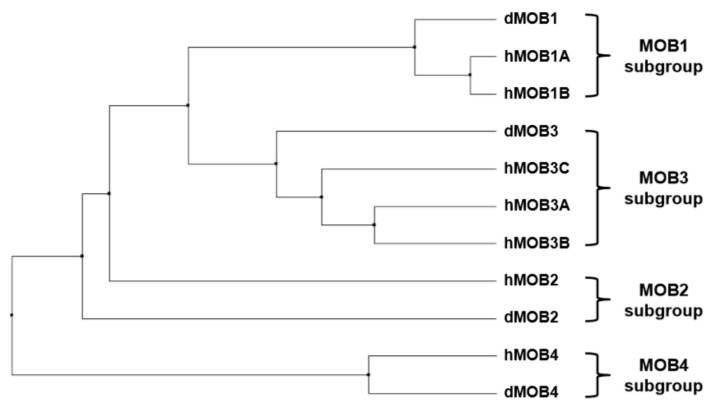
Figure 2
Phylogenetic relationships within the fly and human MOB protein family. The phylogenetic tree was defined using Clustal Omega (https://www.ebi.ac.uk/Tools/msa/clustalo/) together with the Jalview 2.10.5 software using phylogenetic calculation based on the neighbour-joining method. The UniProtKB nomenclature for the analysed proteins is defined in the legend of Figure 1.
Figure 3
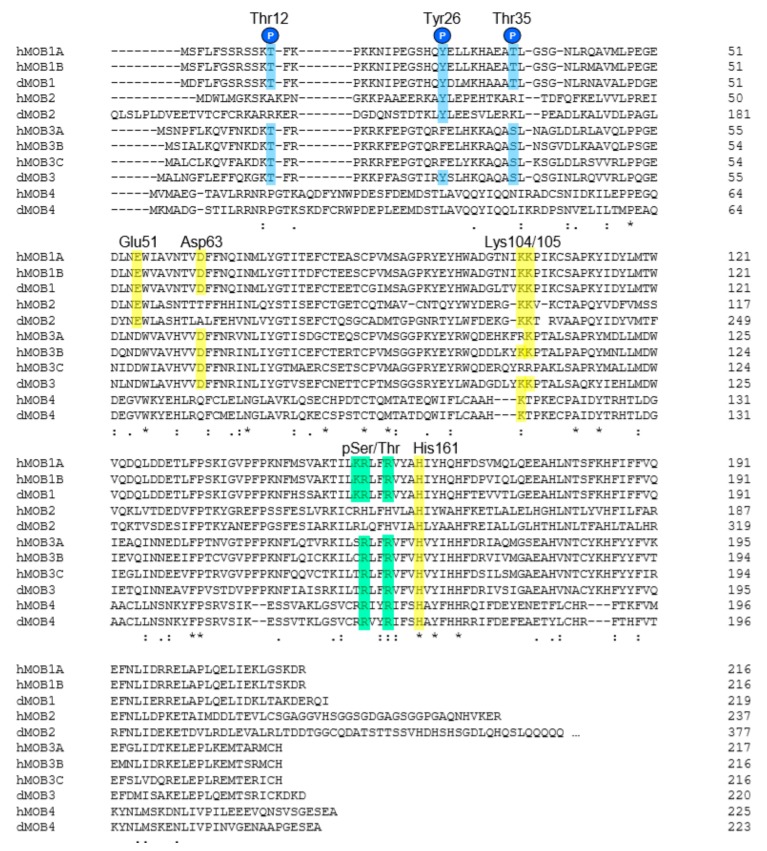
Figure 3
Comparison of the primary protein sequences of human and fly MOBs. Primary protein sequences were aligned using Clustal Omega as defined in the legend of Figure 2. The sites of Thr12, Tyr26 and Thr35 phosphorylations of hMOB1A are highlighted in light blue. Important interaction sites of hMOB1A that were verified by different experimental approaches are displayed in yellow. The key residues of the phospho-Ser/Thr (pSer/Thr) binding pocket of hMOB1A are shown in green. For more details on key residues of hMOB1 that are involved in kinase binding please consult refs. [3,6,70,71,72,78,92,95]. The UniProtKB nomenclature for the analysed proteins is defined in the legends of Figure 1 and Figure 2.
Figure 4
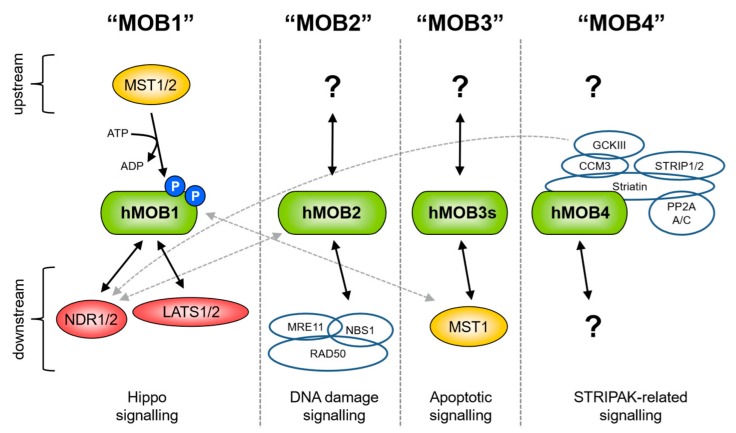
Figure 4
The four branches of MOB control. The “MOB1 branch”: In human cells, hMOB1 phosphorylated by MST1/2 promotes the activation of NDR1/2 and LATS1/2 in the context of Hippo signalling and the regulation of other important cellular functions [1,55,57]. The “MOB2 branch”: hMOB2 can interact with the MRN (Mre11-Rad50-Nbs1) DNA damage sensor complex, thereby supporting DNA damage and consequently cell cycle signalling [37,38]. The “MOB3 branch”: hMOB3s form a complex with MST1, in so doing regulating apoptotic signalling [39]. The “MOB4 branch”: hMOB4 as part of the STRIPAK (Striatin-interacting phosphatase and kinase) complex is likely to support the diverse cellular roles of the STRIPAK complex [43,44]. Notably, it is possible that these MOB branches do not signal in isolation, but rather may be interlinked as highlighted by dashed grey lines. For example, hMOB2 may connect with the “MOB1 branch” by competing with hMOB1 for NDR1/2 binding [35,62], the hMOB3s may link with the “MOB1 branch” through competing with hMOB1 for MST1/2 binding [6,39], or hMOB4 as part of the GCKIII-containing STRIPAK complex may connect with the “MOB1 branch” through GCKIII-mediated phosphorylation of NDR1/2 (see subchapter 4). Noteworthy, Hippo and STRIPAK signalling have already been found to be interconnected (see subchapter 4), although, to our knowledge, the specific roles of hMOB4 have not been defined. hMOBs are in green. MST1/2 and NDR/LATS kinases are in yellow and red, respectively. Established interactions are highlighted by black lines, while putative interconnections between “MOB branches” are shown by dashed grey lines. Phosphorylations are indicated by “P” in blue.

References

    1. Hergovich A. MOB control: Reviewing a conserved family of kinase regulators. Cell Signal. 2011;23:1433–1440. doi: 10.1016/j.cellsig.2011.04.007. - DOI - PMC - PubMed
    1. Chow A., Hao Y., Yang X. Molecular characterization of human homologs of yeast MOB1. Int. J. Cancer. 2010;126:2079–2089. doi: 10.1002/ijc.24878. - DOI - PubMed
    1. Stavridi E.S., Harris K.G., Huyen Y., Bothos J., Verwoerd P.M., Stayrook S.E., Pavletich N.P., Jeffrey P.D., Luca F.C. Crystal structure of a human Mob1 protein: Toward understanding Mob-regulated cell cycle pathways. Structure. 2003;11:1163–1170. doi: 10.1016/S0969-2126(03)00182-5. - DOI - PubMed
    1. He Y., Emoto K., Fang X., Ren N., Tian X., Jan Y.N., Adler P.N. Drosophila Mob family proteins interact with the related tricornered (Trc) and warts (Wts) kinases. Mol. Biol. Cell. 2005;16:4139–4152. doi: 10.1091/mbc.e05-01-0018. - DOI - PMC - PubMed
    1. Luca F.C., Winey M. MOB1, an essential yeast gene required for completion of mitosis and maintenance of ploidy. Mol. Biol. Cell. 1998;9:29–46. doi: 10.1091/mbc.9.1.29. - DOI - PMC - PubMed

Publication types

Substances

LinkOut - more resources