


Maternal Dietary Patterns Are Associated with Pre-Pregnancy Body Mass Index and Gestational Weight Gain: Results from the "Mamma & Bambino" Cohort
- PMID: 31185656
- PMCID: PMC6627583
- DOI: 10.3390/nu11061308
Maternal Dietary Patterns Are Associated with Pre-Pregnancy Body Mass Index and Gestational Weight Gain: Results from the "Mamma & Bambino" Cohort
Abstract
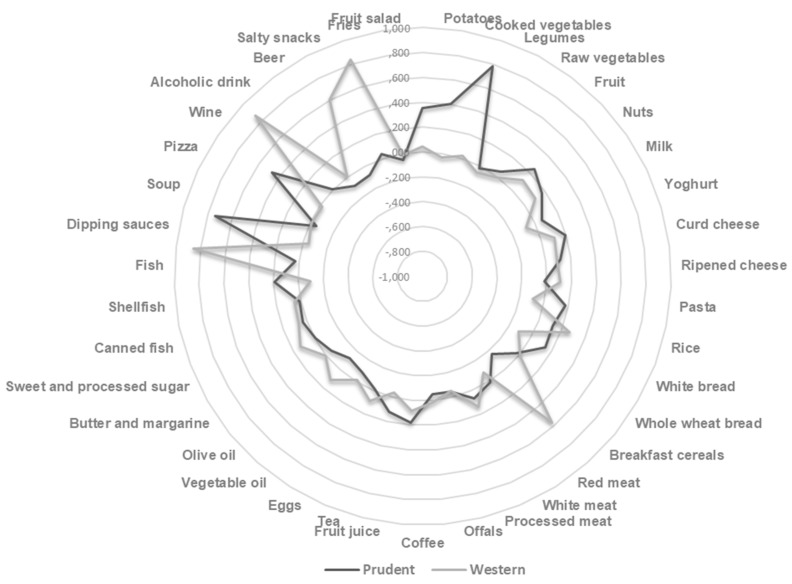
The present study investigated the association of maternal dietary patterns with pre-pregnancy body mass index (BMI) and total gestational weight gain (GWG), using data of 232 women from the "Mamma & Bambino" cohort. Dietary patterns were derived by a food frequency questionnaire and principal component analysis. Self-reported pre-pregnancy BMI and GWG were calculated according to the World Health Organization and Institute of Medicine guidelines, respectively. The adherence to the "Western" dietary pattern-characterized by high intake of red meat, fries, dipping sauces, salty snacks and alcoholic drinks-was associated with increased GWG (β = 1.217; standard error [SE] = 0.487; p = 0.013), especially among obese women (β = 7.363; SE = 1.808; p = 0.005). In contrast, the adherence to the "prudent" dietary pattern-characterized by high intake of boiled potatoes, cooked vegetables, legumes, pizza and soup-was associated with reduced pre-pregnancy BMI (β = -0.631; SE = 0.318; p-trend = 0.038). Interestingly, the adherence to this pattern was positively associated with GWG among underweight (β = 4.127; SE = 1.722; p = 0.048), and negatively among overweight and obese individuals (β = -4.209; SE = 1.635; p = 0.016 and β = -7.356; SE = 2.304; p = 0.031, respectively). Our findings point out that the promotion of a healthy diet might represent a potential preventive strategy against inadequate weight gain, even during the periconceptional period.
Keywords: diet; dietary assessment; epidemiology; neonatal outcomes; pregnancy; public health.
Conflict of interest statement
The authors declare no conflicts of interest.
Figures
References
-
- World Health Organization Obesity and Overweight. [(accessed on 1 April 2019)]; Available online: https://www.who.int/dietphysicalactivity/media/en/gsfs_obesity.pdf.
-
- Labayen I., Ruiz J.R., Vicente-Rodríguez G., Turck D., Rodríguez G., Meirhaeghe A., Molnár D., Sjöström M., Castillo M.J., Gottrand F., et al. Early life programming of abdominal adiposity in adolescents: The HELENA Study. Diabetes Care. 2009;32:2120–2122. doi: 10.2337/dc09-0983. - DOI - PMC - PubMed
-
- De la Torre L., Flick A.A., Istwan N., Rhea D., Cordova Y., Dieguez C., Desch C., González-Quintero V.H. The effect of new antepartum weight gain guidelines and prepregnancy body mass index on the development of pregnancy-related hypertension. Am. J. Perinatol. 2011;28:285–292. doi: 10.1055/s-0030-1271211. - DOI - PubMed
MeSH terms
LinkOut - more resources
Full Text Sources
Medical
Molecular Biology Databases
