. 2019 Jun 11;17(1):196.
doi: 10.1186/s12967-019-1947-7.

Cytokine expression in Treponema pallidum infection

Affiliations

Cytokine expression in Treponema pallidum infection

N Kojima et al. J Transl Med. .

Abstract

Background: Current syphilis tests cannot distinguish between active and past syphilis among patients with serofast rapid plasma reagin (RPR) titers. We investigated whether cytokine profiles might provide insight in the differentiation of active and treated syphilis.

Methods: We collected quarterly serum samples from participants at risk for incident syphilis in a prospective cohort study of men and male-to-female transgender women. We defined incident syphilis as a new RPR titer ≥ 1:8 or a fourfold increase from a prior RPR titer and a positive Treponema pallidum particle agglutination assay. We measured cytokine expression using a 63-multiplex bead-based Luminex assay (eBiosciences/Affymetrix, San Diego, California, USA). We used tertile bins and Chi square tests to identify differences in proportions of cytokines between samples from patients with active and treated syphilis. We constructed a network of cytokine profiles from those findings. We used R software (R version 3.4.1, R, Vienna, Austria) to fit models.

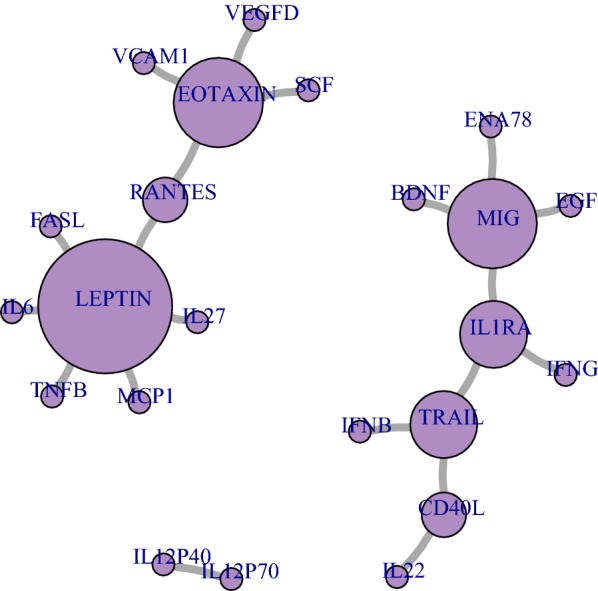
Results: We identified 20 pairs of cytokines (out of 1953 possible pairs) that differed between active and treated syphilis. From those, we identified three cytokine networks of interest: an Eotaxin-Rantes-Leptin network, a Mig-IL1ra-Trail-CD40L network, and an IL12p40-IL12p70 network.

Conclusions: Differences in cytokine profiles are present among men and male-to-female transgender women with active and treated syphilis. Cytokine assays may be a potentially useful tool for identifying active syphilis among patients with serologic syphilis reactivity.

Keywords: Cytokine; Cytokines; Syphilis; Treponema pallidum.


Conflict of interest statement

The authors declare that they have no competing interests.

Figures
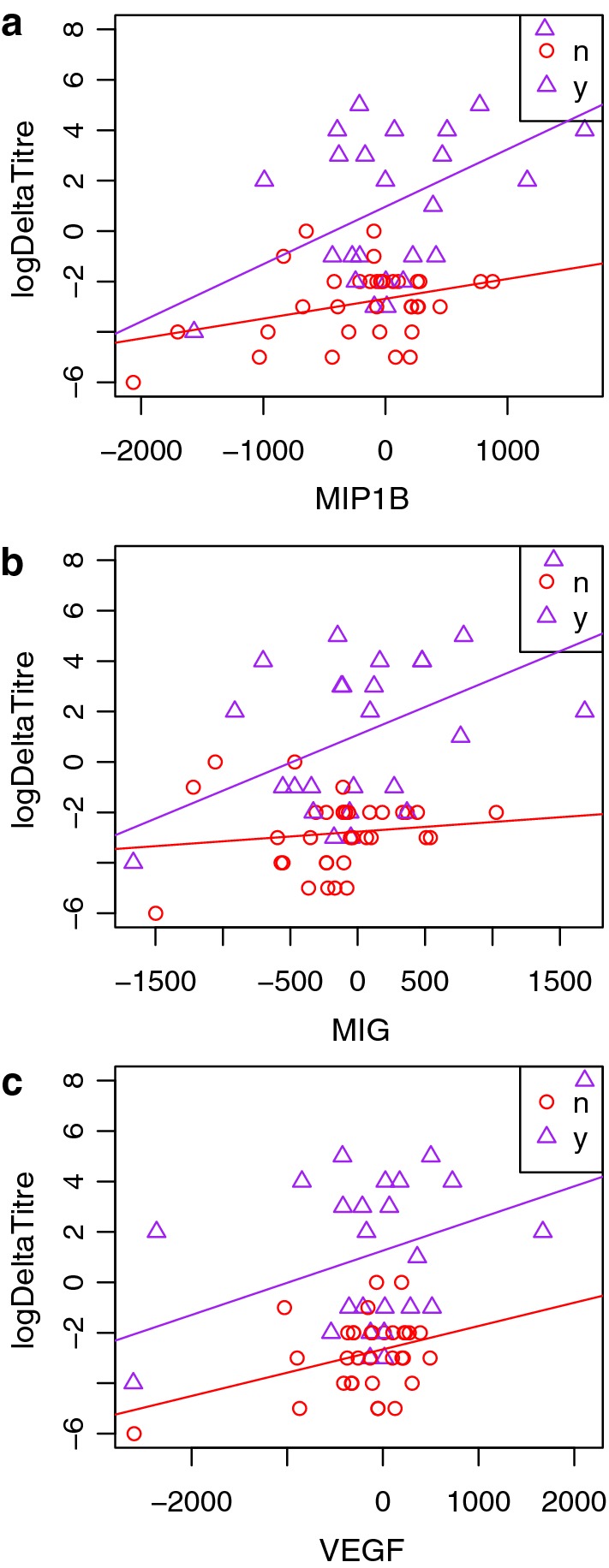
Fig. 1
Fig. 1
a Association between directionality of rapid plasma reagin titers and changes in cytokine concentration for MIP1B; b MIG; and c VEGF. Partial F test p-values were 0.001, 0.0026, and 0.011, respectively. Deltas in titer (log2) were derived as e.g. t1 − t0, with infection = y, n based on t1
Fig. 2
Fig. 2
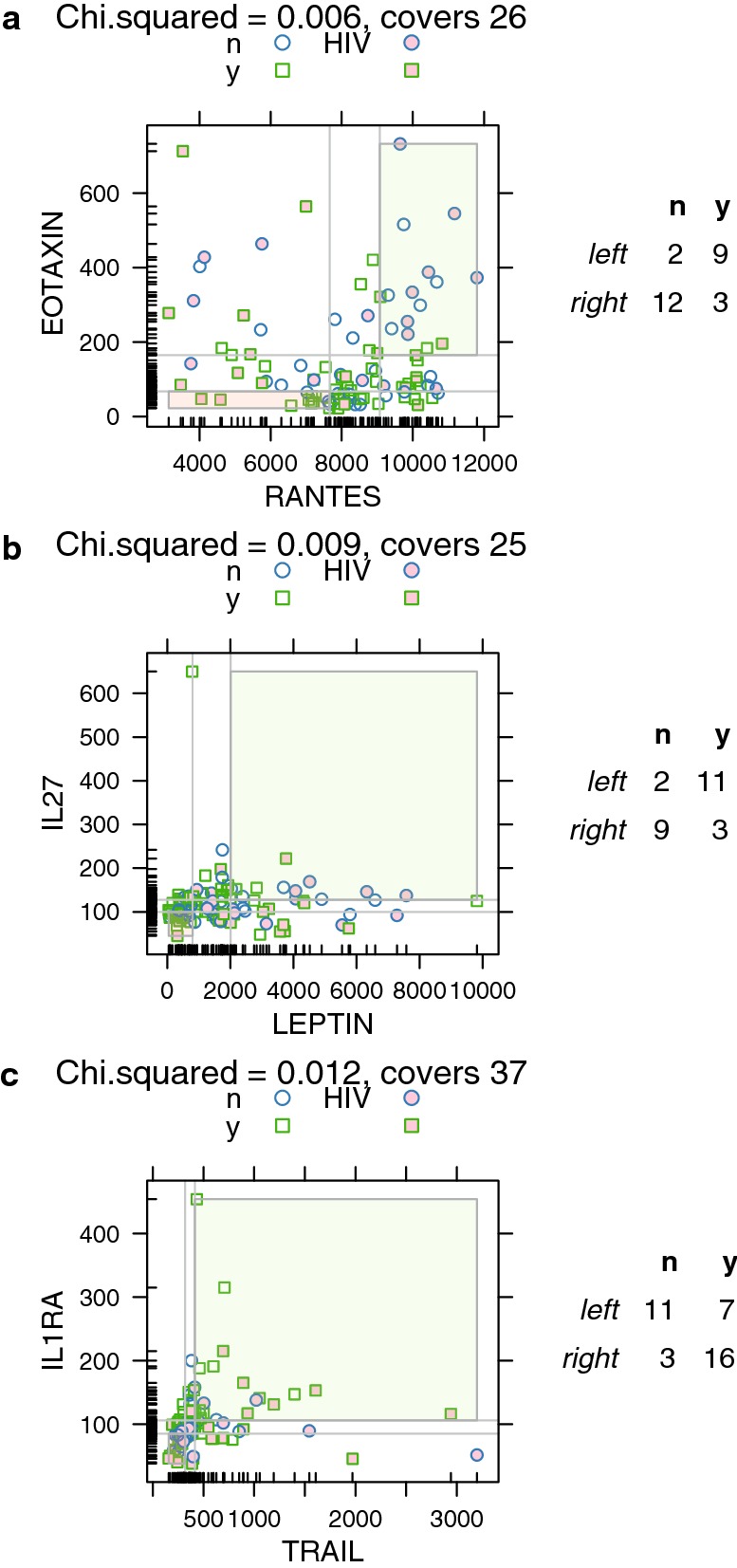
a Eotaxin and Rantes; b IL27 and Leptin; and c Il1RA and Trail. *The three pairs of cytokines that could best distinguish between people with incident syphilis versus people without syphilis. a The measurements for each cytokine were divided into tertiles, indicated by the light gray lines. Of the diagonally opposing pairs corners, RANTES low:EOTAXIN low (pink) and RANTES high:EOTAXIN high (green) contain more observations than did RANTES low:EOTAXIN high and RANTES high:EOTAXIN low. This lower left-hand corner (pink) contains 2 “no infection” samples and 9 “yes infection” samples. The right-hand corner (green) contains 12 “no infection” values and 3 “yes infection.” This difference is statistically significant, suggesting that samples with RANTES low and EOTAXIN low are more likely to suggest infection, while RANTES high and EOTAXIN high are more likely to suggest no infection. The title provides the Chi square p-value and number of observations in the highlighted corners corners. “No infection” samples are shown as circles while “yes infection” samples are shown as squares. Shading indicates samples from patients who are HIV+. The table on the right side of the graph shows counts of “no” and “yes” samples by corner. Black lines along the axes indicated observed values for that cytokine and represent the distribution of observed values. b Analysis as per A, for LEPTIN and IL27. c Analysis as per A, for TRAIL and ILRA
Fig. 3
Fig. 3
Cytokine networks identified from significant pairwise relationships among participants with incident syphilis. *Each circle represents a cytokine, and each line the relationship between them. Circle size is proportional to the number of connections
Fig. 4
Fig. 4
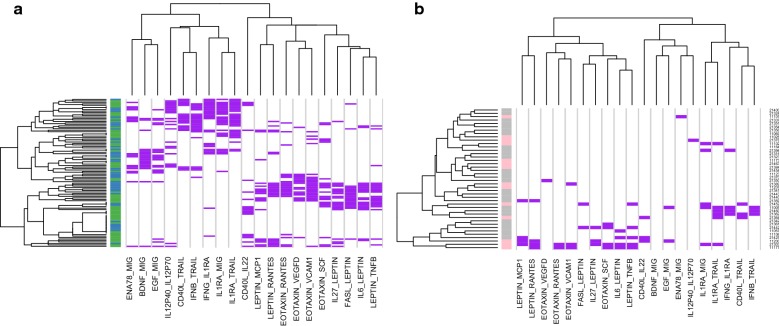
a Heatmap of hierarchical clustering of cytokine networks and participant samples with incident syphilis. Each row is a sample and each column is a cytokine pair. *Purple = correct classification. Blue shading indicates no syphilis while green shading indicates syphilis. b Heatmap of hierarchical clustering of cytokine networks and participants with and without human immunodeficient virus infection. Each row is a participant sample and each column is a cytokine pair. Purple squares indicate that the ratio associated with the cytokine pair correctly classified at least one sample from that participant. *Pink shading represents HIV-infected participants, while gray represents non HIV-infected participants

References

    1. World Health Organization. Proposing 2016–2021 global health sector strategies for HIV, viral hepatitis and sexually transmitted infections (STIs). Briefing note: 16.09.2015: World Health Organization; 2015.
    1. Kojima N, Klausner JD. An update on the global epidemiology of syphilis. Curr Epidemiol Rep. 2018;5(1):24–38. doi: 10.1007/s40471-018-0138-z. - DOI - PMC - PubMed
    1. Workowski KA, Bolan GA, Centers for Disease C, Prevention Sexually transmitted diseases treatment guidelines, 2015. MMWR Recomm Rep. 2015;64(RR-03):1–137. - PMC - PubMed
    1. Morshed MG, Singh AE. Recent trends in the serologic diagnosis of syphilis. Clin Vaccine Immunol. 2015;22(2):137–147. doi: 10.1128/CVI.00681-14. - DOI - PMC - PubMed
    1. World Health Organization . WHO guidelines for the treatment of Treponema pallidum (syphilis) Geneva: World Health Organization; 2016. - PubMed

Publication types