miRNAs and Long-term Breast Cancer Survival: Evidence from the WHEL Study
- PMID: 31186261
- PMCID: PMC6726562
- DOI: 10.1158/1055-9965.EPI-18-1322
miRNAs and Long-term Breast Cancer Survival: Evidence from the WHEL Study
Abstract
Background: There is substantial variation in breast cancer survival rates, even among patients with similar clinical and genomic profiles. New biomarkers are needed to improve risk stratification and inform treatment options. Our aim was to identify novel miRNAs associated with breast cancer survival and quantify their prognostic value after adjusting for established clinical factors and genomic markers.
Methods: Using the Women's Healthy Eating and Living (WHEL) breast cancer cohort with >15 years of follow-up and archived tumor specimens, we assayed PAM50 mRNAs and 25 miRNAs using the Nanostring nCounter platform.
Results: We obtained high-quality reads on 1,253 samples (75% of available specimens) and used an existing research-use algorithm to ascertain PAM50 subtypes and risk scores (ROR-PT). We identified miRNAs significantly associated with breast cancer outcomes and then tested these in independent TCGA samples. miRNAs that were also prognostic in TCGA samples were further evaluated in multiple regression Cox models. We also used penalized regression for unbiased discovery.
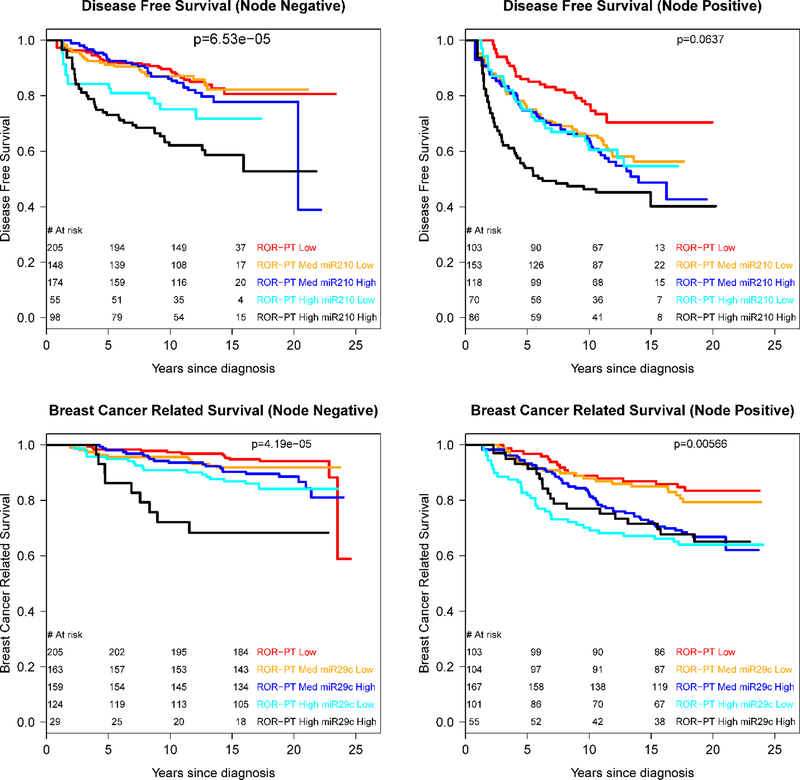
Conclusions: Two miRNAs, 210 and 29c, were associated with breast cancer outcomes in the WHEL and TCGA studies and further improved risk stratification within PAM50 risk groups: 10-year survival was 62% in the node-negative high miR-210-high ROR-PT group versus 75% in the low miR-210- high ROR-PT group. Similar results were obtained for miR-29c. We identified three additional miRNAs, 187-3p, 143-3p, and 205-5p, via penalized regression.
Impact: Our findings suggest that miRNAs might be prognostic for long-term breast cancer survival and might improve risk stratification. Further research to incorporate miRNAs into existing clinicogenomic signatures is needed.
©2019 American Association for Cancer Research.
Figures