


Treatment outcome and prognostic factors in PCNSL
- PMID: 31189479
- PMCID: PMC6563360
- DOI: 10.1186/s13000-019-0833-1
Treatment outcome and prognostic factors in PCNSL
Abstract
Objectives: Standard treatment with a thiotepa-based regimen in countries with a limited resource is less feasible. Aims of the study were to evaluate the treatment outcome, and identify the prognostic factors in patients with primary central nervous system lymphoma (PCNSL).
Methods: We conducted a retrospective study of 43 patients diagnosed with PCNSL, DLBCL subtype, who were treated with either HDMTX-based regimen, whole brain radiotherapy (WBRT), or both between 2010 and 2017.
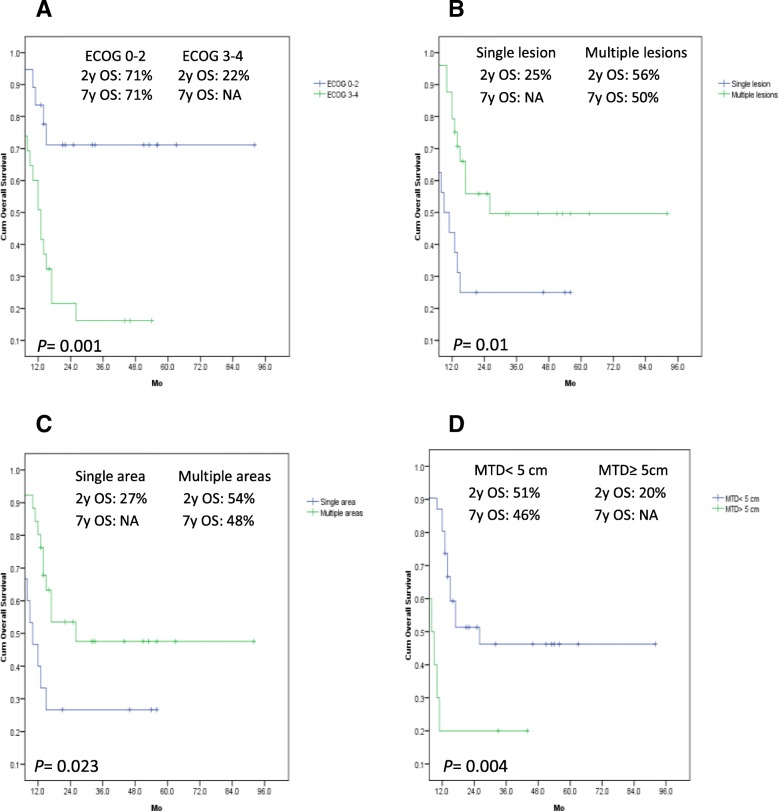
Results: There were 43 patients with a median age of 65 years (range 34-89 years). Protein expression of CD10, Bcl6, MUM1, Bcl2 and MYC were found in 19, 86, 91, 91 and 23%, respectively. Both germinal center B cell (GCB) and double-expressor (MYC+/Bcl2+) lymphomas were found in 21%. Multiple brain lesions and maximum tumor diameter (MTD) ≥5 cm were seen in 27 and 10 patients, respectively. Chemotherapy combined with WBRT, chemotherapy and WBRT were given to 20, 14 and 9 patients, respectively. Overall complete remission (CR) rate was 55.8%. Those receiving a combined-modality therapy had a higher CR rate than those treated with either chemotherapy (75% versus 36%, p = 0.036) or WBRT (75% versus 44%, p = 0.109). Median follow-up time was 17 months, and a 7-year overall survival (OS) was 40%. Features associated with a prolonged OS were an ECOG score ≤ 2 (p = 0.001), multiple brain lesions (p = 0.010), multiple area of brain involvement (p = 0.023), MTD < 5 cm (p = 0.004), GCB subtype (p = 0.003) and positive CD10 staining (p = 0.007). Expression of Bcl2 protein was associated with a significantly worse OS in the non-GCB DLBCL patients.
Discussion: The factors affecting treatment outcomes in PCNSL were cell of origin of DLBCL, lesion characteristics, patients' status and treatment regimen.
Keywords: CD10; Chemotherapy plus WBRT; GCB lymphoma; Non GCB lymphomas; PCNSL.
Conflict of interest statement
The authors declare that they have no competing interests.
Figures

References
MeSH terms
Substances
LinkOut - more resources
Full Text Sources
