Association of changes in red meat consumption with total and cause specific mortality among US women and men: two prospective cohort studies
- PMID: 31189526
- PMCID: PMC6559336
- DOI: 10.1136/bmj.l2110
Association of changes in red meat consumption with total and cause specific mortality among US women and men: two prospective cohort studies
Abstract
Objective: To evaluate the association of changes in red meat consumption with total and cause specific mortality in women and men.
Design: Two prospective cohort studies with repeated measures of diet and lifestyle factors.
Setting: Nurses' Health Study and the Health Professionals Follow-up Study, United States.
Participants: 53 553 women and 27 916 men without cardiovascular disease or cancer at baseline.
Main outcome measure: Death confirmed by state vital statistics records, the national death index, or reported by families and the postal system.
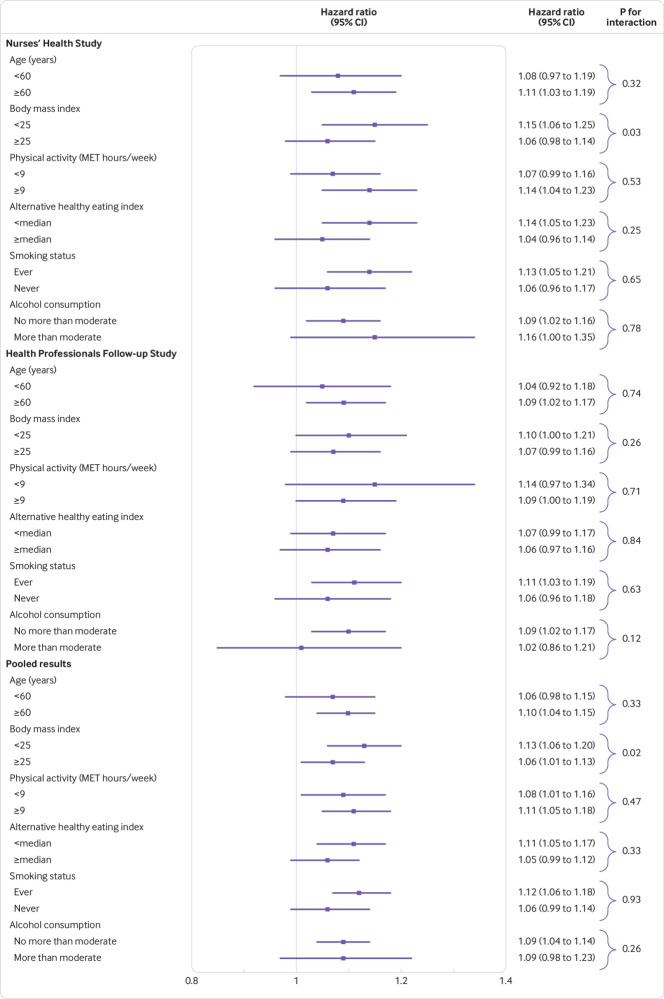
Results: 14 019 deaths occurred during 1.2 million person years of follow-up. Increases in red meat consumption over eight years were associated with a higher mortality risk in the subsequent eight years among women and men (both P for trend<0.05, P for heterogeneity=0.97). An increase in total red meat consumption of at least half a serving per day was associated with a 10% higher mortality risk (pooled hazard ratio 1.10, 95% confidence interval 1.04 to 1.17). For processed and unprocessed red meat consumption, an increase of at least half a serving per day was associated with a 13% higher mortality risk (1.13, 1.04 to 1.23) and a 9% higher mortality risk (1.09, 1.02 to 1.17), respectively. A decrease in consumption of processed or unprocessed red meat of at least half a serving per day was not associated with mortality risk. The association between increased red meat consumption and mortality risk was consistent across subgroups defined by age, physical activity, dietary quality, smoking status, or alcohol consumption.
Conclusion: Increases in red meat consumption, especially processed meat, were associated with higher overall mortality rates.
Published by the BMJ Publishing Group Limited. For permission to use (where not already granted under a licence) please go to http://group.bmj.com/group/rights-licensing/permissions.
Conflict of interest statement
Competing interests: All authors have completed the ICMJE uniform disclosure form at www.icmje.org/coi_disclosure.pdf and declare: support from the National Institutes of Health; National Heart, Lung, and Blood Institute; National Institute of Diabetes and Digestive and Kidney Diseases; and the Boston Obesity Nutrition Research Center for the submitted work; support from the FBH reported being supported by grants HL60712, HL118264, and DK112940 from the National Institutes of Health, and reported receiving research support from the California Walnut Commission and honorariums for lectures from Metagenics and Standard Process and honorariums from Diet Quality Photo Navigation, outside the submitted work.
Figures
References
Publication types
MeSH terms
Grants and funding
LinkOut - more resources
Full Text Sources
Other Literature Sources