Multicenter Study
. 2019 Jun 11;9(6):e026726.
doi: 10.1136/bmjopen-2018-026726.

Changes in hepatitis C burden and treatment trends in Europe during the era of direct-acting antivirals: a modelling study

Affiliations
Multicenter Study

Changes in hepatitis C burden and treatment trends in Europe during the era of direct-acting antivirals: a modelling study

Qiushi Chen et al. BMJ Open. .

Abstract

Objectives: Oral direct-acting antivirals (DAAs) for hepatitis C virus (HCV) have dramatically changed the treatment paradigm. Our aim was to project temporal trends in HCV diagnosis, treatment and disease burden in France, Germany, Italy, Spain and the UK.

Design: A mathematical simulation model of natural history of HCV infection.

Participants: HCV-infected patients defined based on country-specific age, fibrosis and genotype distributions.

Interventions: HCV screening practice and availability of different waves of DAA treatment in each country.

Outcome measures: Temporal trends in the number of patients who achieve sustained virological response (SVR), fail treatment (by drug regimen) and develop advanced sequelae from 2014 to 2030 in each country.

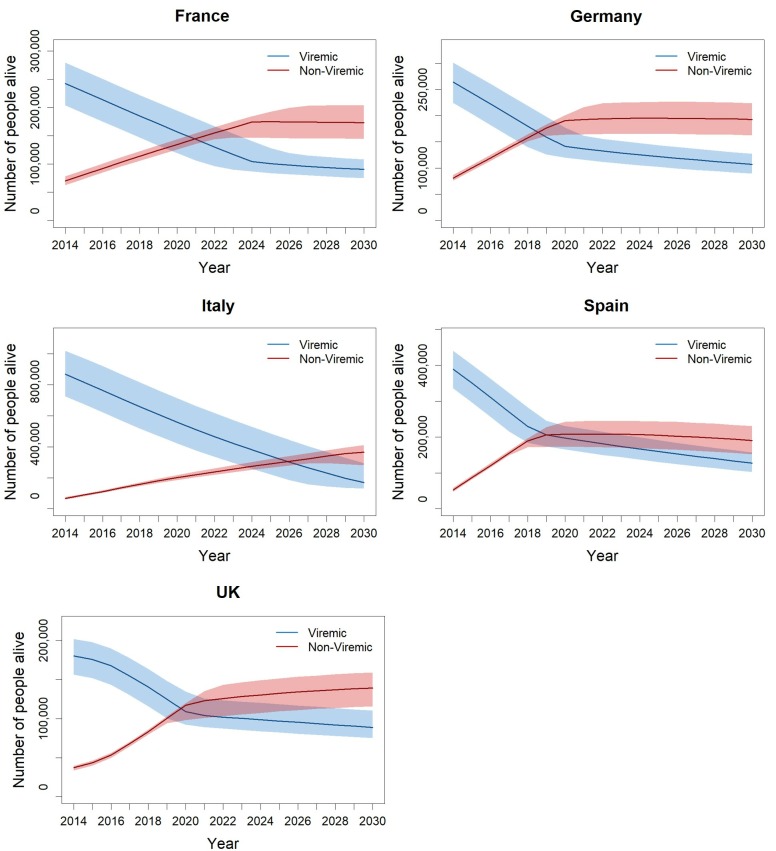
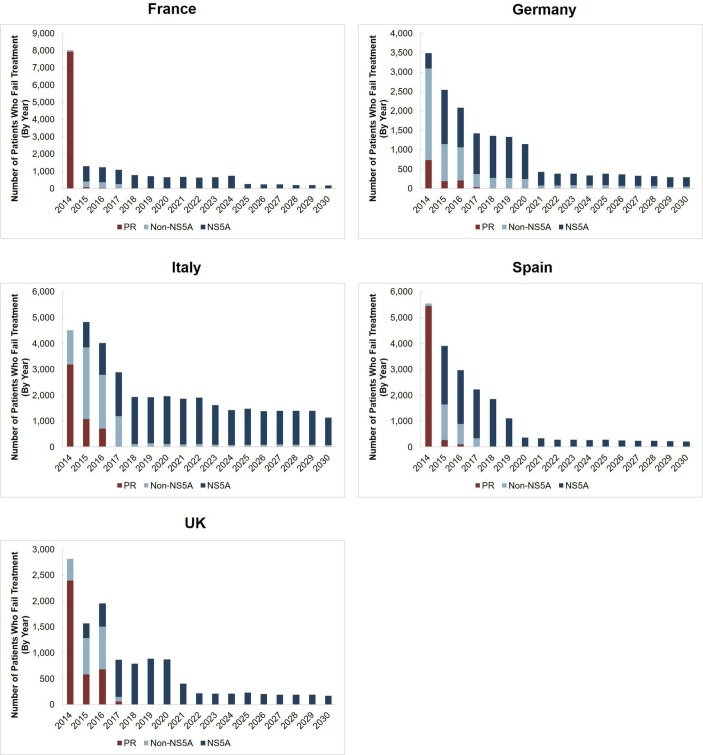
Results: We projected that 1 324 000 individuals would receive treatment from 2014 to 2030 in the five European countries and 12 000-37 000 of them would fail to achieve SVR. By 2021, the number of individuals cured of HCV would supersede the number of actively infected individuals in France, Germany, Spain and the UK. Under status quo, the diagnosis rate would reach between 65% and 75% and treatment coverage between 65% and 74% by 2030 in these countries. The number of patients who fail treatment would decrease over time, with the majority of those who fail treatment having been exposed to non-structural protein 5A inhibitors.

Conclusions: In the era of DAAs, the number of people with HCV who achieved a cure will exceed the number of viraemic patients, but many patients will remain undiagnosed, untreated, fail multiple treatments and develop advanced sequelae. Scaling-up screening and treatment capacity, and timely and effective retreatment are needed to avail the full benefits of DAAs and to meet HCV elimination targets set by WHO.

Keywords: direct-acting antivirals; disease trend; hepatitis C elimination; simulation model; treatment failure.


Conflict of interest statement

Competing interests: JC received research grants and consulting fee from Gilead Science and Merck. TA received consulting fee from Gilead Sciences. SF has servered a speaker for Gilead Sciences, MSD, Abbvie, Bristol–Myers Squibb, Novartis, Bayer and Janssen. All other authors have nothing to report.

Figures
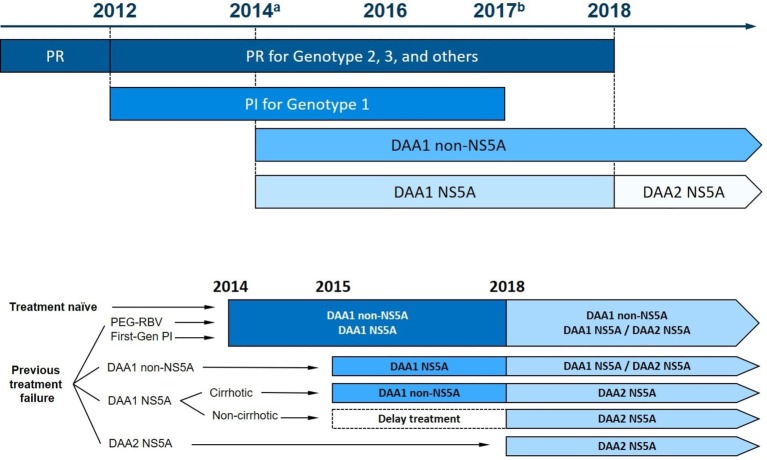
Figure 1
Figure 1
DAA treatment landscape from 2014 onwards (A) and drug regimen type for a patient by treatment history (naïve or type of prior experience) and the year retreatment is offered (B). First generation PI (BOC/TEL+PEG+RBV) used for HCV genotype 1 only. Note that the timing of treatment waves is positioned such that the HCV patients will complete treatment in the given year (not necessarily initiate treatment in that year) DAA1 non-NS5A includes the following drug combinations: SOF +PEG+/-RBV, SOF +/-RBV, SOF +SMV+/-RBV and SMV+PEG+/-RBV. DAA1 NS5A includes the following drug combinations: LDV/SOF+/-RBV, SOF+DCV, DCV+PEG+/-RBV, OBV/PTV/r+DSV+/-RBV, OBV/PTV/r+/-RBV, EBR/GZR and SOF/VEL. DAA2 NS5A includes the next wave of drug combinations such as SOF/VEL/VOX and glecaprevir/pibrentasvir for selected subgroups. Though these drugs became available in mid-2017, the SVR status of patients receiving them would become available from 2018 onwards; therefore, we noted 2018 as the year for this wave of DAAs. BOC, boceprevir; DAA, direct-acting antiviral; DCV, daclatasvir; DSV, dasabuvir; EBR, elbasvir; GZR, grazoprevir; HCV, hepatitis C virus; LDV, ledipasvir; NS5A, non-structural protein 5A; OBV, ombitasvir; PEG, peginterferon; PTV, paritaprevir; r, ritonavir; RBV, ribavirin; SMV, simeprevir; SOF, sofosbuvir; SVR, sustained virological response; TEL, telaprevir; VEL, velpatasvir; VOX, voxilaprevir.
Figure 2
Figure 2
Number of HCV patients alive who either are viraemic (blue) or achieved SVR (red) between 2014 and 2030. Bands show 95% uncertainty intervals generated by probabilistic sensitivity analysis. HCV, hepatitis C virus; SVR, sustained virological response.
Figure 3
Figure 3
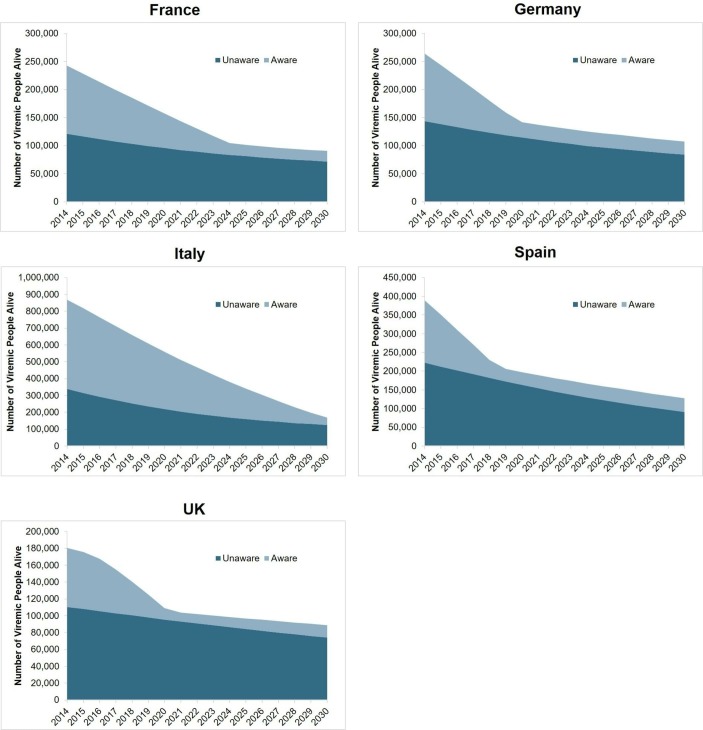
Number of patients alive viraemic patients aware and unaware of their infection between 2014 and 2030.
Figure 4
Figure 4
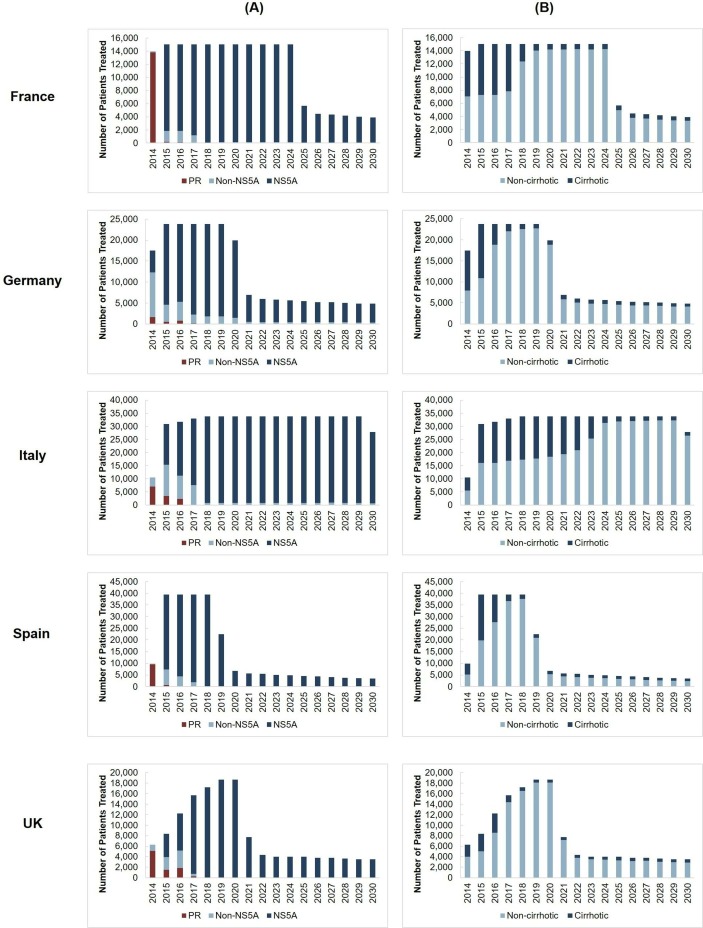
Number of patients treated with DAAs each year from 2014 to 2030 by: (A) NS5A versus non-NS5A inhibitors, (B) presence or absence of cirrhosis. DAAs, direct-acting antivirals; NS5A, non-structural protein 5A.
Figure 5
Figure 5
Number of patients who failed treatment each year from 2014 to 2030 by NS5A versus non-NS5A inhibitors. NS5A, non-structural protein 5A.
Figure 6
Figure 6
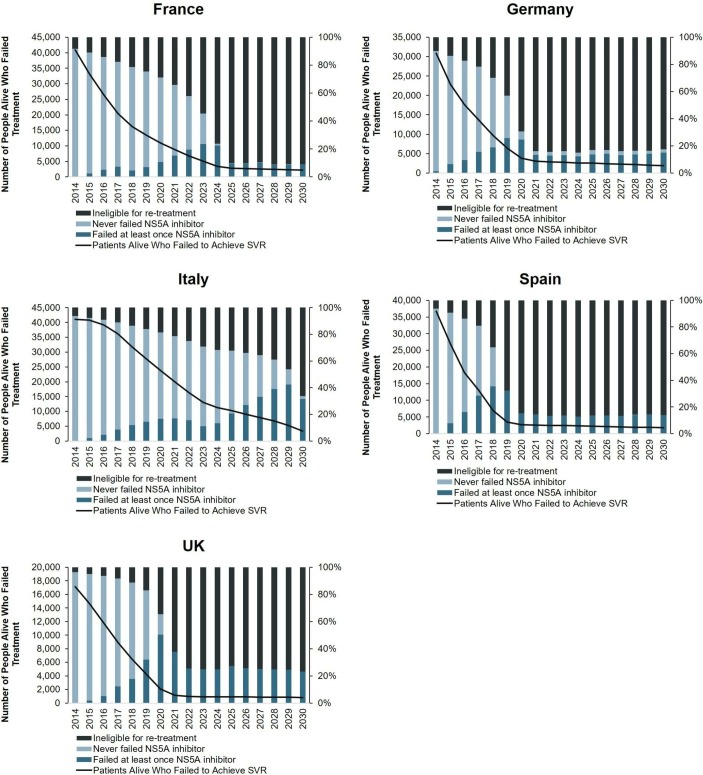
Number of patients alive between 2014 and 2030 who failed to achieve SVR after one or more treatments. SVR, sustained virological response, NS5A, non-structural protein 5A.

References

    1. Razavi H, Robbins S, Zeuzem S, et al. . Hepatitis C virus prevalence and level of intervention required to achieve the WHO targets for elimination in the European Union by 2030: a modelling study. Lancet Gastroenterol Hepatol 2017;2:325–36. 10.1016/S2468-1253(17)30045-6 - DOI - PubMed
    1. Vietri J, Prajapati G, El Khoury AC. The burden of hepatitis C in Europe from the patients' perspective: a survey in 5 countries. BMC Gastroenterol 2013;13:16 10.1186/1471-230X-13-16 - DOI - PMC - PubMed
    1. European Association for the Study of the Liver. Electronic address: easloffice@easloffice.eu European Association for the Study of the Liver. EASL Recommendations on Treatment of Hepatitis C 2018. J Hepatol 2018;69:461–511. 10.1016/j.jhep.2018.03.026 - DOI - PubMed
    1. World Health Organization. Global health sector strategy on viral hepatitis 2016-2021. 2016. http://www.who.int/hepatitis/strategy2016-2021/ghss-hep/en/ (Accessed 3 Jan 2017).
    1. Chhatwal J, He T, Hur C, et al. . Direct-Acting Antiviral Agents for Patients With Hepatitis C Virus Genotype 1 Infection are cost-saving. Clin Gastroenterol Hepatol 2017;15:827–37. 10.1016/j.cgh.2016.09.015 - DOI - PubMed

Publication types

Substances