


Acetotrophic Activity Facilitates Methanogenesis from LCFA at Low Temperatures: Screening from Mesophilic Inocula
- PMID: 31191117
- PMCID: PMC6525847
- DOI: 10.1155/2019/1751783
Acetotrophic Activity Facilitates Methanogenesis from LCFA at Low Temperatures: Screening from Mesophilic Inocula
Abstract
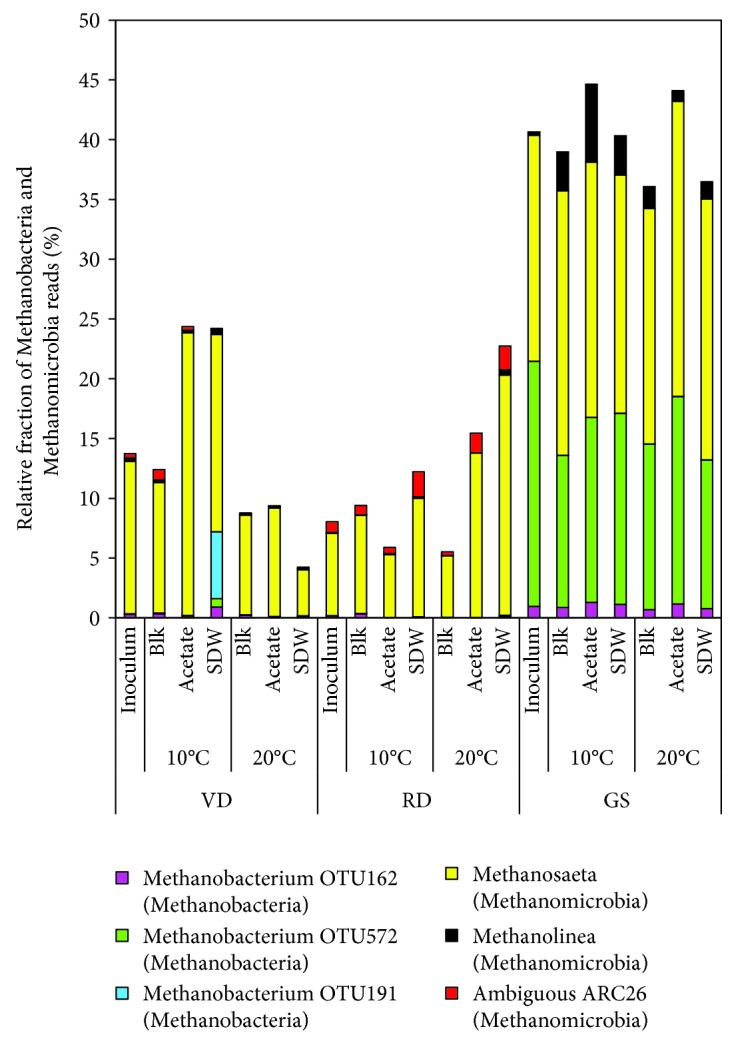
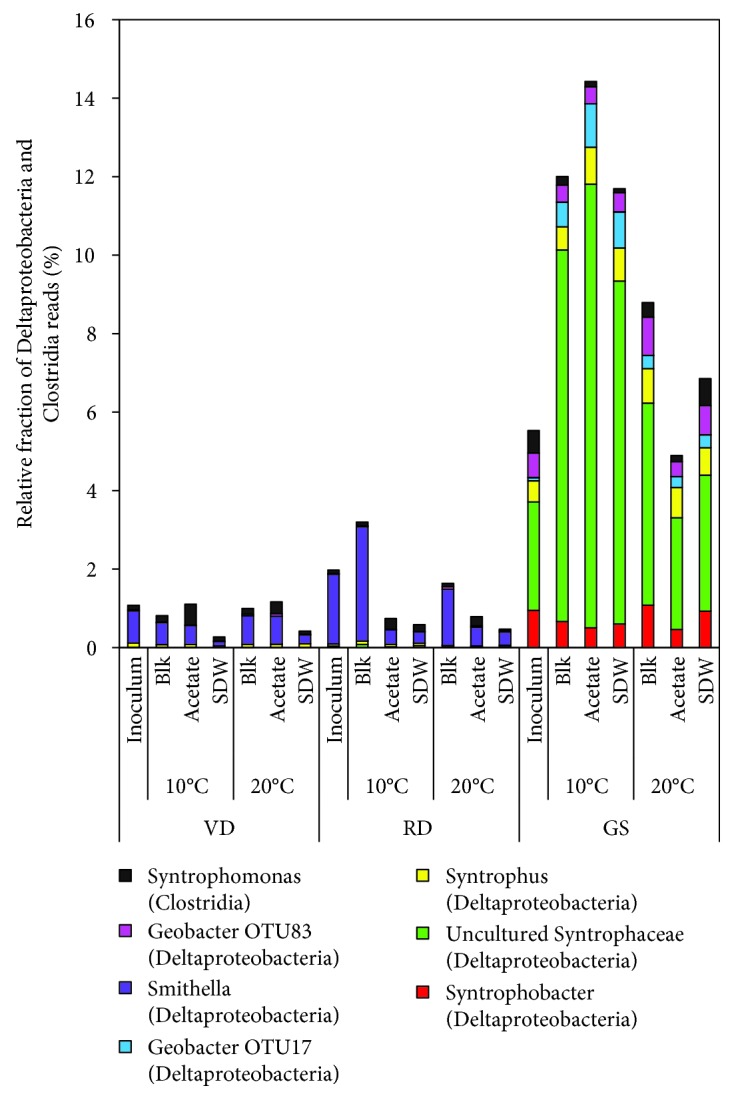
The inoculum source plays a crucial role in the anaerobic treatment of wastewaters. Lipids are present in various wastewaters and have a high methanogenic potential, but their hydrolysis results in the production of long chain fatty acids (LCFAs) that are inhibitory to anaerobic microorganisms. Screening of inoculum for the anaerobic treatment of LCFA-containing wastewaters has been performed at mesophilic and thermophilic conditions. However, an evaluation of inocula for producing methane from LCFA-containing wastewater has not yet been conducted at low temperatures and needs to be undertaken. In this study, three inocula (one granular sludge and two municipal digester sludges) were assessed for methane production from LCFA-containing synthetic dairy wastewater (SDW) at low temperatures (10 and 20°C). A methane yield (based on mL-CH4/g-CODadded) of 86-65% with acetate and 45-20% with SDW was achieved within 10 days using unacclimated granular sludge, whereas the municipal digester sludges produced methane only at 20°C but not at 10°C even after 200 days of incubation. The acetotrophic activity in the inoculum was found to be crucial for methane production from LCFA at low temperatures, highlighting the role of Methanosaeta (acetoclastic archaea) at low temperatures. The presence of bacterial taxa from the family Syntrophaceae (Syntrophus and uncultured taxa) in the inoculum was found to be important for methane production from SDW at 10°C. This study suggests the evaluation of acetotrophic activity and the initial microbial community characteristics by high-throughput amplicon sequencing for selecting the inoculum for producing methane at low temperatures (up to 10°C) from lipid-containing wastewaters.
Figures
Similar articles
-
Molecular insights informing factors affecting low temperature anaerobic applications: Diversity, collated core microbiomes and complexity stability relationships in LCFA-fed systems.Sci Total Environ. 2023 May 20;874:162420. doi: 10.1016/j.scitotenv.2023.162420. Epub 2023 Feb 24. Sci Total Environ. 2023. PMID: 36842571
-
Anaerobic treatment of LCFA-containing synthetic dairy wastewater at 20 °C: Process performance and microbial community dynamics.Sci Total Environ. 2019 Nov 15;691:960-968. doi: 10.1016/j.scitotenv.2019.07.136. Epub 2019 Jul 10. Sci Total Environ. 2019. PMID: 31326818
-
Upflow anaerobic sludge blanket reactor--a review.Indian J Environ Health. 2001 Apr;43(2):1-82. Indian J Environ Health. 2001. PMID: 12397675 Review.
-
Psychrophilic and mesophilic anaerobic treatment of synthetic dairy wastewater with long chain fatty acids: Process performances and microbial community dynamics.Bioresour Technol. 2023 Jul;380:129124. doi: 10.1016/j.biortech.2023.129124. Epub 2023 Apr 29. Bioresour Technol. 2023. PMID: 37127168
-
Ecophysiology of syntrophic communities that degrade saturated and unsaturated long-chain fatty acids.FEMS Microbiol Ecol. 2009 Jun;68(3):257-72. doi: 10.1111/j.1574-6941.2009.00680.x. FEMS Microbiol Ecol. 2009. PMID: 19490126 Review.
References
-
- Faye B., Konuspayeva G. The sustainability challenge to the dairy sector – the growing importance of non-cattle milk production worldwide. International Dairy Journal. 2012;24(2):50–56. doi: 10.1016/j.idairyj.2011.12.011. - DOI
-
- Karadag D., Koroglu O. E., Ozkaya B., et al. Anaerobic granular reactors for the treatment of dairy wastewater: a review. International Journal of Dairy Technology. 2015;68(4):459–470. doi: 10.1111/1471-0307.12252. - DOI
-
- Perle M., Kimchie S., Shelef G. Some biochemical aspects of the anaerobic degradation of dairy wastewater. Water Research. 1995;29(6):1549–1554. doi: 10.1016/0043-1354(94)00248-6. - DOI
Publication types
MeSH terms
Substances
LinkOut - more resources
Full Text Sources
