


Mitochondrial Architecture Rearrangements Produce Asymmetrical Nonadaptive Mutational Pressures That Subvert the Phylogenetic Reconstruction in Isopoda
- PMID: 31192351
- PMCID: PMC6601869
- DOI: 10.1093/gbe/evz121
Mitochondrial Architecture Rearrangements Produce Asymmetrical Nonadaptive Mutational Pressures That Subvert the Phylogenetic Reconstruction in Isopoda
Abstract
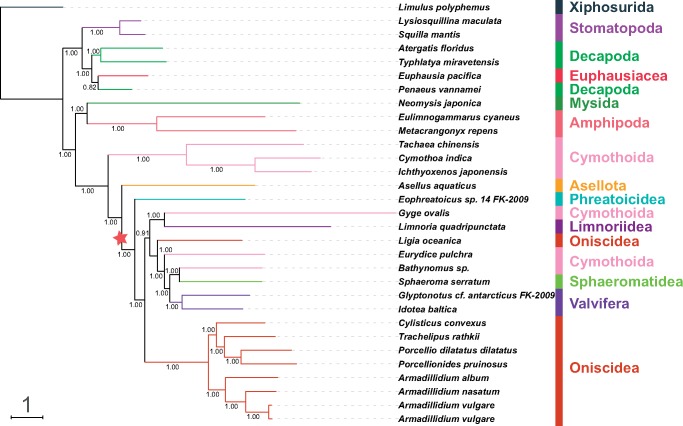
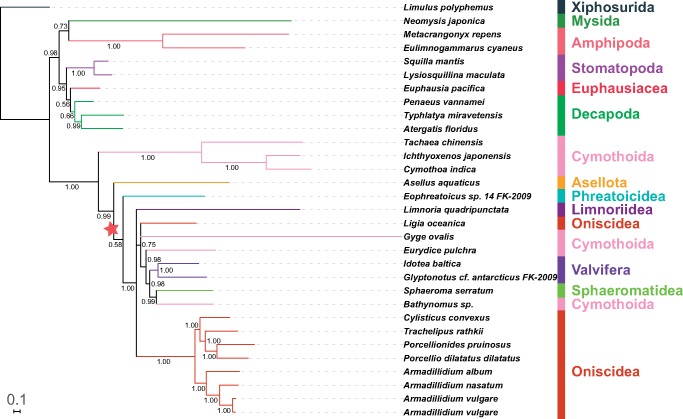
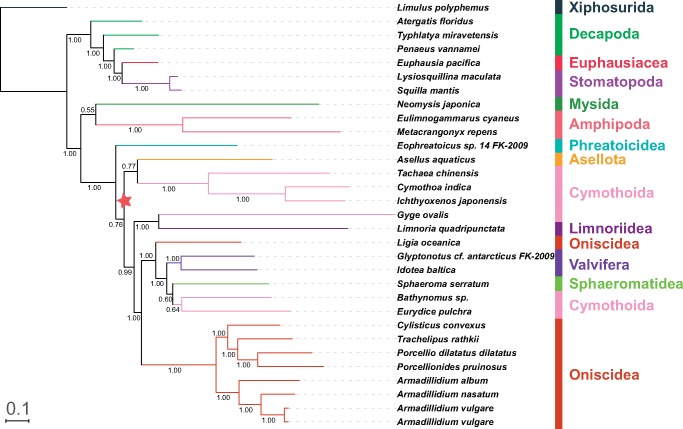
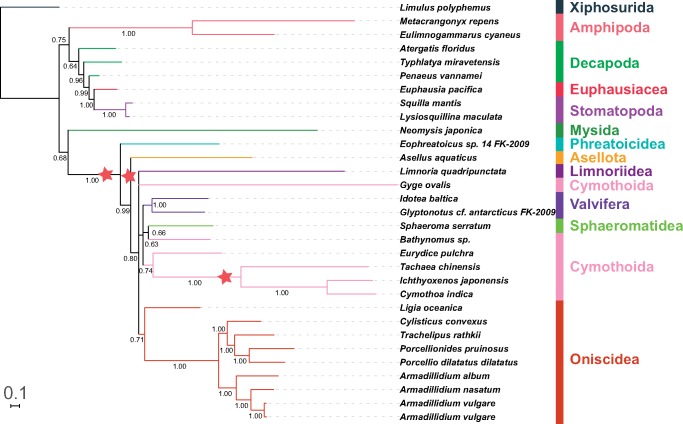
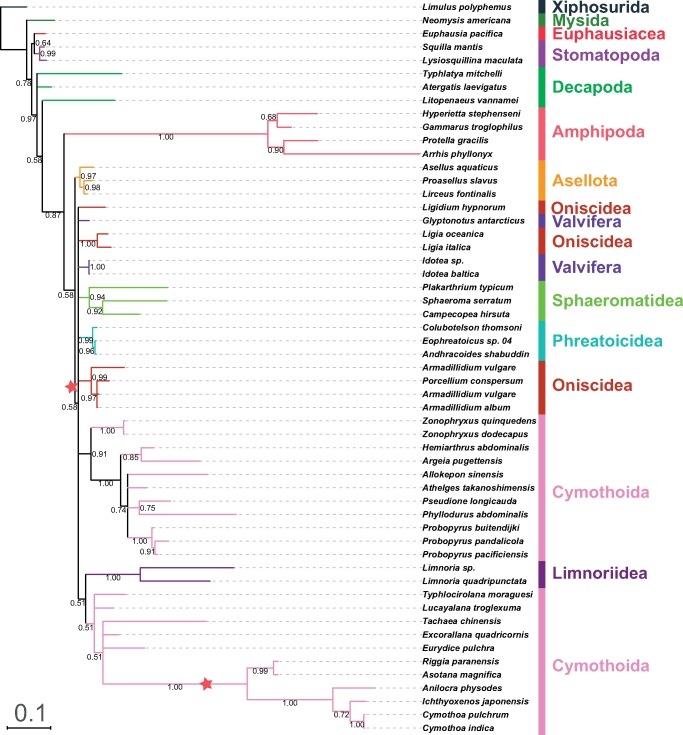
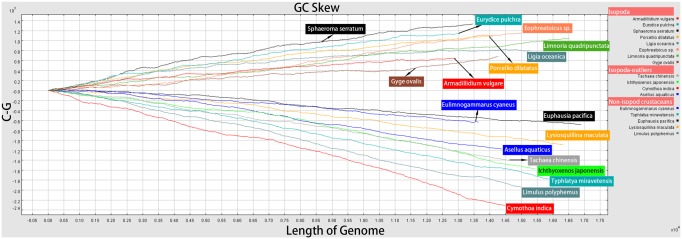
The phylogeny of Isopoda, a speciose order of crustaceans, remains unresolved, with different data sets (morphological, nuclear, mitochondrial) often producing starkly incongruent phylogenetic hypotheses. We hypothesized that extreme diversity in their life histories might be causing compositional heterogeneity/heterotachy in their mitochondrial genomes, and compromising the phylogenetic reconstruction. We tested the effects of different data sets (mitochondrial, nuclear, nucleotides, amino acids, concatenated genes, individual genes, gene orders), phylogenetic algorithms (assuming data homogeneity, heterogeneity, and heterotachy), and partitioning; and found that almost all of them produced unique topologies. As we also found that mitogenomes of Asellota and two Cymothoida families (Cymothoidae and Corallanidae) possess inversed base (GC) skew patterns in comparison to other isopods, we concluded that inverted skews cause long-branch attraction phylogenetic artifacts between these taxa. These asymmetrical skews are most likely driven by multiple independent inversions of origin of replication (i.e., nonadaptive mutational pressures). Although the PhyloBayes CAT-GTR algorithm managed to attenuate some of these artifacts (and outperform partitioning), mitochondrial data have limited applicability for reconstructing the phylogeny of Isopoda. Regardless of this, our analyses allowed us to propose solutions to some unresolved phylogenetic debates, and support Asellota are the most likely candidate for the basal isopod branch. As our findings show that architectural rearrangements might produce major compositional biases even on relatively short evolutionary timescales, the implications are that proving the suitability of data via composition skew analyses should be a prerequisite for every study that aims to use mitochondrial data for phylogenetic reconstruction, even among closely related taxa.
Keywords: Cymothoida; GC skew; base composition skew; compositional heterogeneity; mitochondrial phylogenomics; replication origin inversion.
© The Author(s) 2019. Published by Oxford University Press on behalf of the Society for Molecular Biology and Evolution.
Figures
References
-
- Baele G, Raes J, Van De PY, Vansteelandt S.. 2006. An improved statistical method for detecting heterotachy in nucleotide sequences. Mol Biol Evol. 23(7):1397–1405. - PubMed
-
- Ballard JWO, Whitlock MC.. 2004. The incomplete natural history of mitochondria. Mol Ecol. 13(4):729–744. - PubMed
-
- Bernt M, Braband A, Schierwater B, Stadler PF.. 2013. Genetic aspects of mitochondrial genome evolution. Mol Phylogenet Evol. 69(2):328–338. - PubMed
-
- Boore JL. 2006. The use of genome-level characters for phylogenetic reconstruction. Trends Ecol Evol. 21(8):439–446. - PubMed
Publication types
MeSH terms
LinkOut - more resources
Full Text Sources
Research Materials
Miscellaneous
