


The medicalization of sleeplessness: Results of U.S. office visit outcomes, 2008-2015
- PMID: 31193373
- PMCID: PMC6526300
- DOI: 10.1016/j.ssmph.2019.100388
The medicalization of sleeplessness: Results of U.S. office visit outcomes, 2008-2015
Abstract
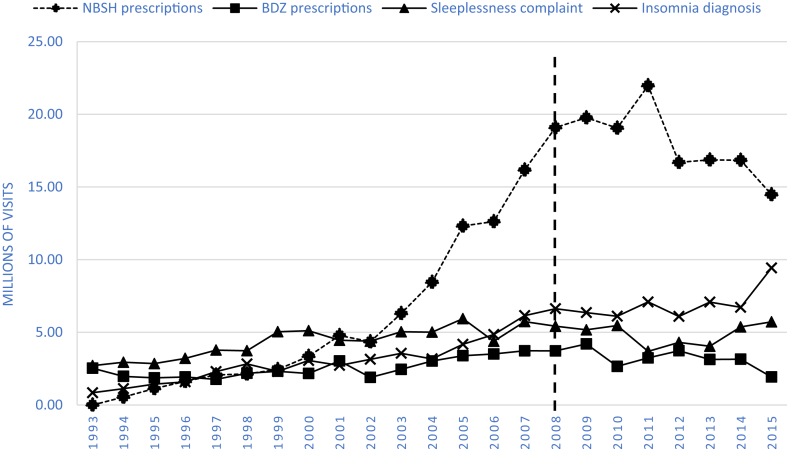
Previous analysis of U.S. physician office visits (1993-2007) indicated that the medicalization of sleeplessness was on the rise and had potentially negative implications for population health. Our study asks if the medicalization of sleeplessness at the level of patient-physician interaction has persisted over time. Using the most recent years available (2008-2015) of the National Ambulatory Medical Care Survey we calculated nationally representative estimates for four sleeplessness-related outcomes of physician office visits: sleeplessness complaint, insomnia diagnosis, and prescription of benzodiazepine and non-benzodiazepine sedative-hypnotics (NBSH). To test for the significance of the linear trajectory, we ran a series of bivariate linear models. We tested three hypotheses grounded in the medicalization framework: if the medicalization of sleeplessness at the interactional level is continuing at a rate comparable to previous analyses, sleeplessness-related outcomes will continue to increase significantly over time (Hypothesis 1); NBSH prescriptions and insomnia diagnoses will continue to outpace sleeplessness complaints (Hypothesis 2); and insomnia diagnoses and use of sedative-hypnotics will increase or remain concentrated among age groups who lack the changing sleep patterns and commonly occurring comorbidities associated with older age (Hypothesis 3). Support for these hypotheses was mixed. Unlike previous analyses wherein all sleeplessness-related outcome trends were positive and statistically significant over time, regression analyses revealed a significant negative NBSH prescription trend 2008-2015 (slope, b = -699,628, P < 0.05). No other associations were significant. Younger age groups were most likely to receive an insomnia diagnosis and NBSH prescription. These trends imply that the medicalization of sleeplessness at the level of patient-physician interaction may be on the decline. We suggest that increasingly negative portrayals of sedative-hypnotics, conservative practice recommendations, and decreased direct-to-consumer advertising for NBSH may decrease consumerism and physician compliance related to the medicalization of sleeplessness. We conclude with a discussion on non-pharmaceutical methods of reducing sleeplessness relevant to population health.
Keywords: Medicalization; Physician office visits; Sedative-hypnotics; Sleeplessness; US.
Figures
References
-
- American Academy of Sleep Medicine . 2004. FDA requests label change for sleep disorder drug products.https://aasm.org/fda-requests-label-change-for-sleep-disorder-drug-produ... 2018.
-
- Barbee H., Moloney M.E., Konrad T.R. Selling slumber: American neoliberalism and the medicalization of sleeplessness. Sociology Compass. 2018;12(10)
-
- Barker K.K. Electronic support groups, patient-consumers, and medicalization: The case of contested illness. Journal of Health and Social Behavior. 2008;49(1):20–36. - PubMed
-
- Barnes C.M., Drake C.L. Prioritizing sleep health: Public health policy recommendations. Perspectives on Psychological Science. 2015;10(6):733–737. - PubMed
LinkOut - more resources
Full Text Sources
Miscellaneous
