


The cost of time: A randomised, controlled trial to assess the economic impact of upfront, point-of-care blood tests in the Emergency Centre
- PMID: 31193827
- PMCID: PMC6543082
- DOI: 10.1016/j.afjem.2019.01.011
The cost of time: A randomised, controlled trial to assess the economic impact of upfront, point-of-care blood tests in the Emergency Centre
Abstract
Introduction: Time and cost constraints abound in the Emergency Centre (EC). These resource-constraints are further magnified in low- and middle-income countries (LMIC). Almost half of all patients presenting to the EC require laboratory tests. Unfortunately, access to laboratory services in LMIC is commonly inadequate. Point-of-Care (POC) tests may assist to avert this shortcoming. The aims of this study were to evaluate the cost effectiveness of upfront POC blood tests performed prior to doctor assessment compared to the standard EC workflow.
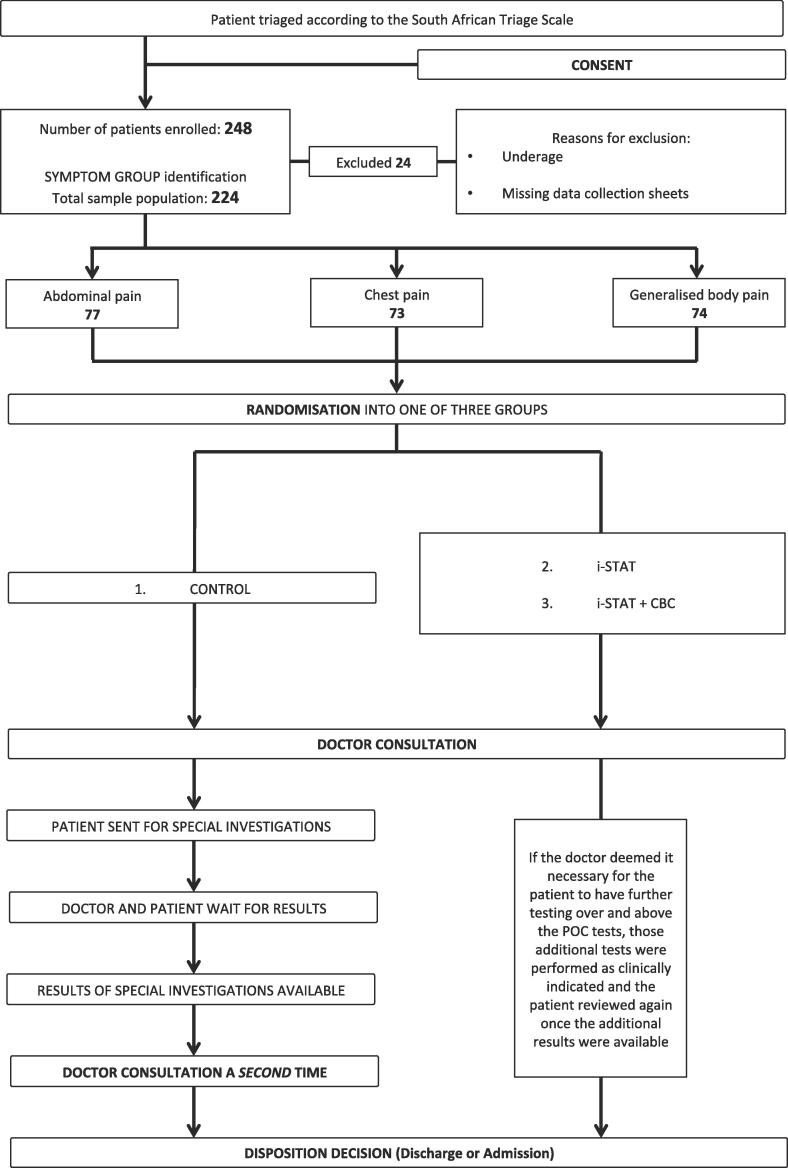
Methods: A secondary analysis was performed on data from a prospective, randomised, controlled trial where patients with abdominal/chest symptoms or generalised body pain/weakness followed either the normal EC workflow pathway or one of two enhanced workflow pathways with POC tests (i-STAT with and without a complete blood count (CBC)) prior to doctor evaluation. The incremental cost effectiveness ratio (ICER) was used to perform the cost effectiveness analysis.
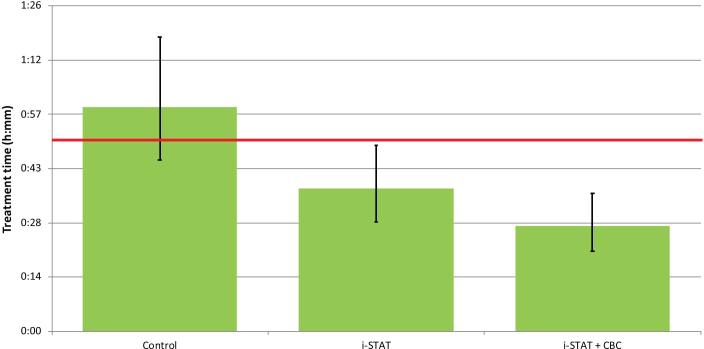
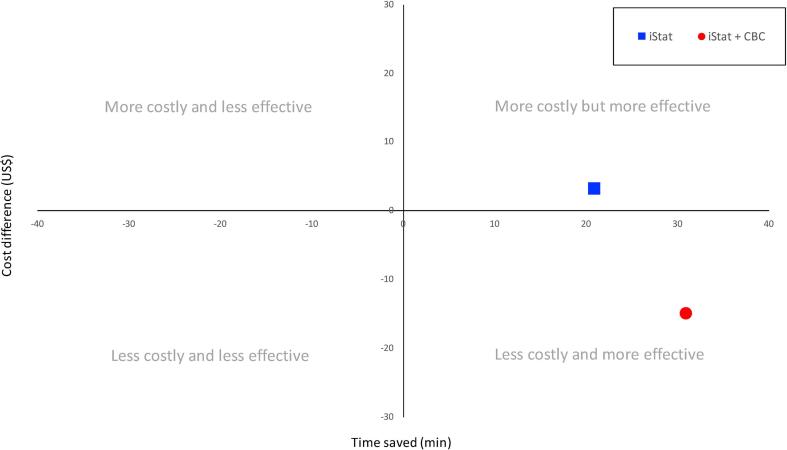
Results: There were 248 patients enrolled in the study. The use of the two upfront, POC test pathways significantly exceeded the primary outcome measure of a 20% reduction in treatment time. In the i-STAT + CBC group, the 31 min. time-saving translated into cost-saving of US$14.96 per patient (IECR 0.27) whereas the 21 min. time-saving in the i-STAT only group only had an additional net cost of US$3.11 per patient (IECR 0.90).
Conclusion: Upfront, POC blood tests can be utilised in the resource-constrained EC to manage patients more efficiently by saving time. This time-saving can, in fact, be more cost effective than traditional EC workflow making it an economically viable option for implementation in LMIC.
Keywords: Economic analysis; Emergency department; Point-of-care systems; Point-of-care testing.
Figures
Similar articles
-
The cost-effectiveness of upfront point-of-care testing in the emergency department: a secondary analysis of a randomised, controlled trial.Scand J Trauma Resusc Emerg Med. 2019 Dec 11;27(1):110. doi: 10.1186/s13049-019-0687-2. Scand J Trauma Resusc Emerg Med. 2019. PMID: 31829227 Free PMC article. Clinical Trial.
-
A Randomized Controlled Trial to Assess the Impact of Upfront Point-of-Care Testing on Emergency Department Treatment Time.Am J Clin Pathol. 2018 Jul 31;150(3):224-234. doi: 10.1093/ajcp/aqy042. Am J Clin Pathol. 2018. PMID: 29931184
-
Doctors' perceptions of the impact of upfront point-of-care testing in the emergency department.PLoS One. 2018 Dec 13;13(12):e0208655. doi: 10.1371/journal.pone.0208655. eCollection 2018. PLoS One. 2018. PMID: 30543668 Free PMC article. Clinical Trial.
-
Point-of-care versus central laboratory testing: an economic analysis in an academic medical center.Clin Ther. 1994 Sep-Oct;16(5):898-910; discussion 854. Clin Ther. 1994. PMID: 7859247 Clinical Trial.
-
Non-invasive imaging software to assess the functional significance of coronary stenoses: a systematic review and economic evaluation.Health Technol Assess. 2021 Sep;25(56):1-230. doi: 10.3310/hta25560. Health Technol Assess. 2021. PMID: 34588097
Cited by
-
Health Economic Evidence of Point-of-Care Testing: A Systematic Review.Pharmacoecon Open. 2021 Jun;5(2):157-173. doi: 10.1007/s41669-020-00248-1. Epub 2021 Jan 6. Pharmacoecon Open. 2021. PMID: 33405188 Free PMC article.
-
Cost-effectiveness of emergency care interventions in low and middle-income countries: a systematic review.Bull World Health Organ. 2020 May 1;98(5):341-352. doi: 10.2471/BLT.19.241158. Epub 2020 Feb 25. Bull World Health Organ. 2020. PMID: 32514199 Free PMC article.
-
Benefits of emergency department routine blood test performance on patients whose allocated triage category is not time critical: a retrospective study.BMC Health Serv Res. 2024 Oct 17;24(1):1252. doi: 10.1186/s12913-024-11612-w. BMC Health Serv Res. 2024. PMID: 39420308 Free PMC article.
-
Utility of Blood Cellular Indices in the Risk Stratification of Patients Presenting with Acute Pulmonary Embolism.Clin Appl Thromb Hemost. 2021 Jan-Dec;27:10760296211052292. doi: 10.1177/10760296211052292. Clin Appl Thromb Hemost. 2021. PMID: 34846193 Free PMC article.
References
-
- Yoon P., Steiner I., Reinhardt G. Analysis of factors influencing length of stay in the emergency department. CJEM. 2003;5(3):155–161. - PubMed
-
- Wilson M.L., Fleming K.A., Kuti M.A., Looi L.M., Lago N., Ru K. Access to pathology and laboratory medicine services: a crucial gap. Lancet. 2018;391(10133):1927–1938. - PubMed
-
- Sayed S., Cherniak W., Lawler M., Tan S.Y., El Sadr W., Wolf N. Improving pathology and laboratory medicine in low-income and middle-income countries: roadmap to solutions. Lancet. 2018;391(10133):1939–1952. - PubMed
LinkOut - more resources
Full Text Sources
