


Quality and quantity: The association of state-level educational policies with later life cardiovascular disease
- PMID: 31195021
- PMCID: PMC6697595
- DOI: 10.1016/j.ypmed.2019.06.008
Quality and quantity: The association of state-level educational policies with later life cardiovascular disease
Abstract
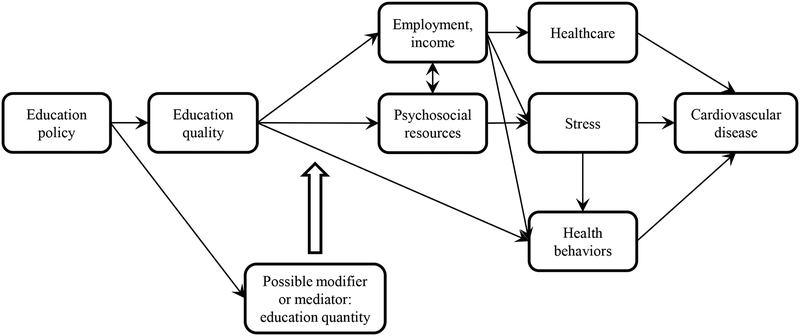
Education is a powerful predictor of cardiovascular morbidity and mortality. While the majority of the literature has focused on years of educational attainment or degree attainment, fewer studies examine the role of educational quality in the prevention of cardiovascular disease (CVD). We tested the hypothesis that average state-level educational quality was associated with CVD, linking state-level data on educational quality with individual demographic and health data from multiple waves of the National Health and Nutrition Examination Survey (N = 34,770). We examined thirteen CVD-related outcomes-including blood pressure, cholesterol, and heart attack-to understand the multiple pathways through which educational quality may influence CVD. The primary predictor was a composite index of educational quality, combining state-level measures of student-teacher ratios, per-pupil expenditures, and school term length. We fit multivariable models, regressing each outcome on the educational quality composite index and adjusting for individual- and state-level covariates. We also assessed whether the association between state educational quality and CVD differed for less educated individuals. Overall, higher educational quality was associated with less smoking (OR = 0.86, 95%CI: 0.77, 0.97), but there was no statistically significant association for the other 12 outcomes. Interaction tests indicated that less educated individuals benefited less from higher educational quality relative to those with more education for several outcomes. Our study suggests that state-level educational quality is not strongly associated with CVD, and that this null association overall may mask heterogeneous benefits that accrue disproportionately to those with higher levels of education.
Keywords: Cardiovascular disease; Educational attainment; Policy evaluation; Socioeconomic status.
Copyright © 2019 Elsevier Inc. All rights reserved.
Conflict of interest statement
Figures
References
-
- Brouilette SW, Moore JS, McMahon AD, Thompson JR, Ford I, Shepherd J, Packard CJ, Samani NJ, West of Scotland Coronary Prevention Study Group, 2007. Telomere length, risk of coronary heart disease, and statin treatment in the West of Scotland Primary Prevention Study: a nested case-control study. Lancet 369:107–14. - PubMed
-
- Card D, Krueger A, 1992. Does school quality matter? Returns to education and the characteristics of public schools in the United States. The Journal of Political Economy 100:1–40.
-
- Card D, Krueger AB, 1992. School quality and black-white relative earnings: A direct assessment. The Quarterly Journal of Economics 107:151–200.
