Review
. 2019 Nov 15;13(6):604-616.
doi: 10.5009/gnl19019.

Perspectives on Current and Novel Treatments for Inflammatory Bowel Disease

Affiliations
Review

Perspectives on Current and Novel Treatments for Inflammatory Bowel Disease

Soo-Young Na et al. Gut Liver. .

Abstract

New therapeutic strategies in inflammatory bowel disease (IBD) have shifted from symptom control towards treat-to-target algorithms in order to optimize treatment results. The treatment of IBD has evolved with the development of tumor necrosis factor-α inhibitors beyond the conventional therapies. In spite of their long-term effectiveness, many patients do not respond to or cannot sustain treatment with these drugs, which have various side effects. Therefore, the development of new drugs targeting specific pathways in the pathogenesis of IBD has become necessary. Some novel biologics and small molecule drugs have shown potential in IBD clinical trials, providing safe and effective results. In addition, clinicians are now trying to target the dysbiotic microbiome of patients with IBD using fecal microbiota transplantation. New tools such as stem cells have also been developed. The available therapeutic options for IBD are expanding rapidly. In the next few years, physicians will face an unprecedented number of options when choosing the best treatments for patients with IBD. This review provides an overview of recent advances in IBD treatment options.

Keywords: Colitis, ulcerative; Crohn disease; Inflammatory bowel diseases; Therapy.


Conflict of interest statement

CONFLICTS OF INTEREST

No potential conflict of interest relevant to this article was reported.

Figures
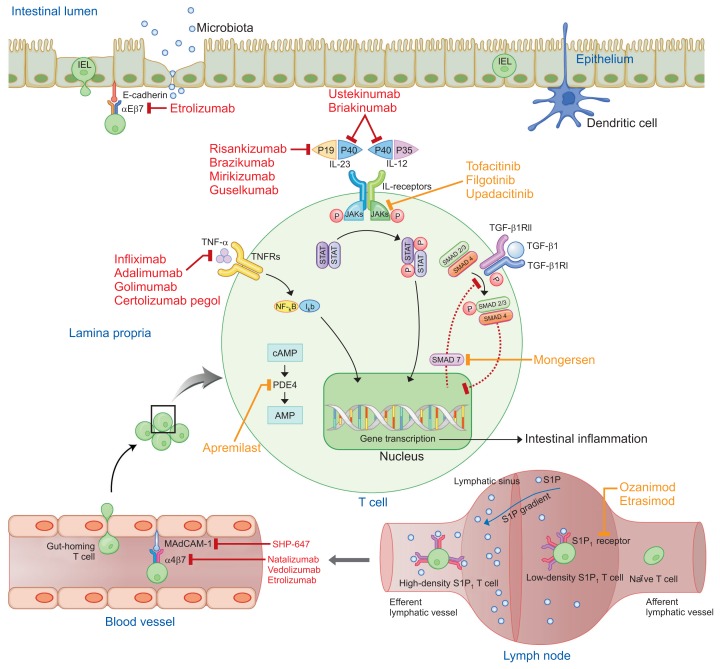
Fig. 1
Fig. 1
Therapeutic targets of novel biologics and small molecules for the treatment of inflammatory bowel disease. Biologics and small molecules are indicated by red and orange colors, respectively. AMP, adenosine monophosphate; cAMP, cyclic adenosine monophosphate; IEL, intraepithelial lymphocyte; Iκb, inhibitor of κB; IL, interleukin; JAK, Janus kinase; MAdCAM-1, mucosal vascular addressin cell adhesion molecule-1; NF-κB, nuclear factor-κB; P, phosphorylation; PDE, phosphodiesterase; S1P, sphingosine-1-phosphate; SMAD, mothers against decapentaplegic homolog; STAT, signal transducer and activator of transcription; TGF-β, transforming growth factor-β; TGF-βR, TGF-β receptor; TNF-α, tumor necrosis factor-α; TNFR, TNF receptor.

References

    1. Burger D, Travis S. Conventional medical management of inflammatory bowel disease. Gastroenterology. 2011;140:1827–1837. doi: 10.1053/j.gastro.2011.02.045. - DOI - PubMed
    1. Rutgeerts P, Sandborn WJ, Feagan BG, et al. Infliximab for induction and maintenance therapy for ulcerative colitis. N Engl J Med. 2005;353:2462–2476. doi: 10.1056/NEJMoa050516. - DOI - PubMed
    1. Reinisch W, Sandborn WJ, Hommes DW, et al. Adalimumab for induction of clinical remission in moderately to severely active ulcerative colitis: results of a randomised controlled trial. Gut. 2011;60:780–787. doi: 10.1136/gut.2010.221127. - DOI - PubMed
    1. Sandborn WJ, van Assche G, Reinisch W, et al. Adalimumab induces and maintains clinical remission in patients with moderate-to-severe ulcerative colitis. Gastroenterology. 2012;142:257–265. doi: 10.1053/j.gastro.2011.10.032. - DOI - PubMed
    1. Targan SR, Hanauer SB, van Deventer SJ, et al. A short-term study of chimeric monoclonal antibody cA2 to tumor necrosis factor alpha for Crohn’s disease. Crohn’s Disease cA2 Study Group. N Engl J Med. 1997;337:1029–1035. doi: 10.1056/NEJM199710093371502. - DOI - PubMed

MeSH terms

LinkOut - more resources