. 2019 Jun 13;9(1):8587.
doi: 10.1038/s41598-019-45029-x.

Sex-specific maternofetal innate immune responses triggered by group B Streptococci

Affiliations

Sex-specific maternofetal innate immune responses triggered by group B Streptococci

Marie-Julie Allard et al. Sci Rep. .

Abstract

Group B Streptococcus (GBS) is one of the most common bacteria isolated in human chorioamnionitis, which is a major risk factor for premature birth and brain injuries. Males are at greater risk than females for developing lifelong neurobehavioural disorders, although the origins of this sex bias remain poorly understood. We previously showed that end-gestational inflammation triggered by GBS led to early neurodevelopmental impairments mainly in the male rat progeny. Identifying key inflammatory players involved in maternofetal immune activation by specific pathogens is critical to develop appropriate novel therapeutic interventions. We aimed to map out the GBS-induced profile of innate immune biomarkers in the maternal-placental-fetal axis, and to compare this immune profile between male and female tissues. We describe here that the GBS-induced immune signalling involved significantly higher levels of interleukin (IL)-1β, cytokine-induced neutrophil chemoattractant-1 (CINC-1/CXCL1) and polymorphonuclear cells (PMNs) infiltration in male compared to female maternofetal tissues. Although male - but not female - fetuses presented increased levels of IL-1β, fetuses from both sexes in-utero exposed to GBS had increased levels of TNF-α in their circulation. Levels of IL-1β detected in fetal sera correlated positively with the levels found in maternal circulation. Here, we report for the first time that the maternofetal innate immune signalling induced by GBS presents a sexually dichotomous profile, with more prominent inflammation in males than females. These sex-specific placental and fetal pro-inflammatory responses are in keeping with the higher susceptibility of the male population for preterm birth, brain injuries and neurodevelopmental disorders such as cerebral palsy and autism spectrum disorders.


Conflict of interest statement

The authors declare no competing interests.

Figures
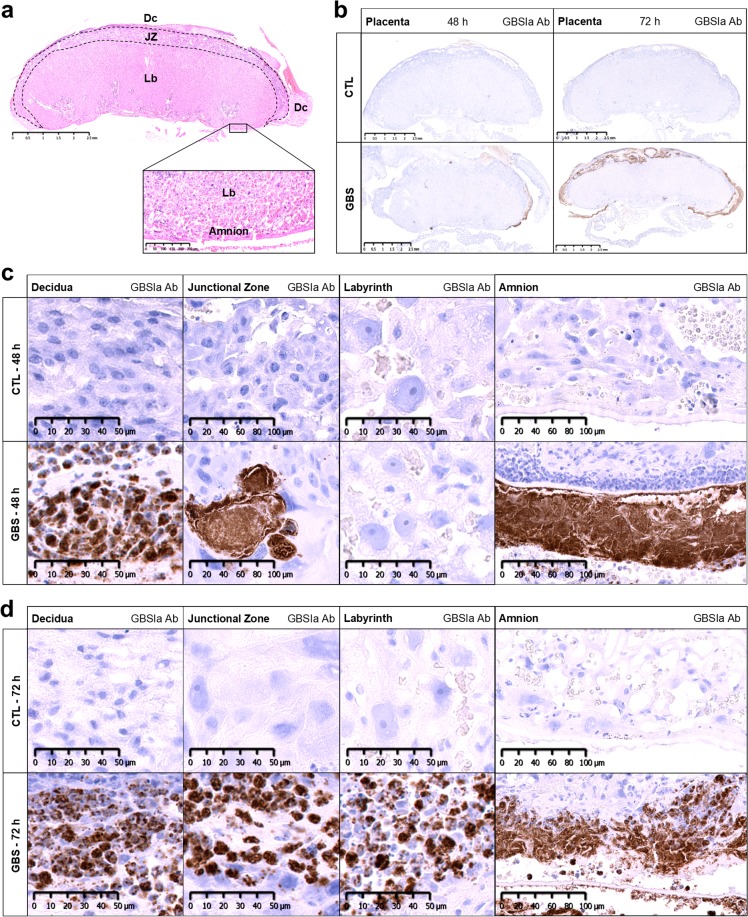
Figure 1
Figure 1
Placental group B Streptococcus (GBS) infection. (a) Global anatomical aspect of coronal section of the placenta stained by hematoxylin and eosin presenting the maternal (decidua [Dc]), maternofetal (junctional zone [JZ]) and fetal (labyrinth [Lb]) compartments, as well as the amnion. (b) Representative images of immunohistochemical detection of GBS serotype Ia showing placentas of dams exposed or unexposed (CTL) to GBS. Scale bar, 2.5 mm. (c,d) Representative GBS-stained bacteria infiltrates in the decidua, junctional zone, labyrinth and amnion at 48 h (c) and 72 h (d) post-inoculation by GBS. Abbreviations: Ab, Antibody; CTL, Control; Dc, Decidua; GBS, Group B Streptococcus; h, hour; JZ, Junctional Zone; Lb, Labyrinth.
Figure 2
Figure 2
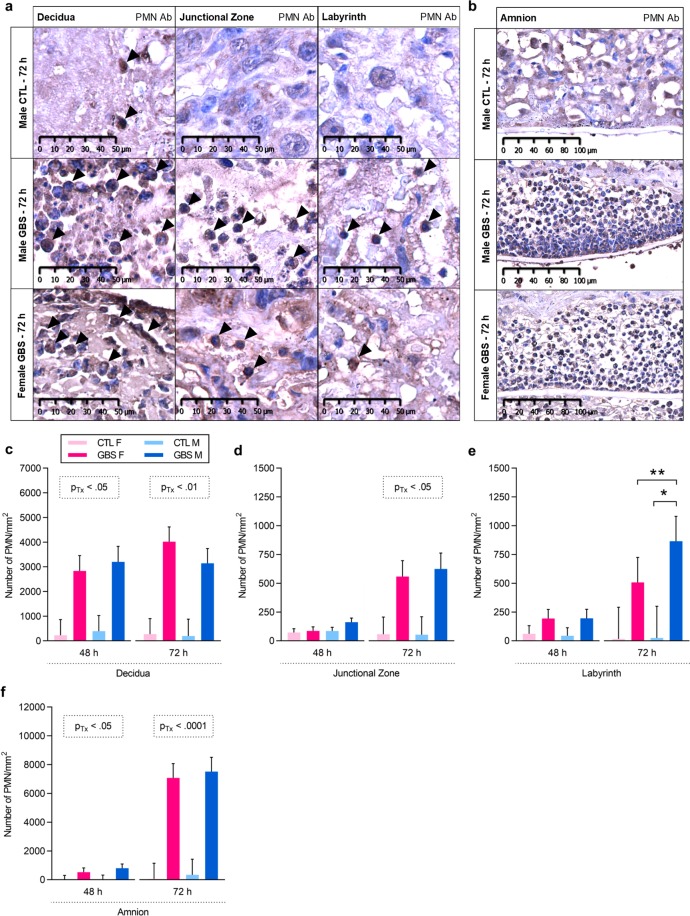
Prenatal GBS infection induces sexually dichotomous polymorphonuclear cells (PMNs) infiltration in placentas. (a,b) Representative images of PMN infiltrates in the decidua, junctional zone, labyrinth (a) and amnion (b) in placentas at 72 h post-injection. (cf) Mean density of PMNs detected by immunohistochemistry in the decidua (c), junctional zone (d), labyrinth (e) and amnion (f) at 48 and 72 h post-injection. Analyses were done by linear mixed model and significant results are shown in the dashed box. Sidak’s multiple comparisons were used when the interaction between sex and treatment was significant. *P < 0.05, **P < 0.01. Bars represent mean ± SEM. Number (n) of placentas: n = 3 [48 h] and n = 6 [72 h] per sex in the GBS group, and n = 5 [48 h] and n = 5 [72 h] per sex in the CTL group. One male and one female placentas were used per litter. Abbreviations: Ab, Antibody; CTL, Control; F, Female; GBS, Group B Streptococcus; h, hour; M, Male; Tx, Treatment.
Figure 3
Figure 3
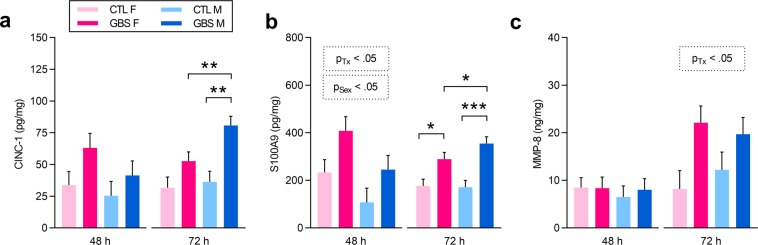
GBS-induced acute chorioamnionitis is associated with sex-specific placental levels of CINC-1 and S100A9 and increased MMP-8 production. (ac) Mean placental concentrations of CINC-1/CXCL1 (a), S100A9 (b) and MMP-8 (c) detected by ELISA at 48 and 72 h post-injection. Analyses were done by linear mixed model and significant results are shown in the dashed box. Sidak’s multiple comparisons were used when the interaction between sex and treatment was significant. *P < 0.05, **P < 0.01, ***P < 0.001. Bars represent mean ± SEM. Number (n) of placentas: n = 4 [48 h] and n = 6 [72 h] per sex in the GBS group, and n = 5 [48 h] and n = 5 [72 h] per sex in the CTL group. One male and one female placentas were used per litter. Abbreviations: CTL, Control; CINC-1, Cytokine-Induced Neutrophil Chemoattractant-1; F, Female; GBS, Group B Streptococcus; h, hour; M, Male; MMP, Matrix Metalloproteinase; Tx, Treatment.
Figure 4
Figure 4
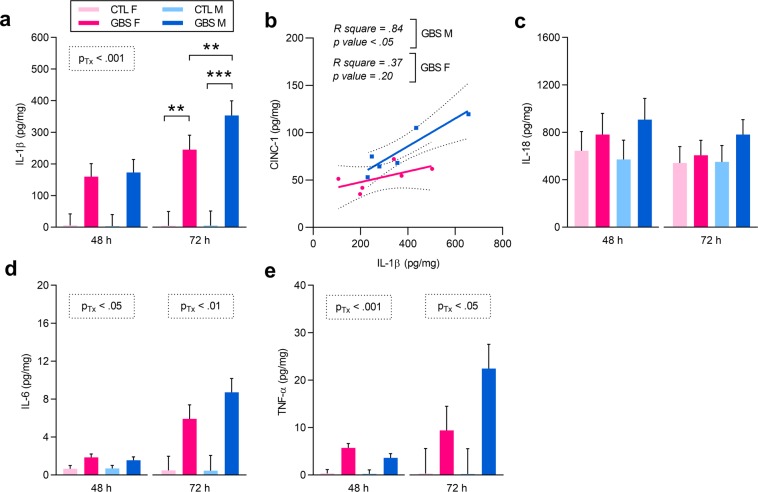
GBS-infected placentas displayed a sex dichotomous pro-inflammatory profile. (a) Mean concentration of IL-1β in placentas at 48 and 72 h quantified by ELISA. Comparisons between GBS-infected versus CTL placentas by linear mixed model, with Sidak’s multiple comparisons when the interaction between sex and treatment was significant. **P < 0.01, ***P < 0.001. (b) Correlation between levels of IL-1β and CINC-1/CXCL1 at 72 h post-injection. The within-subject correlation between IL-1β and CINC-1 levels was analysed by linear regression. (ce) Mean levels of IL-18 (c), IL-6 (d) and TNF-α (e) detected in placentas at 48 and 72 h post-injection by ELISA. Analyses were done by linear mixed model and significant results are shown in the dashed box. Bars represent mean ± SEM. Number (n) of placentas: n = 4 [48 h] and n = 6 [72 h] per sex in the GBS group, and n = 5 [48 h] and n = 5 [72 h] per sex in the CTL group. One male and one female placentas were used per litter. Abbreviations: CTL, Control; CINC-1, Cytokine-Induced Neutrophil Chemoattractant 1; F, Female; GBS, Group B Streptococcus; h, hour; IL, Interleukin; M, Male; TNF-α, Tumor Necrosis Factor-α; Tx, Treatment.
Figure 5
Figure 5
In-situ immunohistochemical analysis revealed sex- and placental compartment-specific increases of IL-1β following GBS-induced acute chorioamnionitis. (ac) Percentage (%) of high positive staining for IL-1β in the decidua (a), junctional zone (b) and labyrinth (c) placental compartments at 48 and 72 h post-injection. Analyses were done by linear mixed model and significant results are shown in the dashed box. Sidak’s multiple comparisons were used when the interaction between sex and treatment was significant. *P < 0.05. Bars represent mean ± SEM. Number (n) of placentas: n = 3 [48 h] and n = 6 [72 h] per sex in the GBS group, and n = 5 [48 h] and n = 5 [72 h] per sex in the CTL group. One male and one female placentas were used per litter. Abbreviations: CTL, Control; F, Female; GBS, Group B Streptococcus; h, hour; IL, Interleukin; M, Male; Tx, Treatment.
Figure 6
Figure 6
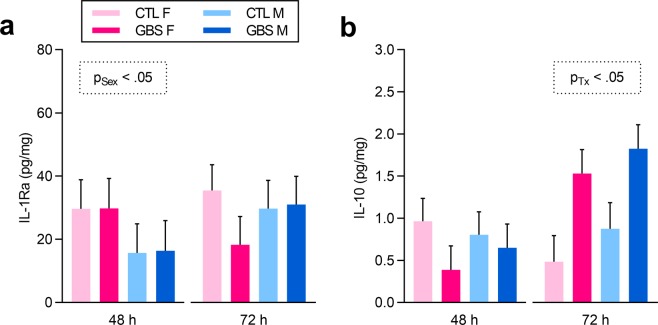
GBS-infected placentas displayed a sexually dichotomous anti-inflammatory profile. (a,b) Mean protein levels of IL-1Ra (a) and IL-10 (b) detected in placentas at 48 and 72 h post-injection by ELISA. Analyses were done by linear mixed model and significant results are shown in the dashed box. Number (n) of placentas: n = 3 [48 h] and n = 6 [72 h] per sex in the GBS group, and n = 5 [48 h] and n = 5 [72 h] per sex in the CTL group. One male and one female placentas were used per litter. Abbreviations: CTL, Control; F, Female; GBS, Group B Streptococcus; h, hour; IL, Interleukin; IL-1Ra, Interleukin-1 Receptor antagonist; M, Male; Tx, Treatment.
Figure 7
Figure 7
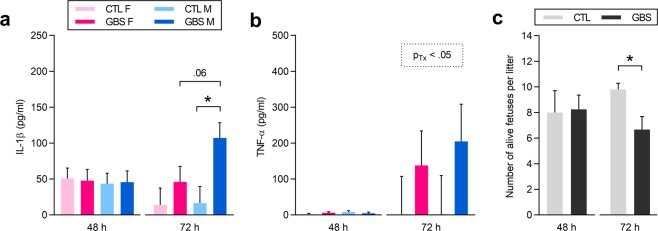
Sex-specific pro-inflammatory responses in the fetal circulation. (a,b) Mean titers of IL-1β (a) and TNF-α (b) detected in the fetal sera at 48 and 72 h post-injection. Comparisons between GBS-exposed versus CTL fetuses by linear mixed model, with Sidak’s multiple comparisons when the interaction between sex and treatment was significant. *P < 0.05. Bars represent mean ± SEM. Significant results are shown in the dashed box. Number (n) of fetuses for IL-1β: n = 4 [48 h] and n = 6 [72 h] per sex in the GBS group, and n = 4 [48 h] and n = 5 [72 h] per sex in the CTL group. Number (n) of fetuses for TNF-α: n = 4 [48 h] and n = 6 [72 h] per sex in the GBS group, and n = 4 [48 h] and n = 5 [72 h] per sex in the CTL group. c Mean number of alive fetuses per litter at 48 and 72 h post-injection. *P < 0.05. Bars represent mean ± SEM. Number (n) of litters: n = 4 [48 h] and n = 6 [72 h] per sex in the GBS group, and n = 5 [48 h] and n = 5 [72 h] per sex in the CTL group. Comparisons between GBS-exposed versus CTL litters by two-tailed Student’s T tests. Abbreviations: CTL, Control; F, Female; GBS, Group B Streptococcus; h, hour; IL, Interleukin; M, Male; TNF-α, Tumor Necrosis Factor-α; Tx, Treatment.
Figure 8
Figure 8
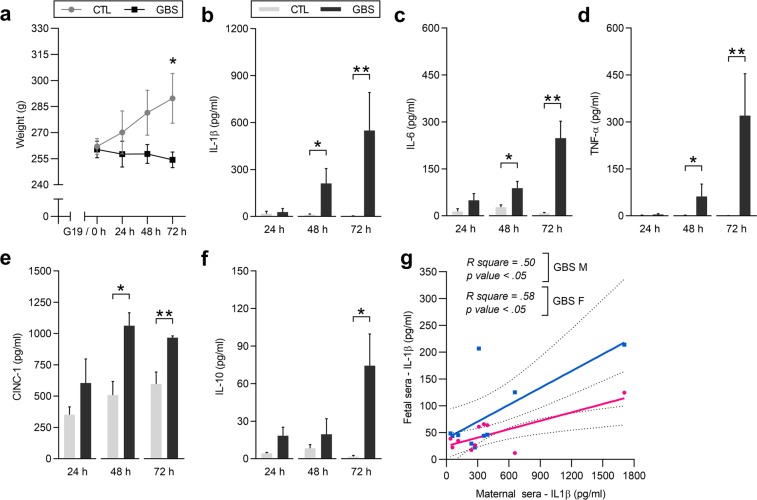
Decreased maternal weight gain and increased pro-inflammatory responses in the maternal circulation associated with GBS-induced acute chorioamnionitis. (a) Daily mean maternal weight from G19/0 h to 72 h post-injection. Comparisons between GBS-exposed versus CTL dams by repeated measures ANOVA, with Sidak’s multiple comparisons when the interaction between G and treatment was significant. *P < 0.05. Bars represent mean ± SEM. (bf) Mean concentrations of IL-1β (b), IL-6 (c), TNF-α (d), CINC-1 (e) and IL-10 (f) in the maternal sera at 24, 48 and 72 h post-injection. Data sets were analysed by two-tailed unpaired Student’s T test and two-tailed unpaired Mann-Whitney test when data were, respectively, normally and not normally distributed (Shapiro-Wilk test). *P < 0.05, **P < 0.01. Bars represent mean ± SEM. Number (n) of dams: n = 4 [24 h], n = 4 [48 h] and n = 6 [72 h] per sex in the GBS group, and n = 3 [24 h], n = 5 [48 h] and n = 5 [72 h] per sex in the CTL group. (g) Correlation between the levels of IL-1β detected in the fetal and maternal sera at 72 h post-injection. The within-litter correlation between IL-1β levels was analysed by linear regression. Abbreviations: CTL, Control; CINC-1, Cytokine-Induced Neutrophil Chemoattractant-1; F, Female; GBS, Group B Streptococcus; h, hour; IL, Interleukin; M, Male; TNF-α, Tumor Necrosis Factor-α; Tx, Treatment.

References

    1. Horvath B, Lakatos F, Tóth C, Bödecs T, Bódis J. Silent chorioamnionitis and associated pregnancy outcomes: a review of clinical data gathered over a 16-year period. J Perinat Med. 2014;42:441–447. doi: 10.1515/jpm-2013-0186. - DOI - PubMed
    1. Saji F, et al. Cytokine production in chorioamnionitis. J Reprod Immunol. 2000;47:185–196. doi: 10.1016/S0165-0378(00)00064-4. - DOI - PubMed
    1. Tita ATN, Andrews WW. Diagnosis and management of clinical chorioamnionitis. Clin Perinatol. 2010;37:339–354. doi: 10.1016/j.clp.2010.02.003. - DOI - PMC - PubMed
    1. Hillier SL, Krohn MA, Kiviat NB, Watts DH, Eschenbach DA. Microbiologic causes and neonatal outcomes associated with chorioamnion infection. Am. J. Obstet. Gynecol. 1991;165:955–961. doi: 10.1016/0002-9378(91)90447-Y. - DOI - PubMed
    1. Lu B, et al. Microbiological and clinical characteristics of Group B Streptococcus isolates causing materno-neonatal infections: high prevalence of CC17/PI-1 and PI-2b sublineage in neonatal infections. J. Med. Microbiol. 2018;67:1551–1559. doi: 10.1099/jmm.0.000849. - DOI - PubMed

Publication types

Substances