


Targeted muscle reinnervation in oncologic amputees: Early experience of a novel institutional protocol
- PMID: 31197851
- PMCID: PMC7701996
- DOI: 10.1002/jso.25586
Targeted muscle reinnervation in oncologic amputees: Early experience of a novel institutional protocol
Abstract
Background: We describe a multidisciplinary approach for comprehensive care of amputees with concurrent targeted muscle reinnervation (TMR) at the time of amputation.
Methods: Our TMR cohort was compared to a cross-sectional sample of unselected oncologic amputees not treated at our institution (N = 58). Patient-Reported Outcomes Measurement Information System (NRS, PROMIS) were used to assess postamputation pain.
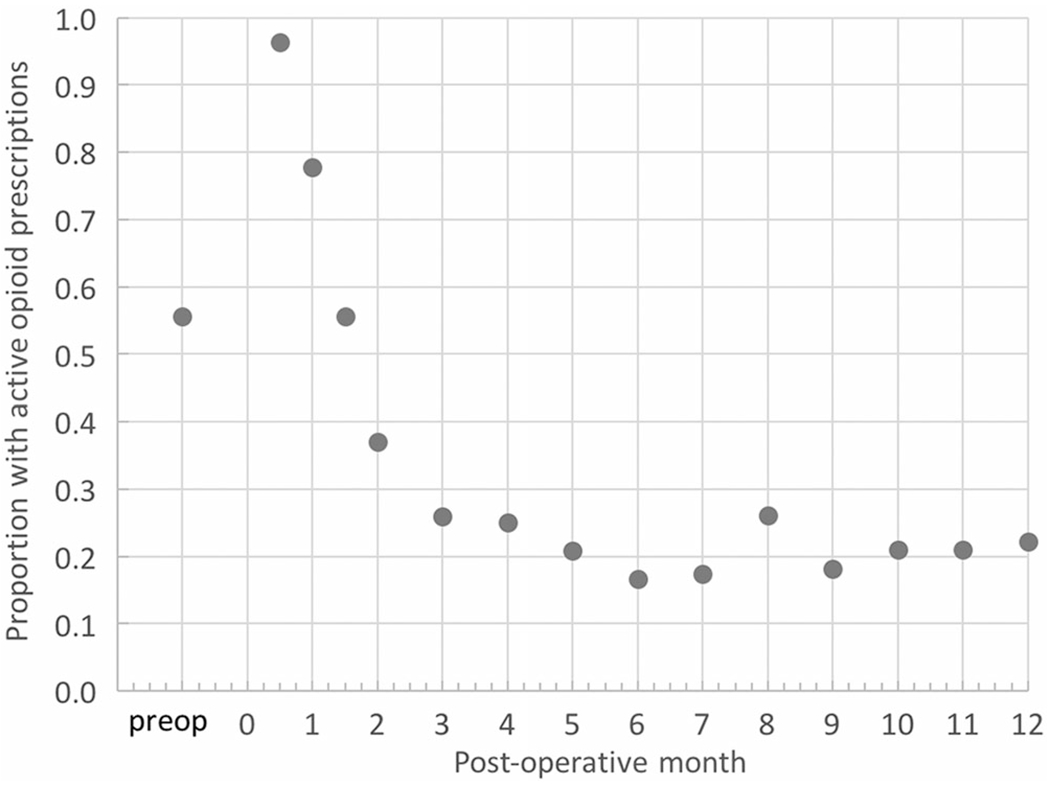
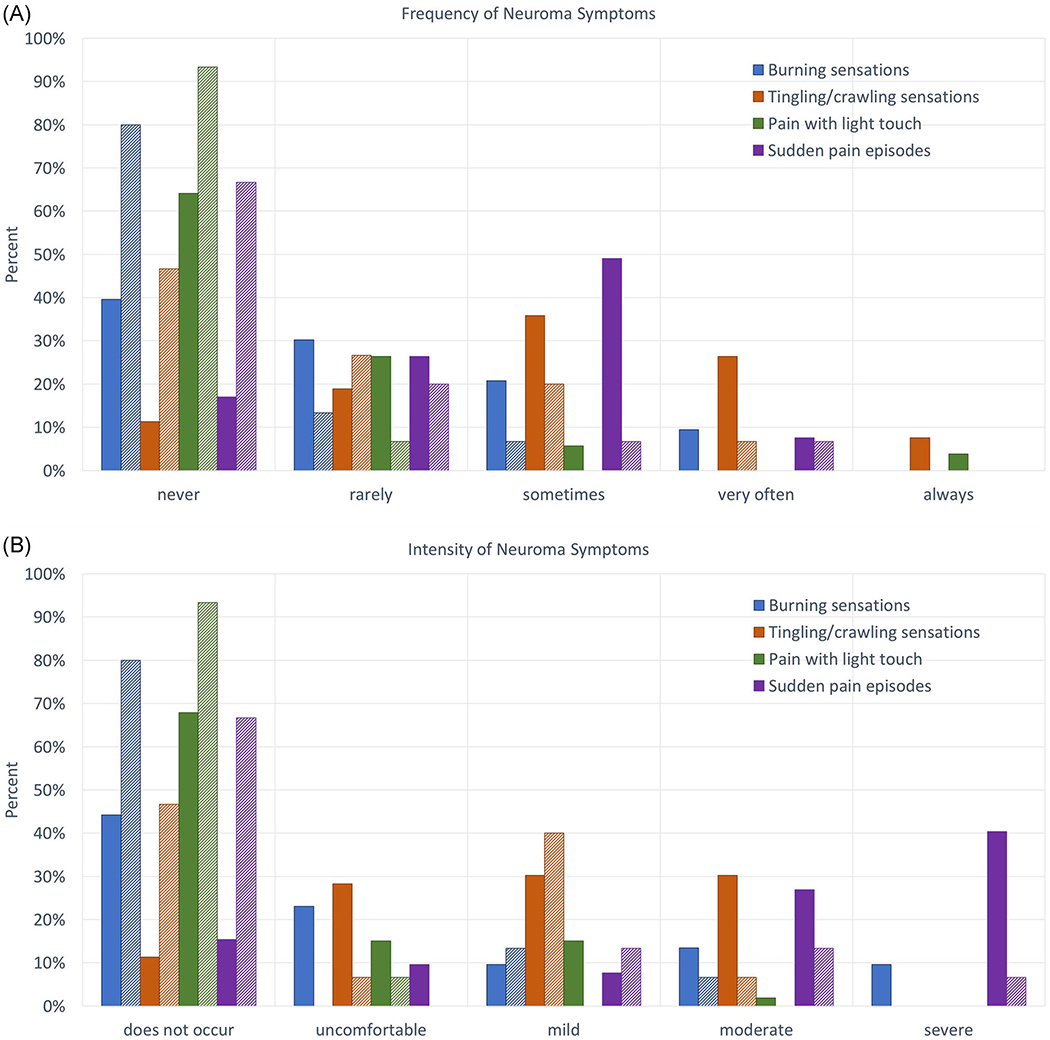
Results: Thirty-one patients underwent amputation with concurrent TMR during the study; 27 patients completed pain surveys; 15 had greater than 1 year follow-up (mean follow-up 14.7 months). Neuroma symptoms occurred significantly less frequently and with less intensity among the TMR cohort. Mean differences for PROMIS pain intensity, behavior, and interference for phantom limb pain (PLP) were 5.855 (95%CI 1.159-10.55; P = .015), 5.896 (95%CI 0.492-11.30; P = .033), and 7.435 (95%CI 1.797-13.07; P = .011) respectively, with lower scores for TMR cohort. For residual limb pain, PROMIS pain intensity, behavior, and interference mean differences were 5.477 (95%CI 0.528-10.42; P = .031), 6.195 (95%CI 0.705-11.69; P = .028), and 6.816 (95%CI 1.438-12.2; P = .014), respectively. Fifty-six percent took opioids before amputation compared to 22% at 1 year postoperatively.
Conclusions: Multidisciplinary care of amputees including concurrent amputation and TMR, multimodal postoperative pain management, amputee-centered rehabilitation, and peer support demonstrates reduced incidence and severity of neuroma and PLP.
Keywords: neuroma; pain management; phantom limb pain; residual limb pain.
© 2019 Wiley Periodicals, Inc.
Conflict of interest statement
CONFLICT OF INTERESTS
The authors declare that there is no conflict of interests.
Figures
Comment in
-
Multidisciplinary care coupled with targeted muscle reinnervation may reduce pain for amputees.CA Cancer J Clin. 2019 Nov;69(6):433-434. doi: 10.3322/caac.21582. Epub 2019 Sep 23. CA Cancer J Clin. 2019. PMID: 31545877 No abstract available.
References
-
- Ziegler-Graham K, MacKenzie EJ, Ephraim PL, Travison TG, Brookmeyer R. Estimating the prevalence of limb loss in the United States: 2005 to 2050. Arch Phys Med Rehabil. 2008;89:422–429. - PubMed
-
- Ephraim PL, Wegener ST, MacKenzie EJ, et al. Phantom pain, residual limb pain, and back pain in amputees: results of a national survey. Arch Phys Med Rehabil. 2005;86:1910–1919. - PubMed
-
- Ehde DM, Czerniecki JM, Smith DG, et al. Chronic phantom sensations, phantom pain, residual limb pain, and other regional pain after lower limb amputation. Arch Phys Med Rehabil. 2000;81:1039–1044. - PubMed
-
- Smith DG, Ehde DM, Legro MW, et al. Phantom limb, residual limb, and back pain after lower extremity amputations. Clin Orthop Relat Res. 1999;361:29–38. - PubMed
MeSH terms
Grants and funding
LinkOut - more resources
Full Text Sources
Medical
Research Materials
