


Development and validation of the needs of children questionnaire: An instrument to measure children's self-reported needs in hospital
- PMID: 31197863
- PMCID: PMC6852052
- DOI: 10.1111/jan.14099
Development and validation of the needs of children questionnaire: An instrument to measure children's self-reported needs in hospital
Abstract
Aim: To develop and psychometrically test the needs of children questionnaire (NCQ), a new instrument to measure school-aged children's self-reported psychosocial physical and emotional needs in paediatric wards.
Design: This is an instrument development study based on recommendations for developing a reliable and valid questionnaire.
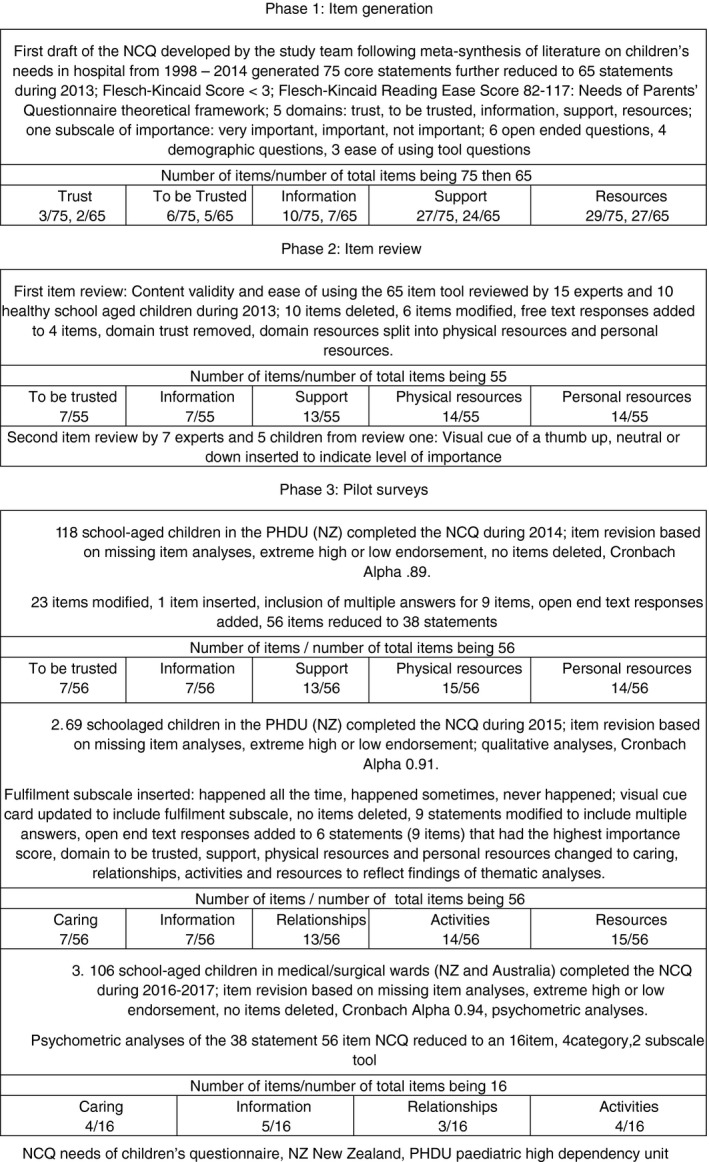
Method: The NCQ was developed over three phases between February 2013-April 2017 and included item generation; content adequacy assessment; questionnaire administration; factor analysis; internal consistency assessment and construct validity. Psychometric properties were assessed after 193 school-aged children completed the needs of children's questionnaire in four paediatric areas in Australia and New Zealand.
Results: The development and validation of the NCQ over two countries resulted in a 16-item, four-category tool to measure the self-reported importance and fulfilment of school-aged children's needs in hospital. Cronbach's alpha for the combined samples was 0.93.
Conclusion: The NCQ bridges a gap to measure the level of importance and fulfilment of school-aged children's self-reported needs in hospital. Future testing and validation is needed in other paediatric areas and countries.
Impact: The 16-item NCQ is a valid measure to evaluate if the quality of care delivered and received in hospital is in line with what children self-report as important and required and to date indicates good usability and utility. Child self-reports are essential to inform healthcare delivery, policy, research and theory development from a child and family-centred care lens that honours the United Nations Convention on the Rights of the Child and the best interests of the child.
目的: 编制儿童需求调查问卷并对其进行心理学测试,该问卷是一种新的测量儿科病房学龄儿童自述社会心理、生理、情感需求的量表。 设计: 这是一项基于编制可信有效问卷建议进行的量表编制研究。 方法: 从2013年2月到2017年4月,儿童需求调查问卷的编制超过三个阶段,包括项目生成、内容适当性评估、问卷管理、因子分析、内部相容性评估以及结构效度等阶段。来自澳大利亚、新西兰四个地区儿科病房的193名学龄儿童填写了儿童需求调查问卷,随后我们对问卷的心理测量特质进行了评估。 结果: 儿童需求调查问卷在两个国家进行编制和验证,最终产生了一个16项4范畴的量表用于测量学龄儿童自述住院需求的重要性和完成度。样卷的综合克隆巴赫系数为0.93。 结论: 儿童需求调查问卷填补了学龄儿童自述住院需求重要性和完成度等级测量的空白。未来还需要在其他国家和地区的儿科病房测试及验证该问卷。 影响: 16项儿童需求调查问卷是一个有效评估医院提供以及儿童接受的看护质量是否与儿童自述重要需求质量一致并确定可用性、有效性高的量表。儿童自述以儿童和家庭为中心,符合《联合国儿童权利公约》以及儿童的最大利益,为医疗的提供、政策、研究以及理论发展提供了相关信息,因而十分重要。.
Keywords: child health care; child self-report; children's needs; instrument development; nursing; reliability; validity.
© 2019 The Authors. Journal of Advanced Nursing Published by John Wiley & Sons Ltd.
Conflict of interest statement
None of the authors have a conflict of interest with respect to the authorship and or publication of this article.
Figures
References
-
- Abdi, H. , & Williams, L. (2010). Principal component analysis. Wiley Interdisciplinary Reviews: Computational Statistics, 2(4), 433–459. 10.1002/wics.101 - DOI
-
- Agency for Healthcare Research and Quality (2018). Development of the CAHPS Child Hospital Survey. Retrieved from http://www.ahrq.gov/cahps/surveys-guidance/hospital/about/dev_child_hp_s...
-
- Berman, A. , Liu, B. , Ullman, S. , Jadbäck, I. , & Engström, K. (2016). Children’s quality of life based on the KIDSCREEN‐27: Child self‐report, parent ratings and child‐parent agreement in a Swedish random population sample. PLoS ONE, 11(3), e0150545 10.1371/journal.pone.0150545 - DOI - PMC - PubMed
-
- Bluebond‐Langner, M. , Belasco, J. , & DeMesquita Wander, M. (2010). “I Want to Live, Until I don't Want to Live Anymore”: Involving children with life‐threatening and life‐shortening illnesses in decision making about care and treatment. Nursing Clinics of North America, 45(3), 329–343. 10.1016/j.cnur.2010.03.004 - DOI - PubMed
Publication types
MeSH terms
Grants and funding
LinkOut - more resources
Full Text Sources
Miscellaneous
