Comparative Evaluation of Depth of Penetration of Root Canal Irrigant After Using Manual, Passive Ultrasonic, and Diode Laser-Assisted Irrigant Activation Technique
- PMID: 31198340
- PMCID: PMC6555378
- DOI: 10.4103/JPBS.JPBS_300_18
Comparative Evaluation of Depth of Penetration of Root Canal Irrigant After Using Manual, Passive Ultrasonic, and Diode Laser-Assisted Irrigant Activation Technique
Abstract
Aim: The aim of this study was to compare and evaluate the penetration depth of irrigant after using manual, passive ultrasonic, and diode laser-assisted irrigant activation technique.
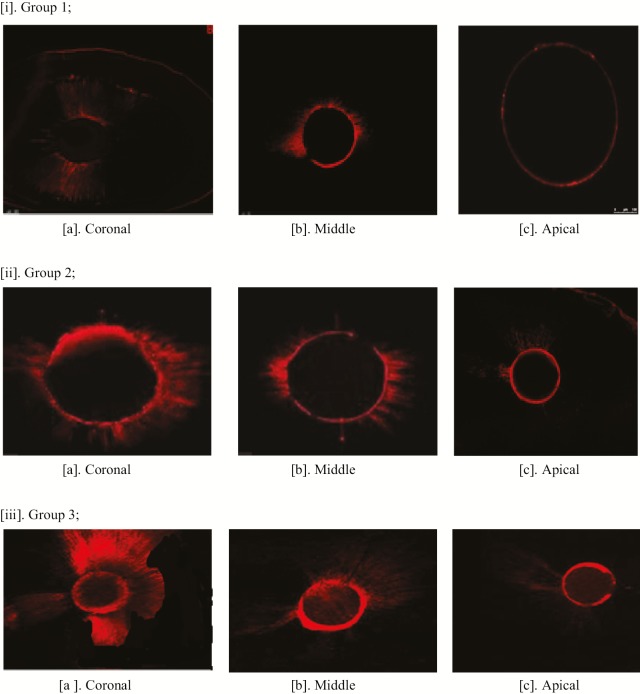
Materials and methods: Ninety extracted single-rooted human mandibular premolars were selected (N = 90). Teeth were decoronated and working length was standardized for 12 mm. Root canals were shaped using ProTaper Universal F3. Saline was used as an irrigant in between every successful instrumentation. After completion of chemomechanical preparation, root canals were filled with Rhodamine-B-labeled sodium hypochlorite (3%). Teeth samples were divided into three experimental groups. In Group 1 (n = 30), manual irrigant activation was performed for 30 seconds with master cone gutta-percha (F3) in gentle up and down motion. In Group 2 (n = 30), ultrasonic irrigant activation was performed using passive ultrasonic endo tips for 30 seconds. In Group 3 (n = 30), laser activation was performed using diode laser for 30 seconds with 200-µm tips. Transverse sections were made at 2, 5, and 8 mm from the root apex and were observed under confocal laser scanning microscopy. Maximum penetration depth of irrigant was recorded and statistically analyzed.
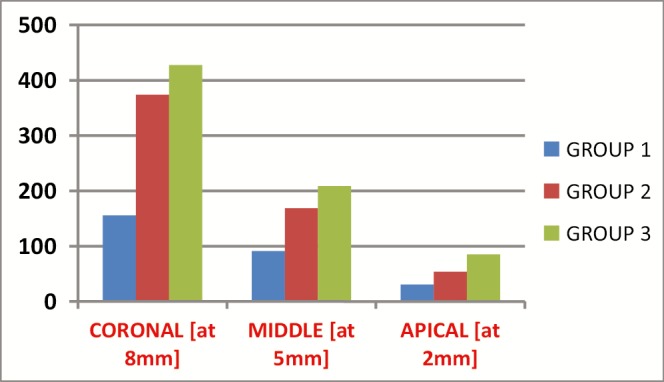
Result: In the all three groups, coronal third (sections at 8 mm from root apex) showed the highest penetration depth of irrigant. Laser activation (Group 3) showed the highest penetration depth in all the three sections when compared with manual and passive ultrasonic irrigant activation. One-way analysis of variance and post hoc test showed there were significantly high differences among all the three groups and also at all three levels (P < 0.05).
Conclusion: Diode laser-assisted irrigant activation technique had better penetration depth in all the three aspects of root dentin.
Keywords: Confocal laser scanning microscopy; diode laser; passive ultrasonic irrigation; sodium hypochlorite; tubular penetration.
Conflict of interest statement
There are no conflicts of interest.
Figures
References
-
- Hulsmann M, Peters OA, Dummer PMH. Mechanical preparation of root canals: Shaping goals, techniques and means. Endod Topics. 2005;10:30–76.
-
- Zehnder M. Root canal irrigants. J Endod. 2006;32:389–98. - PubMed
-
- Blum JY, Abadie MJ. Study of the Nd:YAP laser. Effect on canal cleanliness. J Endod. 1997;23:669–75. - PubMed
-
- Siqueira JF, Jr, Rôças IN. Clinical implications and microbiology of bacterial persistence after treatment procedures. J Endod. 2008;34:1291–1301.e3. - PubMed
-
- Zou L, Shen Y, Li W, Haapasalo M. Penetration of sodium hypochlorite into dentin. J Endod. 2010;36:793–6. - PubMed
LinkOut - more resources
Full Text Sources
Miscellaneous