


Understanding Long-Term Trajectories in Web-Based Happiness Interventions: Secondary Analysis From Two Web-Based Randomized Trials
- PMID: 31199342
- PMCID: PMC6592489
- DOI: 10.2196/13253
Understanding Long-Term Trajectories in Web-Based Happiness Interventions: Secondary Analysis From Two Web-Based Randomized Trials
Abstract
Background: A critical issue in understanding the benefits of Web-based interventions is the lack of information on the sustainability of those benefits. Sustainability in studies is often determined using group-level analyses that might obscure our understanding of who actually sustains change. Person-centric methods might provide a deeper knowledge of whether benefits are sustained and who tends to sustain those benefits.
Objective: The aim of this study was to conduct a person-centric analysis of longitudinal outcomes, examining well-being in participants over the first 3 months following a Web-based happiness intervention. We predicted we would find distinct trajectories in people's pattern of response over time. We also sought to identify what aspects of the intervention and the individual predicted an individual's well-being trajectory.
Methods: Data were gathered from 2 large studies of Web-based happiness interventions: one in which participants were randomly assigned to 1 of 14 possible 1-week activities (N=912) and another wherein participants were randomly assigned to complete 0, 2, 4, or 6 weeks of activities (N=1318). We performed a variation of K-means cluster analysis on trajectories of life satisfaction (LS) and affect balance (AB). After clusters were identified, we used exploratory analyses of variance and logistic regression models to analyze groups and compare predictors of group membership.
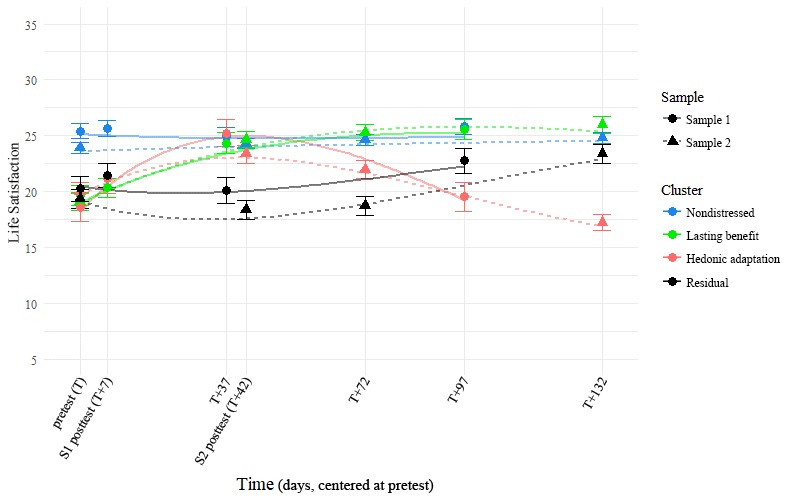
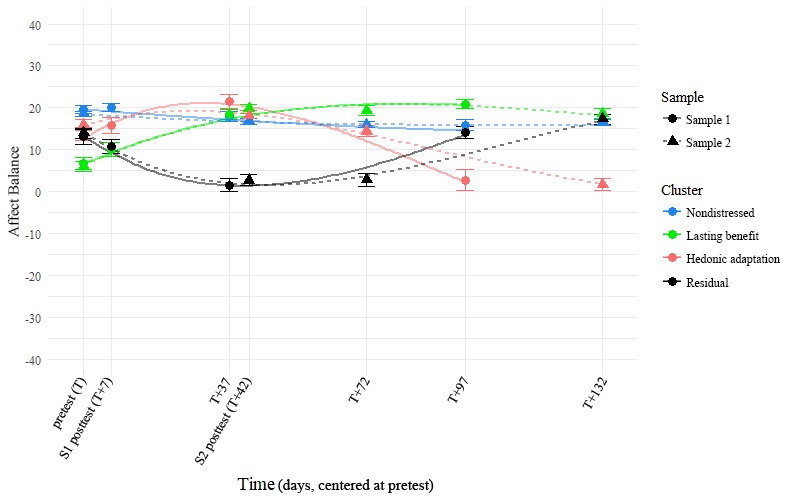
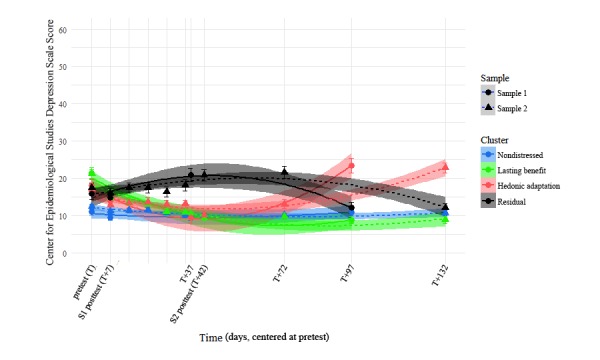
Results: Cluster analysis produced similar cluster solutions for each sample. In both cases, participant trajectories in LS and AB fell into 1 of 4 distinct groups. These groups were as follows: those with high and static levels of happiness (n=118, or 42.8%, in Sample 1; n=306, or 52.8%, in Sample 2), those who experienced a lasting improvement (n=74, or 26.8% in Sample 1; n=104, or 18.0%, in Sample 2), those who experienced a temporary improvement but returned to baseline (n=37, or 13.4%, in Sample 1; n=82, or 14.2%, in Sample 2), and those with other trajectories (n=47, or 17.0%, in Sample 1; n=87, or 15.0% in Sample 2). The prevalence of depression symptoms predicted membership in 1 of the latter 3 groups. Higher usage and greater adherence predicted sustained rather than temporary benefits.
Conclusions: We revealed a few common patterns of change among those completing Web-based happiness interventions. A noteworthy finding was that many individuals began quite happy and maintained those levels. We failed to identify evidence that the benefit of any particular activity or group of activities was more sustainable than any others. We did find, however, that the distressed portion of participants was more likely to achieve a lasting benefit if they continued to practice, and adhere to, their assigned Web-based happiness intervention.
Keywords: cluster analysis; depression; happiness; random allocation.
©Christopher A Sanders, Stephen M Schueller, Acacia C Parks, Ryan T Howell. Originally published in the Journal of Medical Internet Research (http://www.jmir.org), 08.06.2019.
Conflict of interest statement
Conflicts of Interest: The authors declare no conflicts of interest.
Figures

References
-
- Leykin Y, Aguilera A, Torres LD, Pérez-Stable EJ, Muñoz RF. Interpreting the outcomes of automated internet-based randomized trials: example of an International Smoking Cessation Study. J Med Internet Res. 2012 Feb;14(1):e5. doi: 10.2196/jmir.1829. http://www.jmir.org/2012/1/e5/ v14i1e5 - DOI - PMC - PubMed
-
- Gow RW, Trace SE, Mazzeo SE. Preventing weight gain in first year college students: an online intervention to prevent the “freshman fifteen”. Eat Behav. 2010 Jan;11(1):33–9. doi: 10.1016/j.eatbeh.2009.08.005. http://europepmc.org/abstract/MED/19962118 S1471-0153(09)00086-5 - DOI - PMC - PubMed
-
- Bolier L, Abello KM. Online positive psychological interventions: state of the art and future directions. In: Parks AC, Schueller SM, editors. The Wiley Blackwell Handbook of Positive Psychological Interventions. Oxford, England: Wiley Blackwell; 2014. pp. 286–309.
MeSH terms
LinkOut - more resources
Full Text Sources
