


Factors associated with the double burden of malnutrition among adolescents, National Adolescent School-Based Health Survey (PENSE 2009 and 2015)
- PMID: 31199844
- PMCID: PMC6570028
- DOI: 10.1371/journal.pone.0218566
Factors associated with the double burden of malnutrition among adolescents, National Adolescent School-Based Health Survey (PENSE 2009 and 2015)
Erratum in
-
Correction: Factors associated with the double burden of malnutrition among adolescents, National Adolescent School-Based Health Survey (PENSE 2009 and 2015).PLoS One. 2019 Jun 27;14(6):e0219315. doi: 10.1371/journal.pone.0219315. eCollection 2019. PLoS One. 2019. PMID: 31247043 Free PMC article.
Abstract
Objective: To assess the sociodemographic factors associated with the double burden of malnutrition (DBM) among Brazilian adolescents.
Methods: This was a descriptive study based on data from 59,637 and 10,770 students who participated in the National Adolescent School-Based Health Survey (PeNSE), 2009 and 2015 editions, respectively. Weight and height measurements were obtained to evaluate nutritional status. DBM was classified as follows: adolescents with high BMI-for-age and low height-for-age (BMI/A: Z-score > +1 and H/A: Z-score < -2). Sociodemographic data on the participants were also collected. A multinomial logistic regression analysis was used to detect associations of interest.
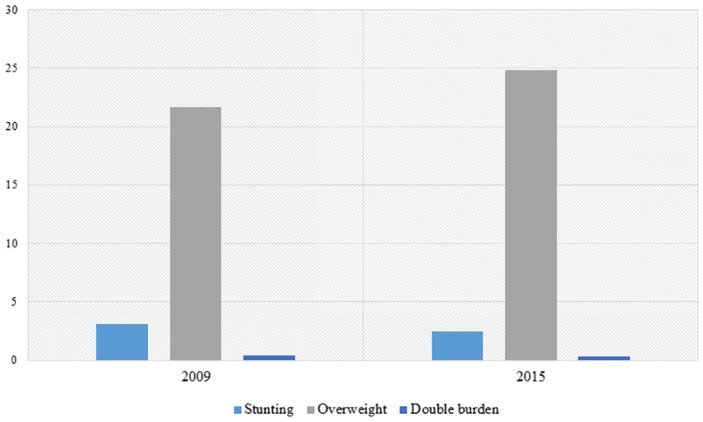
Results: The prevalence of DBM in the 2009 and 2015 editions of the PeNSE was 0.4% and 0.3%, respectively. In the 2009 edition, the chance of DBM was lower among boys (OR = 0.60; 95% CI = 0.45-0.81) and higher among those over 14 years old (OR = 2.40; 95% CI = 1.80-3.20), living in the country's north and northeast regions (OR = 2.01; 95% CI = 1.49-2.84), and from families with a low maternal education level (OR = 1.48; 95% CI = 1.07-2.04). In the 2015 edition, no significant associations were found regarding the DBM outcome.
Conclusion: The results indicate the presence of socioeconomic inequalities in the occurrence of DBM in the 2009 edition of the PeNSE. Simultaneous interventions in the area of equity are necessary to prevent the advancement of nutrition-related problems.
Conflict of interest statement
The authors have declared that no competing interests exist.
Figures
References
-
- Prentice AM. The Double Burden of Malnutrition in Countries Passing through the Economic Transition. Annals of nutrition & metabolism. 2018;72 Suppl 3:47–54. - PubMed
MeSH terms
LinkOut - more resources
Full Text Sources
Medical
