. 2019 Aug 6;30(2):329-342.e5.
doi: 10.1016/j.cmet.2019.05.015. Epub 2019 Jun 13.

Extracellular Vesicle-Contained eNAMPT Delays Aging and Extends Lifespan in Mice

Affiliations

Extracellular Vesicle-Contained eNAMPT Delays Aging and Extends Lifespan in Mice

Mitsukuni Yoshida et al. Cell Metab. .

Abstract

Aging is a significant risk factor for impaired tissue functions and chronic diseases. Age-associated decline in systemic NAD+ availability plays a critical role in regulating the aging process across many species. Here, we show that the circulating levels of extracellular nicotinamide phosphoribosyltransferase (eNAMPT) significantly decline with age in mice and humans. Increasing circulating eNAMPT levels in aged mice by adipose-tissue-specific overexpression of NAMPT increases NAD+ levels in multiple tissues, thereby enhancing their functions and extending healthspan in female mice. Interestingly, eNAMPT is carried in extracellular vesicles (EVs) through systemic circulation in mice and humans. EV-contained eNAMPT is internalized into cells and enhances NAD+ biosynthesis. Supplementing eNAMPT-containing EVs isolated from young mice significantly improves wheel-running activity and extends lifespan in aged mice. Our findings have revealed a novel EV-mediated delivery mechanism for eNAMPT, which promotes systemic NAD+ biosynthesis and counteracts aging, suggesting a potential avenue for anti-aging intervention in humans.

Keywords: EV; NAD+; adipose tissue; aging; eNAMPT; exosome; extracellular vesicle; hypothalamus; longevity; metabolism.


Conflict of interest statement

Declaration of Interests

S.I. receives a part of patent-licensing fees from MetroBiotech (USA) and Teijin Limited (Japan) through Washington University. R.S.A. is a co-founder of Metro Midwest Biotech. All other authors have no financial interests.

Figures

Figure 1.
Figure 1.. Plasma eNAMPT levels are reduced with age in both mice and humans and predicts remaining lifespans of individual mice.
(A) Plasma eNAMPT levels of female and male mice at 6 and 18 months of age (n=5). (B) Plasma eNAMPT concentrations of female and male mice at 6 and 18 months of age over a 24-hr period (n=5 per time point per age). The differences between plasma eNAMPT levels at 6 and 18 months of age were assessed by two-way repeated measures ANOVA, and the age effects were significant in both males and females (p<0.05). (C) Plasma eNAMPT levels of mice and humans across different age groups (n=9 for mice; n=13 for humans). (D) Relationship of plasma eNAMPT levels and the remaining lifespans of individual mice (n=8). eNAMPT levels were measured at 26-28 months of age.
Figure 2.
Figure 2.. Adipose tissue-specific overexpression of Nampt maintains higher plasma eNAMPT levels and NAD+ biosynthesis in multiple tissues during aging.
(A) Plasma eNAMPT levels of control (CTRL) and ANKI mice at 4 months of age (n=3-4 per group per sex). (B) Plasma eNAMPT levels of control and ANKI mice at 24 months of age (n=3-4 per group per sex). (C) Tissue NAD+ levels of control and ANKI mice at 20 months of age (n=3 per group per sex).
Figure 3.
Figure 3.
Aged ANKI mice display significant enhancement of physical activity and sleep quality. (A) Wheel-running activity of control (CTRL) and ANKI female mice at 4 and 18 months of age (4-month old, n=3; 18-month old, n=10-13 per group). (B) Total ambulatory (upper panel) and rearing (lower panel) activities of control and ANKI female mice at 18 months of age (n=4-5 per group). (C) The levels of sleep fragmentation in 4 and 20 month-old male mice (n=6 per group) and control and ANKI mice at 20 months of age (n=7-8 per group; male and female mice combined). The numbers of transitions between NREM sleep (NR) and wake (W) cycles are shown. (D) mRNA expression levels of Ox2r and Prdm13 in the hypothalami of control and ANKI female mice at 20 months of age (n=3-6 per group).
Figure 4.
Figure 4.. Aged ANKI mice show significant improvement in glucose tolerance, insulin secretion, and photoreceptor function.
(A, B) Blood glucose (n=8-13) (A) and insulin (n=8-9) (B) levels during the IPGTTs in control (CTRL) and ANKI male mice at 17-20 months of age. (C-E) Total numbers (C), representative images (D), and size distributions (E) of pancreatic islets in the pancreata of control and ANKI male mice at 20 months of age (n=3 per group). (F) Scotopic a, scotopic b, and photopic b waves from ERG analysis of control and ANKI mice at 18-20 months of age (n=6-7 per group; male and female combined).
Figure 5.
Figure 5.. Female ANKI mice exhibit significant extension of median lifespan and delay in aging.
(A) Kaplan-Meier curves of female and male ANKI mice (females, control 39, ANKI 40; males, control 39, ANKI 39). (B) Lifespan parameters of control and ANKI mice. Mean and maximal lifespans of the oldest 10% and 20% of each cohort are shown as mean values ± SEM. The differences in survival curves and mean lifespans were assessed by Gehan-Breslow-Wilcoxon test and Student’s t test, respectively. (C) Age-associated mortality rates of control and ANKI female and male mice. (D) Identified causes of death in aged control and ANKI mice (n=37). Sarcoma subtypes includes histio-, hemangio-, lipo-, and fibrosarcoma, and carcinoma subtypes includes hepatocellular, bronchiolo-alveolar, and cholangiocarcinoma.
Figure 6.
Figure 6.. Plasma eNAMPT is exclusively localized to EVs in both mice and humans.
(A) Comparison of eNAMPT, EV marker proteins (TSG101, CD63, CD81, and CD9), and non-EV proteins (transferrin and albumin) in whole plasma, EV fraction, and supernatant isolated by ultracentrifugation and the Total Exosome Isolation (TEI) kit. The protein concentrations were typically ~0.4 and ~1 μg/μl for EVs purified by ultracentrifugation and the TEI kit, respectively, when EVs were reconstituted with an equal volume of PBS to the starting volume of plasma. 40 μg of protein from each fraction were loaded. (B) Comparison of eNAMPT and EV marker proteins in six fractions (F1-6) isolated from sucrose density-gradient centrifugation. 2 ml of plasma were used for this fractionation. (C) Comparison of eNAMPT in whole plasma (P), EV fraction (E), and supernatant (S) isolated from three 4 month-old male mice and 37, 41, and 45 year-old male human donors. Each fraction was loaded after adjusting them to an equal volume. (D) Comparison of eNAMPT, TSG101, transferrin, and immunoglobulin light chain (Ig LC) in the treatment of mouse plasma with proteinase K and/or Triton X-100. (E) Levels of EV-contained eNAMPT (EV-eNAMPT) and CD63 in the plasma from 6 and 22 month-old mice (n=4 per group). (F) Levels of EV-contained eNAMPT (EV-eNAMPT) and CD63 in the plasma of control (CTRL) and ANKI mice at 24 month of age (n=4 per group).
Figure 7.
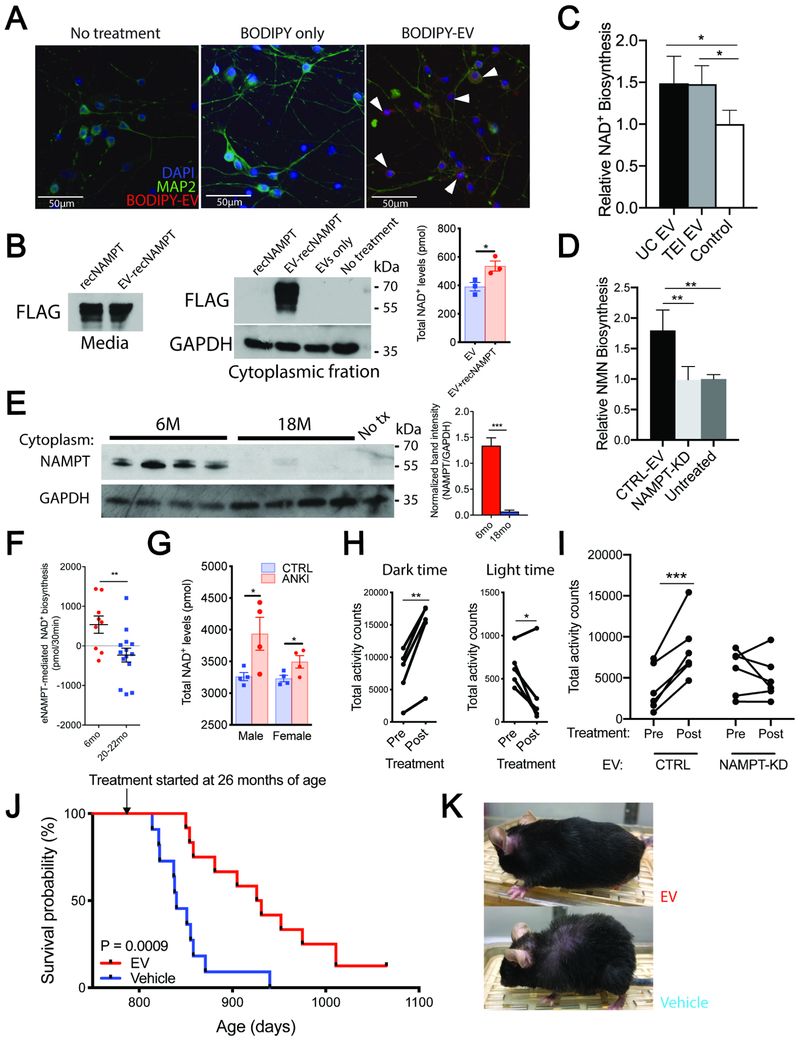
Figure 7.. EV-contained eNAMPT directly enhances NAD+ biosynthesis in primary hypothalamic neurons and ameliorates age-associated decline in physical activity and extends lifespan in mice.
(A) Fluorescent images of primary hypothalamic neurons following the incubation with BODIPY-labeled EVs. EVs purified from 400 μl of mouse plasma were added to 200 μl of culture media. Arrowheads indicate neurons that internalized BODIPY-labeled EVs. (B) Cytoplasmic levels of FLAG-tagged recombinant NAMPT (recNAMPT) and cellular NAD+ levels in the primary hypothalamic neurons after incubated with recNAMPT alone or EV-contained recNAMPT (n=3). (C) Relative rate of NAD+ biosynthesis in primary hypothalamic neurons after incubating with EVs isolated from plasma with ultracentrifugation and TEI kit (n=4). (D) Relative cellular NAMPT activity in primary hypothalamic neurons after incubating with control (CTRL) and Nampt-knockdown (NAMPT-KD) EVs generated from OP9 adipocytes (n=3-6). (E) Levels of cytoplasmic NAMPT and NAD+ in primary hypothalamic neurons after incubated with EVs isolated from 6 and 18 month-old mice (n=4). (F) NAD+ level changes after incubating with EVs isolated from 6 and 20-22 month-old mice. (n=9-13) (G) NAD+ levels in primary hypothalamic neurons after incubating with EVs isolated from control (CTRL) and ANKI mice at 20 months of age. (H) Total wheel-running activity counts of 20 month-old female mice during dark and light times before and after 4 consecutive daily injections of EVs purified from 4-6 month-old mice (n=5). (I) Total wheel-running activity counts of 25 month-old female mice during the dark time before and after 4 consecutive daily injections of control (CTRL) and Nampt-knockdown (NAMPT-KD) EVs purified from OP9 adipocytes (n=6). (J, K) Kaplan-Meier curves (J) and representative images (K) of aged female mice injected with vehicle or EVs isolated from 4-12 month-old mice (n=11-12). The mouse images were taken after 3 months of treatment.

References

    1. Canto C, Menzies KJ, and Auwerx J (2015). NAD(+) Metabolism and the Control of Energy Homeostasis: A Balancing Act between Mitochondria and the Nucleus. Cell Metab. 22, 31–53. - PMC - PubMed
    1. Dahl TB, Holm S, Aukrust P, and Halvorsen B (2012). Visfatin/NAMPT: A Multifaceted Molecule with Diverse Roles in Physiology and Pathophysiology. Annu. Rev. Nutr. 32, 229–243. - PubMed
    1. Durcin M, Fleury A, Taillebois E, Hilairet G, Krupova Z, Henry C, Truchet S, Trotzmuller M, Kofeler H, Mabilleau G, et al. (2017). Characterisation of adipocyte-derived extracellular vesicle subtypes identifies distinct protein and lipid signatures for large and small extracellular vesicles. J. Extracell. Vesicles 6, 1305677. - PMC - PubMed
    1. Fukuhara A, Matsuda M, Nishizawa M, Segawa K, Tanaka M, Kishimoto K, Matsuki Y, Murakami M, Ichisaka T, Murakami H, et al. (2007). Retraction. Science 318, 565b. - PubMed
    1. Garten A, Schuster S, Penke M, Gorski T, de Giorgis T, and Kiess W (2015). Physiological and pathophysiological roles of NAMPT and NAD metabolism. Nat. Rev. Endocrinol. 11, 535–546. - PubMed

Publication types

Substances