


A comprehensive review and performance evaluation of bioinformatics tools for HLA class I peptide-binding prediction
- PMID: 31204427
- PMCID: PMC7373177
- DOI: 10.1093/bib/bbz051
A comprehensive review and performance evaluation of bioinformatics tools for HLA class I peptide-binding prediction
Abstract
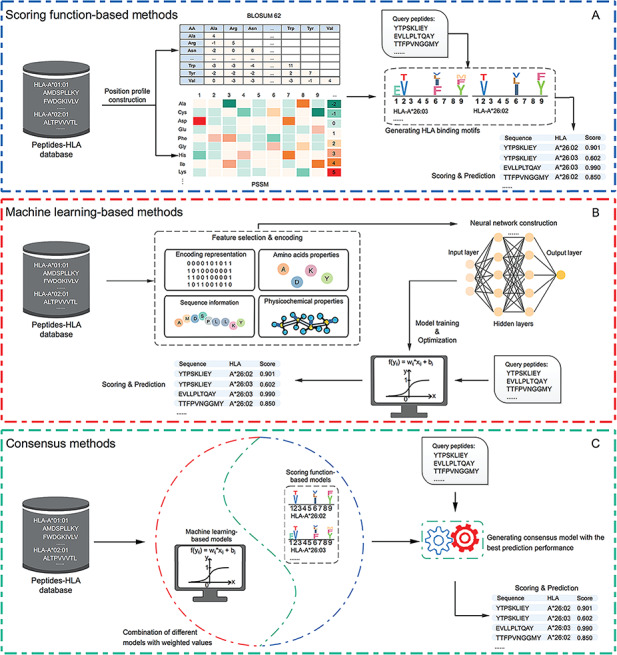
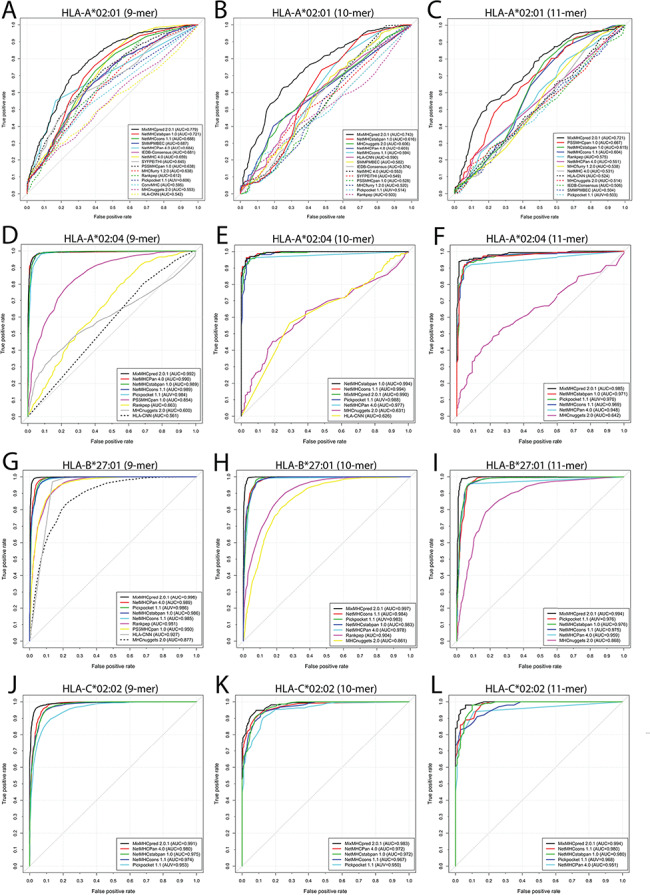
Human leukocyte antigen class I (HLA-I) molecules are encoded by major histocompatibility complex (MHC) class I loci in humans. The binding and interaction between HLA-I molecules and intracellular peptides derived from a variety of proteolytic mechanisms play a crucial role in subsequent T-cell recognition of target cells and the specificity of the immune response. In this context, tools that predict the likelihood for a peptide to bind to specific HLA class I allotypes are important for selecting the most promising antigenic targets for immunotherapy. In this article, we comprehensively review a variety of currently available tools for predicting the binding of peptides to a selection of HLA-I allomorphs. Specifically, we compare their calculation methods for the prediction score, employed algorithms, evaluation strategies and software functionalities. In addition, we have evaluated the prediction performance of the reviewed tools based on an independent validation data set, containing 21 101 experimentally verified ligands across 19 HLA-I allotypes. The benchmarking results show that MixMHCpred 2.0.1 achieves the best performance for predicting peptides binding to most of the HLA-I allomorphs studied, while NetMHCpan 4.0 and NetMHCcons 1.1 outperform the other machine learning-based and consensus-based tools, respectively. Importantly, it should be noted that a peptide predicted with a higher binding score for a specific HLA allotype does not necessarily imply it will be immunogenic. That said, peptide-binding predictors are still very useful in that they can help to significantly reduce the large number of epitope candidates that need to be experimentally verified. Several other factors, including susceptibility to proteasome cleavage, peptide transport into the endoplasmic reticulum and T-cell receptor repertoire, also contribute to the immunogenicity of peptide antigens, and some of them can be considered by some predictors. Therefore, integrating features derived from these additional factors together with HLA-binding properties by using machine-learning algorithms may increase the prediction accuracy of immunogenic peptides. As such, we anticipate that this review and benchmarking survey will assist researchers in selecting appropriate prediction tools that best suit their purposes and provide useful guidelines for the development of improved antigen predictors in the future.
Keywords: HLA; bioinformatics; machine learning; peptide binding; performance benchmarking; prediction model; sequence analysis; web server.
© The Author(s) 2019. Published by Oxford University Press. All rights reserved. For Permissions, please email: journals.permissions@oup.com.
Figures
References
-
- Purcell AW, McCluskey J, Rossjohn J. More than one reason to rethink the use of peptides in vaccine design. Nat Rev Drug Discov 2007;6:404. - PubMed
Publication types
MeSH terms
Substances
Grants and funding
LinkOut - more resources
Full Text Sources
Other Literature Sources
Research Materials
