


Exercise training undertaken by people within 12 months of lung resection for non-small cell lung cancer
- PMID: 31204439
- PMCID: PMC6571512
- DOI: 10.1002/14651858.CD009955.pub3
Exercise training undertaken by people within 12 months of lung resection for non-small cell lung cancer
Abstract
Background: Decreased exercise capacity and health-related quality of life (HRQoL) are common in people following lung resection for non-small cell lung cancer (NSCLC). Exercise training has been demonstrated to confer gains in exercise capacity and HRQoL for people with a range of chronic conditions, including chronic obstructive pulmonary disease and heart failure, as well as in people with prostate and breast cancer. A programme of exercise training may also confer gains in these outcomes for people following lung resection for NSCLC. This systematic review updates our 2013 systematic review.
Objectives: The primary aim of this review was to determine the effects of exercise training on exercise capacity and adverse events in people following lung resection (with or without chemotherapy) for NSCLC. The secondary aims were to determine the effects of exercise training on other outcomes such as HRQoL, force-generating capacity of peripheral muscles, pressure-generating capacity of the respiratory muscles, dyspnoea and fatigue, feelings of anxiety and depression, lung function, and mortality.
Search methods: We searched for additional randomised controlled trials (RCTs) in the Cochrane Central Register of Controlled Trials (CENTRAL) (the Cochrane Library 2019, Issue 2 of 12), MEDLINE (via PubMed) (2013 to February 2019), Embase (via Ovid) (2013 to February 2019), SciELO (The Scientific Electronic Library Online) (2013 to February 2019), and PEDro (Physiotherapy Evidence Database) (2013 to February 2019).
Selection criteria: We included RCTs in which participants with NSCLC who underwent lung resection were allocated to receive either exercise training, which included aerobic exercise, resistance exercise, or a combination of both, or no exercise training.
Data collection and analysis: Two review authors screened the studies and identified those eligible for inclusion. We used either postintervention values (with their respective standard deviation (SD)) or mean changes (with their respective SD) in the meta-analyses that reported results as mean difference (MD). In meta-analyses that reported results as standardised mean difference (SMD), we placed studies that reported postintervention values and those that reported mean changes in separate subgroups. We assessed the certainty of evidence for each outcome by downgrading or upgrading the evidence according to GRADE criteria.
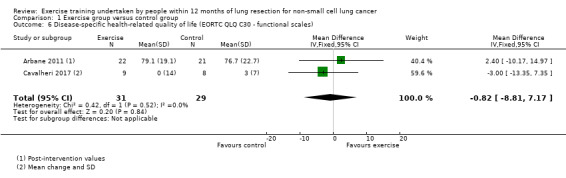
Main results: Along with the three RCTs included in the original version of this review (2013), we identified an additional five RCTs in this update, resulting in a total of eight RCTs involving 450 participants (180 (40%) females). The risk of selection bias in the included studies was low and the risk of performance bias high. Six studies explored the effects of combined aerobic and resistance training; one explored the effects of combined aerobic and inspiratory muscle training; and one explored the effects of combined aerobic, resistance, inspiratory muscle training and balance training. On completion of the intervention period, compared to the control group, exercise capacity expressed as the peak rate of oxygen uptake (VO2peak) and six-minute walk distance (6MWD) was greater in the intervention group (VO2peak: MD 2.97 mL/kg/min, 95% confidence interval (CI) 1.93 to 4.02 mL/kg/min, 4 studies, 135 participants, moderate-certainty evidence; 6MWD: MD 57 m, 95% CI 34 to 80 m, 5 studies, 182 participants, high-certainty evidence). One adverse event (hip fracture) related to the intervention was reported in one of the included studies. The intervention group also achieved greater improvements in the physical component of general HRQoL (MD 5.0 points, 95% CI 2.3 to 7.7 points, 4 studies, 208 participants, low-certainty evidence); improved force-generating capacity of the quadriceps muscle (SMD 0.75, 95% CI 0.4 to 1.1, 4 studies, 133 participants, moderate-certainty evidence); and less dyspnoea (SMD -0.43, 95% CI -0.81 to -0.05, 3 studies, 110 participants, very low-certainty evidence). We observed uncertain effects on the mental component of general HRQoL, disease-specific HRQoL, handgrip force, fatigue, and lung function. There were insufficient data to comment on the effect of exercise training on maximal inspiratory and expiratory pressures and feelings of anxiety and depression. Mortality was not reported in the included studies.
Authors' conclusions: Exercise training increased exercise capacity and quadriceps muscle force of people following lung resection for NSCLC. Our findings also suggest improvements on the physical component score of general HRQoL and decreased dyspnoea. This systematic review emphasises the importance of exercise training as part of the postoperative management of people with NSCLC.
Conflict of interest statement
VC, KH, and SJ conducted a study that was included in this review (Cavalheri 2017). Consequently, the 'Risk of bias' assessment for that study was performed by CB and VRF.
Vinicius Cavalheri: none known
Chris Burtin: none known
Vittoria R Formico: none known
Mika L Nonoyama: none known
Sue Jenkins: none known
Martijn A Spruit: Prof Spruit discloses receiving personal remuneration for consultancy and/or lectures from Boehringer Ingelheim, AstraZeneca, and GSK outside the submitted work.
Kylie Hill: is a member of the Editorial Board for the
Figures




Update of
-
Exercise training undertaken by people within 12 months of lung resection for non-small cell lung cancer.Cochrane Database Syst Rev. 2013 Jul 31;(7):CD009955. doi: 10.1002/14651858.CD009955.pub2. Cochrane Database Syst Rev. 2013. Update in: Cochrane Database Syst Rev. 2019 Jun 17;6:CD009955. doi: 10.1002/14651858.CD009955.pub3. PMID: 23904353 Updated.
Comment in
-
Is exercise training effective within 12 months of lung resection for non-small cell lung cancer?-A Cochrane Review summary with commentary.PM R. 2021 Mar;13(3):336-338. doi: 10.1002/pmrj.12564. Epub 2021 Mar 5. PM R. 2021. PMID: 33527624 No abstract available.
References
References to studies included in this review
Arbane 2011 {published data only}
-
- Arbane G, Jackson D, Summers R, Williams L, Tropman D, Garrod R. Early exercise training after thoracotomy prevents quadriceps sarcopenia for people with lung cancer. European Respiratory Society 2009 Annual Congress; 2009 09 12‐16; Vienna. European Respiratory Society, 2009:819s.
-
- Arbane G, Jackson D, Tropman D, Garrod R. An early exercise intervention prevents quadriceps weakness after thoracotomy for non‐small cell lung cancer: randomised controlled trial. Thorax 2009;64:A20‐1. - PubMed
-
- Arbane G, Tropman D, Jackson D, Garrod R. Evaluation of an early exercise intervention after thoracotomy for non‐small cell lung cancer (NSCLC), effects on quality of life, muscle strength and exercise tolerance: randomised controlled trial. Lung Cancer 2011;71(2):229‐34. - PubMed
Arbane 2014 {published data only}
-
- Arbane G, Douiri A, Hart N, Hopkinson NS, Singh S, Speed C, et al. Effect of postoperative physical training on activity after curative surgery for non‐small cell lung cancer: a multicentre randomised controlled trial. Physiotherapy 2014;100(2):100‐7. - PubMed
Brocki 2014 {published data only}
-
- Brocki B, Rodkjaer L, Nekrasas V, Due KM, Andreasen J. Effects of an outpatient exercise training programme after lung cancer operation ‐ a randomised single‐blinded clinical trial. Physiotherapy 2011;97:eS156‐7.
-
- Brocki B, Rodkjær L, Nekrasas V, Due K, Dethlefsen C, Andreasen J. Rehabilitation after lung cancer operation‐ a randomised controlled study. European Respiratory Society 2010 Annual Congress; 2010 09 18‐22; Barcelona. European Respiratory Society, 2010:331s.
-
- Brocki BC, Andreasen JJ, Nielsen LR, Nekrasas V, Gorst‐Rasmussen A, Westerdahl E. Short and long‐term effects of supervised versus unsupervised exercise training on health‐related quality of life and functional outcomes following lung cancer surgery ‐ a randomized controlled trial. Lung Cancer 2014;83(1):102‐8. - PubMed
Cavalheri 2017 {published data only}
Edvardsen 2015 {published data only}
-
- Edvardsen E, Skjønsberg OH, Holme I, Nordsletten L, Borchsenius F, Anderssen SA. High‐intensity training following lung cancer surgery: a randomised controlled trial. Thorax 2015;70(3):244‐50. - PubMed
Messaggi‐Sartor 2018 {published data only}
-
- Messaggi‐Sartor M, Marco E, Martínez‐Téllez E, Rodriguez‐Fuster A, Palomares C, Chiarella S, et al. Combined aerobic exercise and high‐intensity respiratory muscle training in patients surgically treated for non‐small cell lung cancer: a pilot randomized clinical trial. European Journal of Physical and Rehabilitation Medicine 2018 Jul 6 [Epub ahead of print]. [DOI: 10.23736/S1973-9087.18.05156-0] - DOI - PubMed
Salhi 2015 {published and unpublished data}
-
- Meerbeeck JP, Salhi B, Haenebalcke C, Perez‐Bogerd S, Nguyen MD, Malfait TLA, et al. Resistance training in patients with radically treated respiratory cancer: mature results of a multi‐centre randomised phase 3 trial (reinforce). Journal of Thoracic Oncology 2013;8:S245.
-
- Salhi B, Haenebalcke C, Perez‐Bogerd S, Nguyen MD, Ninane V, Malfait TLA, et al. Rehabilitation in patients with radically treated respiratory cancer: a randomised controlled trial comparing two training modalities. Lung Cancer 2015;89(2):167‐74. - PubMed
-
- Surmont VF, Salhi B, Haenebalcke C, Bogerd SP, Dang DMN, Colman R, et al. REINFORCE: A randomized trial of resistance training in patients with radically treated respiratory cancer. Journal of Clinical Oncology 2013;31(15_suppl):7541.
Stigt 2013 {published and unpublished data}
-
- Stigt JA, Uil SM, Riesen SJ, Simons FJ, Denekamp M, Shahin GM, et al. A randomized controlled trial of postthoracotomy pulmonary rehabilitation in patients with resectable lung cancer. Journal of Thoracic Oncology 2013;8(2):214‐21. - PubMed
References to studies excluded from this review
Brocki 2016 {published and unpublished data}
-
- Brocki BC, Andreasen JJ, Langer D, Souza DSR, Westerdahl E. Postoperative inspiratory muscle training in addition to breathing exercises and early mobilization improves oxygenation in high‐risk patients after lung cancer surgery: a randomized controlled trial. European Journal of Cardio‐thoracic Surgery 2016;49(5):1483‐91. - PubMed
Chen 2015 {published data only}
Chen 2016 {published data only}
Granger 2013 {published data only}
-
- Granger CL, Chao C, McDonald CF, Berney S, Denehy L. Safety and feasibility of an exercise intervention for patients following lung resection: a pilot randomized controlled trial. Lung Cancer 2013;12(3):213‐24. - PubMed
Hoffman 2017 {published data only}
-
- Hoffman AJ, Brintnall RA. A home‐based exercise intervention for non‐small cell lung cancer patients post‐thoracotomy. Seminars in Oncology Nursing 2017;33(1):106‐17. - PubMed
Hsiao 2017 {published data only}
-
- Hsiao WL. Testing efficacy of a pulmonary rehabilitation program for post lung cancer resection surgery. Journal of Thoracic Oncology 2017;12(11 Suppl 2):S2024.
Jakobsen 2013 {published data only}
-
- Jakobsen E, Dan Joergensen O, Ladegaard L, Petersen S, Aagaard I, Mikkelsen P, et al. Postoperative rehabilitation and follow‐up ‐ a randomized study. Journal of Thoracic Oncology 2013;8:S390‐1.
Karvinen 2014 {published data only}
Ledderer 2013 {published data only}
-
- Ledderer L, Cour K, Mogensen O, Jakobsen E, Depont Christensen R, Kragstrup J, et al. Feasibility of a psychosocial rehabilitation intervention to enhance the involvement of relatives in cancer rehabilitation: pilot study for a randomized controlled trial. Patient 2013; Vol. 6, issue 3:201‐12. - PubMed
Liu 2015 {published data only}
Novoa 2017 {published data only}
-
- Novoa NM, Esteban P, Hernandez N, Gomez Hernandez MT, Varela G. Randomized trial to evaluate the beneficial effects of an unsupervised postoperative physical training protocol after lung resection: negative results. Interactive Cardiovascular and Thoracic Surgery 2017;25:i25.
Tenconi 2017 {published data only}
-
- Tenconi S, Galeone C, Fugazzaro S, Rapicetta C, Piro R, Formisano D. Perioperative and long‐term effects of comprehensive pulmonary rehabilitation on exercise capacity, postoperative outcome and quality of life in patients undergoing lung resection: a randomized controlled trial granted by the ministry of health. Interactive CardioVascular and Thoracic Surgery 2017;25:i25.
Wang 2013 {published data only}
-
- Wang R, Liu J, Chen P, Yu D. Regular Tai Chi exercise decreases the percentage of type 2 cytokine‐producing cells in postsurgical non‐small cell lung cancer survivors. Cancer Nursing 2013;36(4):E27‐34. - PubMed
Weiner 1997 {published data only}
-
- Weiner P, Man A, Weiner M, Rabner M, Waizman J, Magadle R, et al. The effect of incentive spirometry and inspiratory muscle training on pulmonary function after lung resection. Journal of Thoracic and Cardiovascular Surgery 1997; Vol. 113, issue 3:552‐7. - PubMed
Additional references
AIHW 2017
-
- Australian Institute of Health and Welfare. Cancer in Australia 2017. www.aihw.gov.au/cancer/ (accessed 13 November 2018).
Atkins 2004
Bailey 2010
Baracos 2010
-
- Baracos VE, Reiman T, Mourtzakis M, Gioulbasanis I, Antoun S. Body composition in patients with non‐small cell lung cancer: a contemporary view of cancer cachexia with the use of computed tomography image analysis. American Journal of Clinical Nutrition 2010;91 Suppl:1133‐7. - PubMed
Beck 2017
-
- Beck BR, Daly RM, Singh MA, Taaffe DR. Exercise and Sports Science Australia (ESSA) position statement on exercise prescription for the prevention and management of osteoporosis. Journal of Science and Medicine in Sport 2017;20(5):438‐45. [PUBMED: 27840033] - PubMed
Bendixen 2016
-
- Bendixen M, Jorgensen OD, Kronborg C, Andersen C, Licht PB. Postoperative pain and quality of life after lobectomy via video‐assisted thoracoscopic surgery or anterolateral thoracotomy for early stage lung cancer: a randomised controlled trial. Lancet Oncology 2016;17(6):836‐44. [PUBMED: 27160473] - PubMed
Bray 2018
Brunelli 2013
-
- Brunelli A, Kim AW, Berger KI, Addrizzo‐Harris DJ. Physiologic evaluation of the patient with lung cancer being considered for resectional surgery: diagnosis and management of lung cancer, 3rd ed: American College of Chest Physicians evidence‐based clinical practice guidelines. Chest 2013;143(5 Suppl):e166S‐90S. [PUBMED: 23649437] - PubMed
Burtin 2017
-
- Burtin C, Franssen FME, Vanfleteren LEGW, Groenen MTJ, Wouters EFM, Spruit MA. Lower‐limb muscle function is a determinant of exercise tolerance after lung resection surgery in patients with lung cancer. Respirology (Carlton, Vic.) 2017;22(6):1185‐9. [PUBMED: 28370836] - PubMed
Carson 2013
Cavalheri 2013
-
- Cavalheri V, Jenkins S, Hill K. Physiotherapy practice patterns for patients undergoing surgery for lung cancer: a survey of hospitals in Australia and New Zealand. Internal Medicine Journal 2013;43(4):394‐401. - PubMed
Cavalheri 2013a
Cavalheri 2015
-
- Cavalheri V, Jenkins S, Cecins N, Gain K, Phillips M, Sanders LH, et al. Impairments after curative intent treatment for non‐small cell lung cancer: a comparison with age and gender‐matched healthy controls. Respiratory Medicine 2015;109(10):1332‐9. [PUBMED: 26342839] - PubMed
Cavalheri 2016
Cavalheri 2017a
Cesario 2007
-
- Cesario A, Ferri L, Galetta D, Pasqua F, Bonassi S, Clini E, et al. Post‐operative respiratory rehabilitation after lung resection for non‐small cell lung cancer. Lung Cancer 2007;57(2):175‐80. [PUBMED: 17442449] - PubMed
Chandler 2016
-
- Chandler J, Lasserson T, Higgins JPT, Tovey D, Churchill R. Standards for the planning, conduct and reporting of updates of Cochrane Intervention Reviews. Higgins JPT, Lasserson T, Chandler J, Tovey D, Churchill R. Methodological Expectations of Cochrane Intervention Reviews. Cochrane: London, 2016.
Coups 2009
Covidence 2017
-
- Covidence systematic review software. Veritas Health Innovation, Melbourne, Australia. Available at www.covidence.org. Veritas Health Innovation, Melbourne, Australia. Available at www.covidence.org.
Crandall 2014
-
- Crandall K, Maguire R, Campbell A, Kearney N. Exercise intervention for patients surgically treated for non‐small cell lung cancer (NSCLC): a systematic review. Surgical Oncology 2014;23(1):17‐30. [PUBMED: 24529937] - PubMed
Cykert 2000
-
- Cykert S, Kissling G, Hansen CJ. Patient preferences regarding possible outcomes of lung resection: what outcomes should preoperative evaluations target?. Chest 2000;117(6):1551‐9. - PubMed
D'Silva 2018
-
- D'Silva A, Gardiner PA, Boyle T, Bebb DG, Johnson ST, Vallance JK. Associations of objectively assessed physical activity and sedentary time with health‐related quality of life among lung cancer survivors: a quantile regression approach. Lung Cancer 2018;119:78‐84. [PUBMED: 29656757] - PubMed
Dagnelie 2007
-
- Dagnelie PC, Pijls‐Johannesma MC, Lambin P, Beijer S, Ruysscher D, Kempen GI. Impact of fatigue on overall quality of life in lung and breast cancer patients selected for high‐dose radiotherapy. Annals of Oncology 2007;18(5):940‐4. - PubMed
Danish Lung Cancer Registry 2009
-
- Danish Lung Cancer Registry. Yearly Report for 2009. lungecancer.dk/documents/00140.pdf (accessed 18 May 2012).
Dayen 2017
DerSimonian 1986
-
- DerSimonian R, Laird N. Meta‐analysis in clinical trials. Controlled Clinical Trials 1986;7(3):177‐88. - PubMed
Dowman 2014
Fagundes 2015
Feinstein 2010
Gopaldas 2010
-
- Gopaldas RR, Bakaeen FG, Dao TK, Walsh GL, Swisher SG, Chu D. Video‐assisted thoracoscopic versus open thoracotomy lobectomy in a cohort of 13,619 patients. Annals of Thoracic Surgery 2010;89(5):1563‐70. - PubMed
Granger 2011
-
- Granger CL, McDonald CF, Berney S, Chao C, Denehy L. Exercise intervention to improve exercise capacity and health related quality of life for patients with non‐small cell lung cancer: a systematic review. Lung Cancer 2011;72(2):139‐53. [PUBMED: 21316790] - PubMed
Granger 2014
-
- Granger CL, McDonald CF, Irving L, Clark RA, Gough K, Murnane A, et al. Low physical activity levels and functional decline in individuals with lung cancer. Lung Cancer 2014;83(2):292‐9. [PUBMED: 24360323] - PubMed
Granger 2015
-
- Granger CL, Holland AE, Gordon IR, Denehy L. Minimal important difference of the 6‐minute walk distance in lung cancer. Chronic Respiratory Disease 2015;12(2):146‐54. [PUBMED: 25749346] - PubMed
Granger 2016
-
- Granger CL, Parry SM, Edbrooke L, Denehy L. Deterioration in physical activity and function differs according to treatment type in non‐small cell lung cancer ‐ future directions for physiotherapy management. Physiotherapy 2016;102(3):256‐63. [PUBMED: 26597694] - PubMed
Guyatt 2008
Harrison 2012
-
- Harrison SL, Greening NJ, Williams JE, Morgan MD, Steiner MC, Singh SJ. Have we underestimated the efficacy of pulmonary rehabilitation in improving mood?. Respiratory Medicine 2012;106(6):838‐44. [PUBMED: 22197576] - PubMed
Higgins 2011
-
- Higgins JPT, Green S (editors). Cochrane Handbook for Systematic Reviews of Interventions Version 5.1.0 (updated March 2011). The Cochrane Collaboration, 2011. Available from handbook.cochrane.org.
Huang 2015
Jemal 2017
Jett 2013
-
- Jett JR, Schild SE, Kesler KA, Kalemkerian GP. Treatment of small cell lung cancer: diagnosis and management of lung cancer, 3rd ed: American College of Chest Physicians evidence‐based clinical practice guidelines. Chest 2013;143(5 Suppl):e400S‐19S. [PUBMED: 23649448] - PubMed
Jones 2007
-
- Jones LW, Peddle CJ, Eves ND, Haykowsky MJ, Courneya KS, Mackey JR, et al. Effects of presurgical exercise training on cardiorespiratory fitness among patients undergoing thoracic surgery for malignant lung lesions. Cancer 2007;110(3):590‐8. - PubMed
Jones 2008
-
- Jones LW, Eves ND, Haykowsky M, Joy AA, Douglas PS. Cardiorespiratory exercise testing in clinical oncology research: systematic review and practice recommendations. Lancet Oncology 2008;9(8):757‐65. - PubMed
Jones 2009
-
- Jones LW, Eves ND, Waner E, Joy AA. Exercise therapy across the lung cancer continuum. Current Oncology Reports 2009;11(4):255‐62. [PUBMED: 19508829] - PubMed
Jones 2010
Lahart 2018
Landreneau 1993
-
- Landreneau RJ, Hazelrigg SR, Mack MJ, Dowling RD, Burke D, Gavlick J, et al. Postoperative pain‐related morbidity: video‐assisted thoracic surgery versus thoracotomy. Annals of Thoracic Surgery 1993;56(6):1285‐9. - PubMed
Maltais 2014
-
- Maltais F, Decramer M, Casaburi R, Barreiro E, Burelle Y, Debigare R, et al. An official American Thoracic Society/European Respiratory Society statement: update on limb muscle dysfunction in chronic obstructive pulmonary disease. American Journal of Respiratory and Critical Care Medicine 2014;189(9):e15‐62. [PUBMED: 24787074] - PMC - PubMed
McCarthy 2015
Mishra 2012
Mouronte‐Roibas 2018
-
- Mouronte‐Roibas C, Leiro‐Fernandez V, Ruano‐Ravina A, Ramos‐Hernandez C, Abal‐Arca J, Parente‐Lamelas I, et al. Chronic obstructive pulmonary disease in lung cancer patients: prevalence, underdiagnosis, and clinical characterization. Respiration 2018;95(6):414‐21. [PUBMED: 29587299] - PubMed
Murphy 2010
-
- Murphy RA, Mourtzakis M, Chu QS, Reiman T, Mazurak VC. Skeletal muscle depletion is associated with reduced plasma (n‐3) fatty acids in non‐small cell lung cancer patients. Journal of Nutrition 2010;140(9):1602‐6. - PubMed
Myrdal 2003
Nezu 1998
-
- Nezu K, Kushibe K, Tojo T, Takahama M, Kitamura S. Recovery and limitation of exercise capacity after lung resection for lung cancer. Chest 1998;113(6):1511‐6. - PubMed
O'Driscoll 1999
-
- O'Driscoll M, Corner J, Bailey C. The experience of breathlessness in lung cancer. European Journal of Cancer Care 1999;8(1):37‐43. - PubMed
Office for National Statistics 2015
-
- Office for National Statistics 2015. Deaths registered in England and Wales (series DR): 2015. www.ons.gov.uk/releases/deathsregisteredinenglandandwalesseriesdr2013 (accessed 13 November 2018).
Peddle‐McIntyre 2019
Poghosyan 2013
-
- Poghosyan H, Sheldon LK, Leveille SG, Cooley ME. Health‐related quality of life after surgical treatment in patients with non‐small cell lung cancer: a systematic review. Lung Cancer 2013;81(1):11‐26. [PUBMED: 23562675] - PubMed
Porszasz 2005
-
- Porszasz J, Emtner M, Goto S, Somfay A, Whipp BJ, Casaburi R. Exercise training decreases ventilatory requirements and exercise‐induced hyperinflation at submaximal intensities in patients with COPD. Chest 2005;128(4):2025‐34. [PUBMED: 16236851] - PubMed
Pouwels 2015
-
- Pouwels S, Fiddelaers J, Teijink JA, Woorst JF, Siebenga J, Smeenk FW. Preoperative exercise therapy in lung surgery patients: a systematic review. Respiratory Medicine 2015;109(12):1495‐504. [PUBMED: 26303337] - PubMed
Puhan 2016
RevMan 2014 [Computer program]
-
- The Nordic Cochrane Centre, The Cochrane Collaboration. Review Manager (RevMan). Version 5.3. Copenhagen: The Nordic Cochrane Centre, The Cochrane Collaboration, 2014.
Samsa 1999
-
- Samsa G, Edelman D, Rothman ML, Williams GR, Lipscomb J, Matchar D. Determining clinically important differences in health status measures: a general approach with illustration to the Health Utilities Index Mark II. PharmacoEconomics 1999;15(2):141‐55. [PUBMED: 10351188] - PubMed
Sarna 2004
Schneider 2007
-
- Schneider CM, Hsieh CC, Sprod LK, Carter SD, Hayward R. Exercise training manages cardiopulmonary function and fatigue during and following cancer treatment in male cancer survivors. Integrative Cancer Therapies 2007;6(3):235‐41. - PubMed
Sebio Garcia 2016
-
- Sebio Garcia R, Yanez Brage MI, Gimenez Moolhuyzen E, Granger CL, Denehy L. Functional and postoperative outcomes after preoperative exercise training in patients with lung cancer: a systematic review and meta‐analysis. Interactive Cardiovascular and Thoracic Surgery 2016;23(3):486‐97. [PUBMED: 27226400] - PubMed
Sher 2008
-
- Sher T, Dy GK, Adjei AA. Small cell lung cancer. Mayo Clinic Proceedings 2008;83(3):355‐67. - PubMed
Simoff 2013
-
- Simoff MJ, Lally B, Slade MG, Goldberg WG, Lee P, Michaud GC, et al. Symptom management in patients with lung cancer: diagnosis and management of lung cancer, 3rd ed: American College of Chest Physicians evidence‐based clinical practice guidelines. Chest 2013;143(5 Suppl):e455S‐97S. [PUBMED: 23649452] - PubMed
Sommer 2018
-
- Sommer MS, Staerkind MEB, Christensen J, Vibe‐Petersen J, Larsen KR, Holst Pedersen J, et al. Effect of postsurgical rehabilitation programmes in patients operated for lung cancer: a systematic review and meta‐analysis. Journal of Rehabilitation Medicine 2018;50(3):236‐45. [PUBMED: 29392334] - PubMed
Spruit 2006
-
- Spruit MA, Janssen PP, Willemsen SC, Hochstenbag MM, Wouters EF. Exercise capacity before and after an 8‐week multidisciplinary inpatient rehabilitation program in lung cancer patients: a pilot study. Lung Cancer 2006;52(2):257‐60. [PUBMED: 16529844] - PubMed
Sugimura 2006
-
- Sugimura H, Yang P. Long‐term survivorship in lung cancer: a review. Chest 2006;129(4):1088‐97. - PubMed
Publication types
MeSH terms
LinkOut - more resources
Full Text Sources
Medical
