


Prevalence of visual impairment among school children in three primary schools of Sekela Woreda, Amhara regional state, north-west Ethiopia
- PMID: 31205693
- PMCID: PMC6537079
- DOI: 10.1177/2050312119849769
Prevalence of visual impairment among school children in three primary schools of Sekela Woreda, Amhara regional state, north-west Ethiopia
Abstract
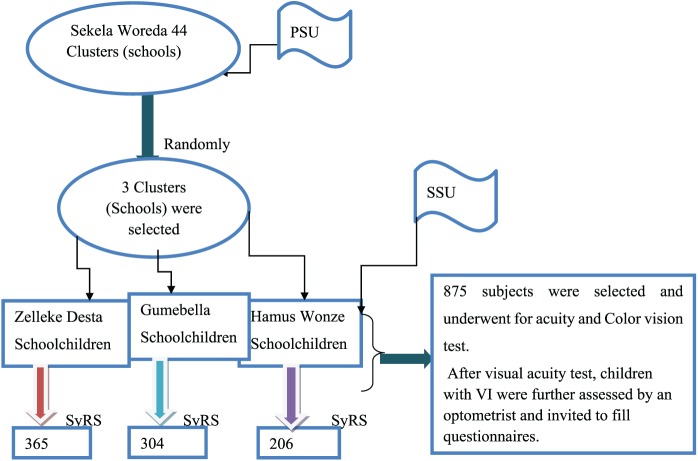
Background: Although there are limited studies, recent data are lacking to determine the prevalence of eye problems in Ethiopia accurately and there is no scientific evidence of such study in Sekela Woreda. The purpose of this study was to determine the prevalence of visual impairment among school children in Sekela Woreda, Ethiopia.
Methods: The study design was a community-based analytical cross-sectional with a multi-stage cluster random sampling technique from September to November 2016.Visual acuity was tested using Snellen's "E" chart while color vision was tested using Ishihara chart. The data were analyzed using SPSS version 20 software, and binary logistic regression was used to identify factors associated with visual impairment.
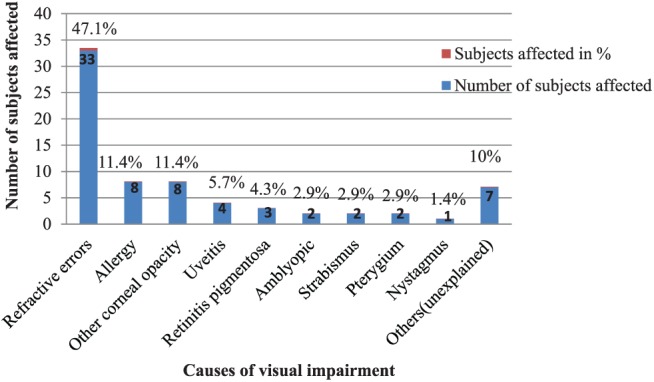
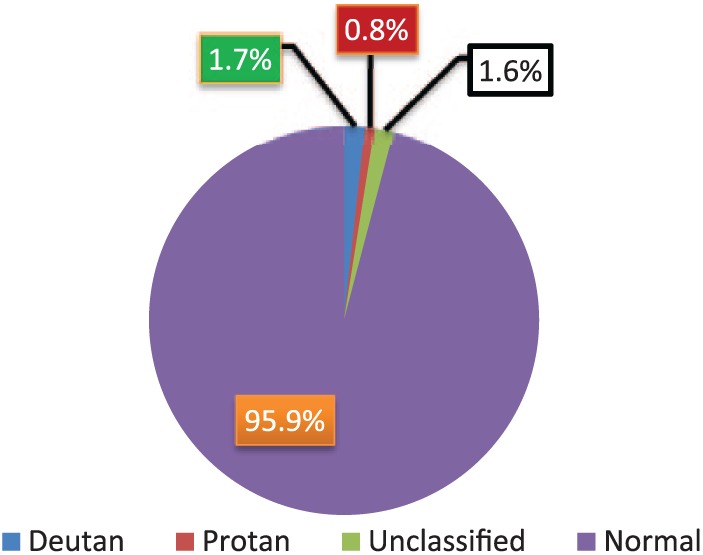
Results: A total of 875 participants, 466 (53.3%) males and 409 (46.7%) females, with an age range of 8-18 years were screened for visual acuity and color vision deficiency. The prevalence of visual impairment (visual acuity ⩽ 6/12) in "either eye" was 70 (8.0%). Among these, 37 (52.9%) were males and 33 (41.1%) were females. The prevalence of low vision (visual acuity ) and blindness (visual acuity < 3/60) in "either eye" were 28 (3.2%) and 10 (1.1%), respectively. Thirty two (3.7%) had mild visual impairment . The prevalence of color vision deficiency was 36 (4.1%). Among these, 27 (3%) were males and 9 (1.1%) were females. The variables age (adjusted odds ratio (95% confidence interval) = 1.14 (1.01-1.28) and color blindness (adjusted odds ratio (95% confidence interval) = 3.93(1.69-9.09) were significantly associated with visual impairment.
Conclusion: The prevalence of blindness and low vision in school children were higher than the national prevalence in Ethiopia. Increasing age and color defective vision were factors associated with the children's visual impairment. The Woreda health office ought to work with responsible stakeholders to tackle the situation in early childhood.
Keywords: Ethiopia; Prevalence; color blindness schoolchildren; visual impairment.
Conflict of interest statement
Declaration of conflicting interests: The author(s) declared no potential conflicts of interest with respect to the research, authorship, and/or publication of this article.
Figures
References
-
- World Health Organization. Global data on visual impairments. In: Global data final for web. Geneva: World Health Organization, 2012, pp. 1–6.
-
- Salomão SR, Mitsuhiro MR, Belfort R., Jr. Visual impairment and blindness: an overview of prevalence and causes in Brazil. An Acad Bras Cienc 2009; 81(3): 539–549. - PubMed
LinkOut - more resources
Full Text Sources
