Review
. 2020 Apr;32(13):e1901255.
doi: 10.1002/adma.201901255. Epub 2019 Jun 17.

Biomimetic Nanotechnology toward Personalized Vaccines

Affiliations
Review

Biomimetic Nanotechnology toward Personalized Vaccines

Jiarong Zhou et al. Adv Mater. 2020 Apr.

Abstract

While traditional approaches for disease management in the era of modern medicine have saved countless lives and enhanced patient well-being, it is clear that there is significant room to improve upon the current status quo. For infectious diseases, the steady rise of antibiotic resistance has resulted in super pathogens that do not respond to most approved drugs. In the field of cancer treatment, the idea of a cure-all silver bullet has long been abandoned. As a result of the challenges facing current treatment and prevention paradigms in the clinic, there is an increasing push for personalized therapeutics, where plans for medical care are established on a patient-by-patient basis. Along these lines, vaccines, both against bacteria and tumors, are a clinical modality that could benefit significantly from personalization. Effective vaccination strategies could help to address many challenging disease conditions, but current vaccines are limited by factors such as a lack of potency and antigenic breadth. Recently, researchers have turned toward the use of biomimetic nanotechnology as a means of addressing these hurdles. Recent progress in the development of biomimetic nanovaccines for antibacterial and anticancer applications is discussed, with an emphasis on their potential for personalized medicine.

Keywords: anticancer vaccinations; bacteria vaccinations; biomimetic nanoparticles; nanomedicine; personalized medicine.


Figures

Figure 1.
Figure 1.
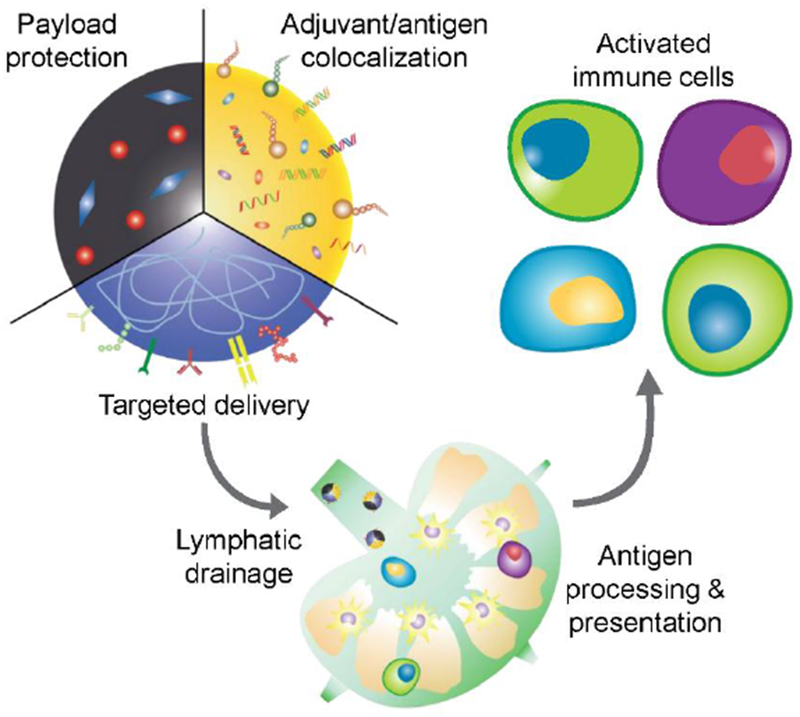
Overview of vaccine nanotechnology. Nanoparticles offer several advantages that can aid in the design of more effective vaccine formulations, including the ability to protect the bioactivity of encapsulated payloads, colocalize antigen and adjuvant for unified delivery to immune cells, and target specific cell subsets through the introduction of functional surface ligands. Their small size also enables efficient lymphatic transport, which can facilitate processes such as antigen presentation and lead to more potent immune activation.
Figure 2.
Figure 2.
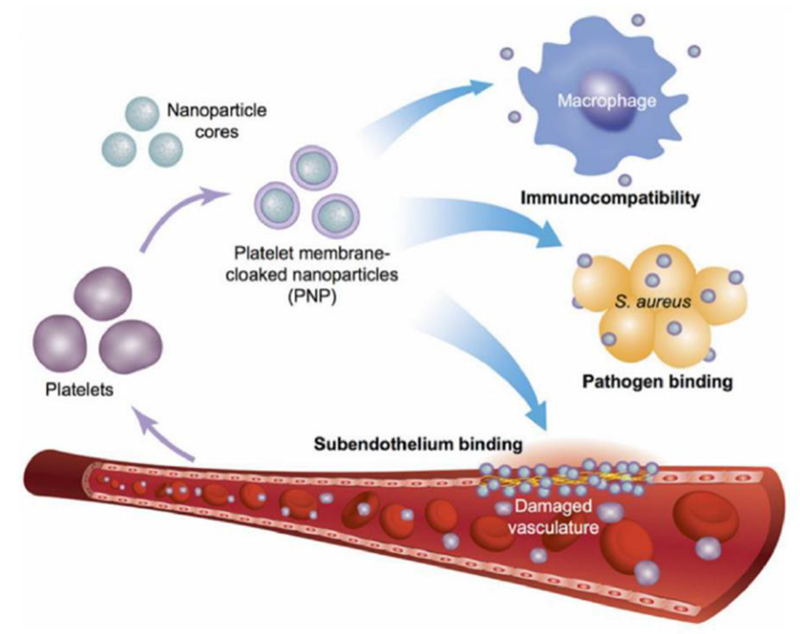
Platelet membrane-coated nanoparticles. Platelet membrane is derived from whole platelets by a repeated freeze-thaw process. The purified membranes can then be fused with a nanoparticulate core, enabling natural targeting affinity towards pathogens and damaged vasculature. Reproduced with permission.[110] Copyright 2015, Springer Nature.
Figure 3.
Figure 3.
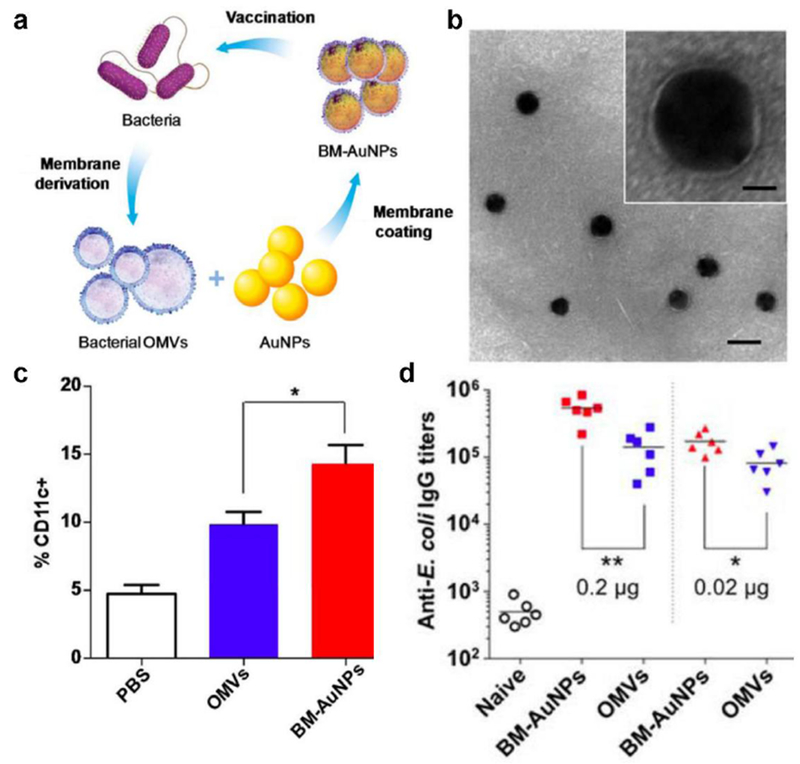
OMV-coated gold nanoparticles for antibacterial vaccination. a) OMVs are collected from bacteria and then coated onto gold nanoparticles (AuNPs), and the resulting bacterial membrane-coated AuNPs (BM-AuNPs) can be used to vaccinate against the source bacteria. b) Transmission electron microscopy (TEM) image of BM-AuNPs (scale bar, 50 nm). Inset: a single BM-AuNP (scale bar, 10 nm). c,d) When administered in vivo, BM-AuNPs can recruit more APCs in the lymph nodes (c) and generate stronger anti-E. coli IgG titers (d). Reproduced with permission.[138] Copyright 2015, American Chemistry Society.
Figure 4.
Figure 4.
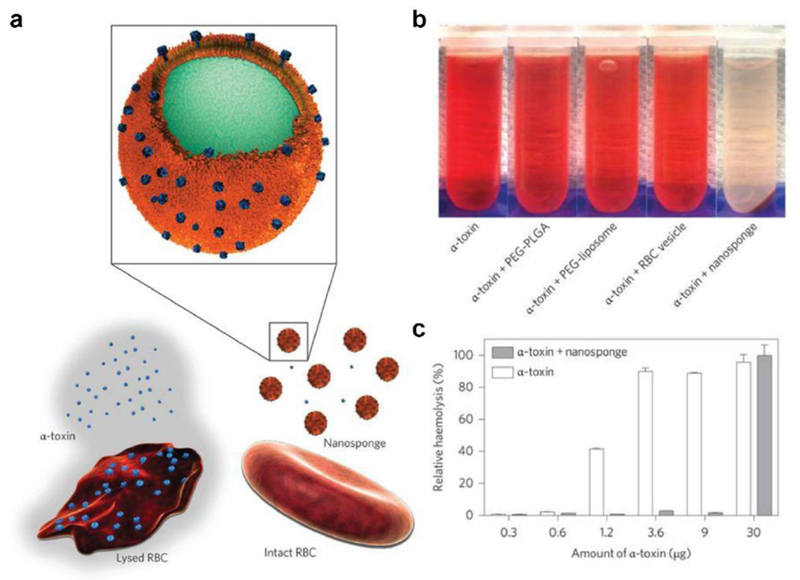
RBC nanosponges for biodetoxification. a) RBC nanosponges are fabricated by coating RBC membrane onto a polymeric core. The nanosponges can protect healthy RBCs from toxin-mediated hemolysis. b) Staphylococcal α-toxin preincubated with RBC nanosponges are unable to lyse native RBCs, whereas no protection is conferred after preincubation with various controls. c) RBC nanosponges negate the hemolytic activity of α-toxin in a concentration-dependent manner. Reproduced with permission.[146] Copyright 2013, Springer Nature.
Figure 5.
Figure 5.
RBC-based nanotoxoids for multiantigenic antibacterial vaccination. a) Bacteria secrete numerous virulence factors that can cause cellular damage. When incubated with nanosponges, the toxicity of the secretions is neutralized, enabling the resulting toxin-inserted nanotoxoid formulations to be used as a vaccine for eliciting multiantigenic immunity. b) Vaccination using nanotoxoids loaded with a hemolytic supernatant fraction (hSP) from S. aureus concurrently potentiates humoral antibody responses against multiple known toxins. Reproduced with permission.[150] Copyright 2017, Wiley-VCH.
Figure 6.
Figure 6.
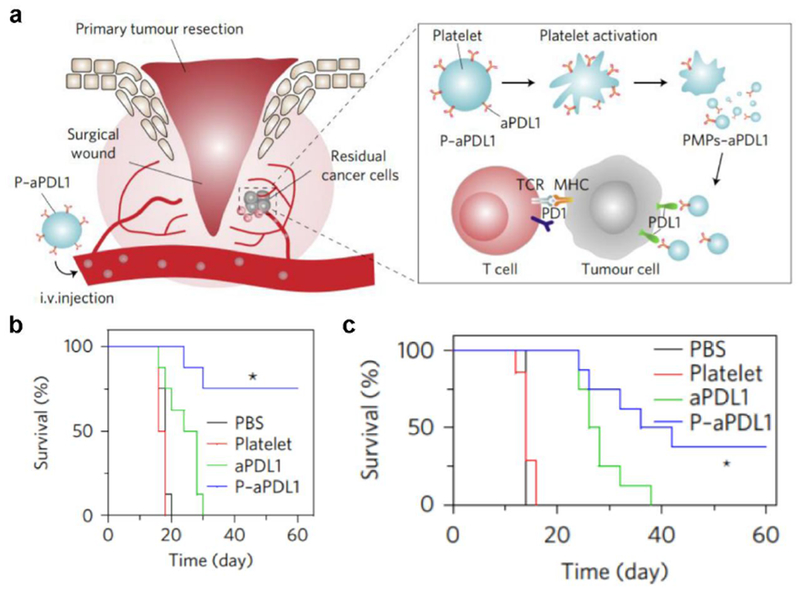
Engineered platelet microparticles for targeted checkpoint blockade therapy. a) Platelet-derived vesicles functionalized with anti-PD-L1 (aPDL1) can bind to surgical wounds after tumor resection, reducing tumor immunosuppression and enabling attack of tumor cells by T cells. b, c) When used to treat tumor-bearing mice, aPDL1-functionalized platelet vesicles significantly enhance survival in an incomplete surgery tumor model (b) and an incomplete resection and metastasis model (c). Reproduced with permission.[158] Copyright 2017, Springer Nature.
Figure 7.
Figure 7.
Plant virus-like particles (VLPs) for in situ anticancer vaccination. a) Nucleic acid-free VLPs are produced in plants. When delivered to tumors, the VLPs enhance neutrophil activity, which ultimately leads to tumor destruction by T lymphocytes. b, c) When used to vaccinate tumor-bearing mice, empty cowpea mosaic virus (eCPMV) particles can significantly prolong survival in a 4T1-luciferase metastatic breast cancer model (b) and an ID8-Def20/Vegf-A ovarian cancer model (c). Reproduced with permission.[164, 165] Copyright 2016, Springer Nature.
Figure 8.
Figure 8.
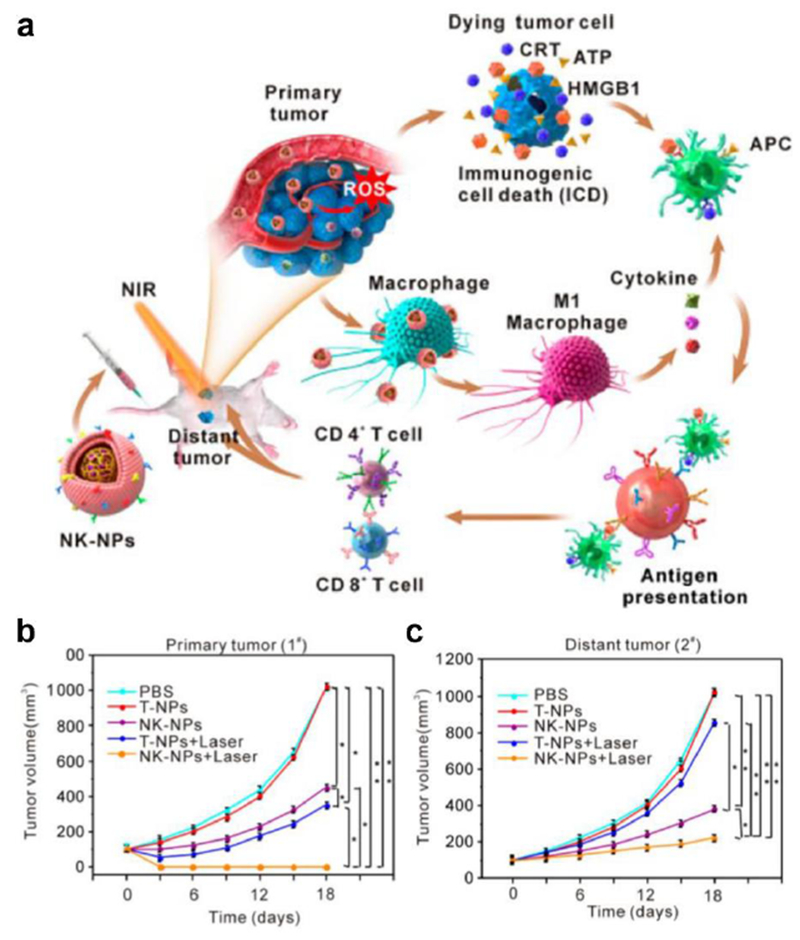
Natural killer cell membrane-coated nanoparticles (NK-NPs) for cancer therapy. a) Photosensitizer-loaded NK-NPs are administered in vivo and naturally accumulate at the tumor site. Photodynamic treatment of the tumor cells can cause immunogenic cell death and trigger the release of damage-associated molecular patterns (DAMPs) to recruit APCs for immune activation. b, c) Treatment using NK-NPs with irradiation leads to the eradication of primary tumors (b) and controls growth of distant tumors through the abscopal effect (c). Reproduced with permission.[179] Copyright 2018, American Chemistry Society.
Figure 9.
Figure 9.
Artificial APCs (aAPCs) for direct stimulation of T cells. a) The two signals required for immune cell activation are conjugated onto magnetic nanoclusters coated with azide-engineered leukocyte membrane. Once administered, the magnetic aAPCs enable manual guidance of CTLs to the tumor. b) Co-incubation of aAPCs with CD8+ T cells induces activation and proliferation. c) Treatment with aAPC-guided adoptively transferred CTLs significantly controls tumor growth. Reproduced with permission.[183] Copyright 2017, American Chemistry Society.
Figure 10.
Figure 10.
Cancer cell membrane-coated nanoparticles (CCNPs) for multiantigenic anticancer vaccination. a) Cancer cell membrane is coated onto polymeric nanoparticles loaded with the adjuvant CpG, and the resulting CpG-CCNP formulation can be used to stimulate multiantigenic antitumor immunity. b) Vaccination with CpG-CCNPs induces CTLs specific for the gp100 and TRP2 melanoma-associated antigens. c) Mice vaccinated with CpG-CCNPs are able to better reject B16F10 tumor challenge. Reproduced with permission.[210] Copyright 2017, Wiley-VCH.
Figure 11.
Figure 11.
Personalized biomimetic nanovaccines. For anticancer vaccination, antigenic material can be collected directly from a patient’s resected tumor, formulated into a biomimetic nanoparticle, and then administered back into the patient to promote tumor-specific immunity. For antibacterial vaccination, strain-specific virulence factors or membrane can be immobilized onto nanoparticle substrates, and the resulting complexes can be used to vaccinate patients with an identified risk against the associated pathogen.

References

    1. Kenyon C, Cell 2005, 120, 449. - PubMed
    1. Lovly CM, Carbone DP, Nat. Rev. Clin. Oncol. 2011, 8, 68. - PubMed
    1. Sorlie T, Perou CM, Tibshirani R, Aas T, Geisler S, Johnsen H, Hastie T, Eisen MB, van de Rijn M, Jeffrey SS, Thorsen T, Quist H, Matese JC, Brown PO, Botstein D, Lonning PE, Borresen-Dale AL, Proc. Natl. Acad. Sci. USA 2001, 98, 10869. - PMC - PubMed
    1. Vargo-Gogola T, Rosen JM, Nat. Rev. Cancer 2007, 7, 659. - PubMed
    1. Nishino M, Ramaiya NH, Hatabu H, Hodi FS, Nat. Rev. Clin. Oncol. 2017, 14, 655. - PMC - PubMed

MeSH terms