


1,2-(Bis)trifluoromethylation of Alkynes: A One-Step Reaction to Install an Underutilized Functional Group
- PMID: 31206968
- PMCID: PMC7065645
- DOI: 10.1002/anie.201905247
1,2-(Bis)trifluoromethylation of Alkynes: A One-Step Reaction to Install an Underutilized Functional Group
Abstract
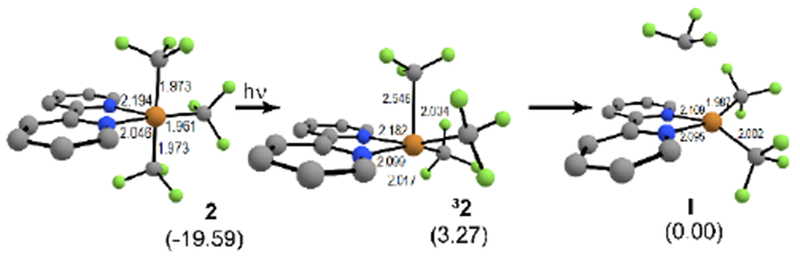
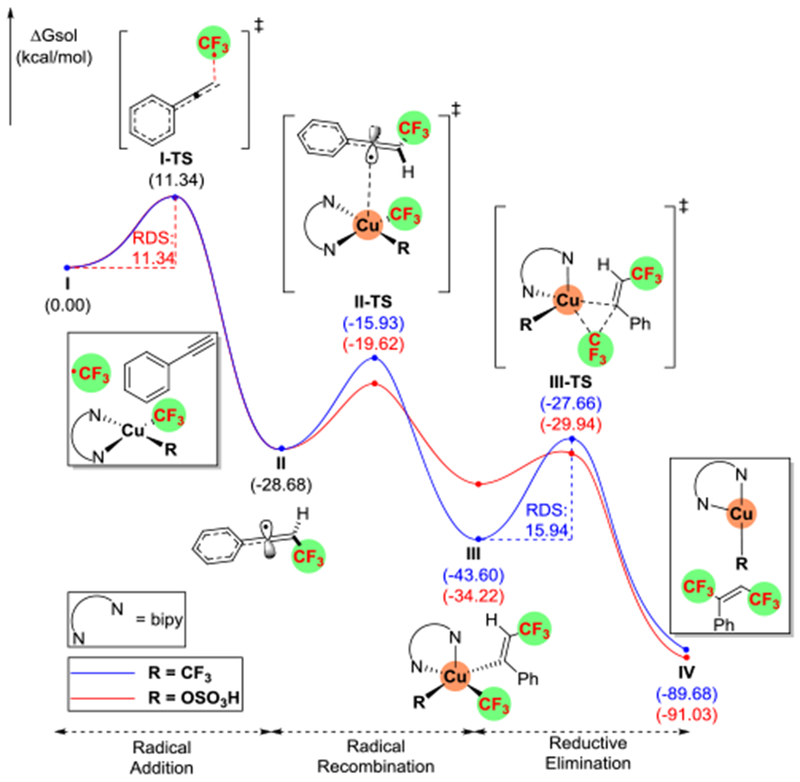
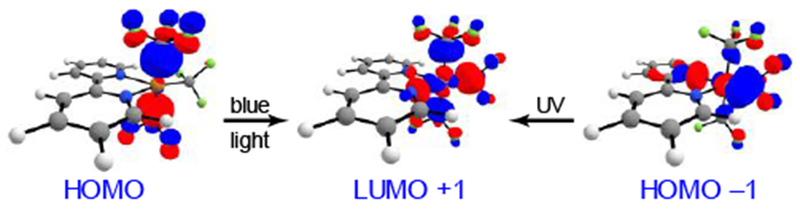
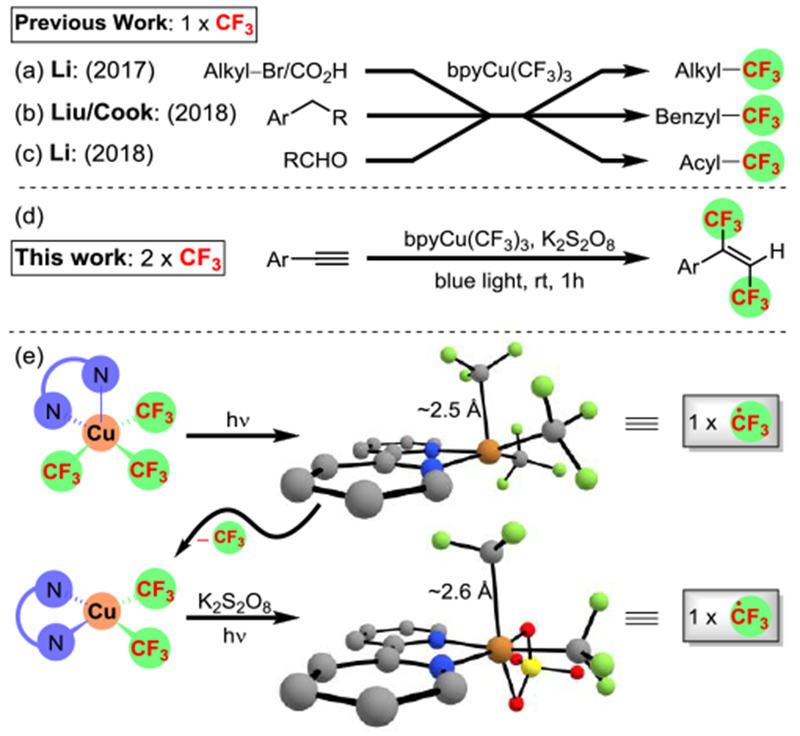
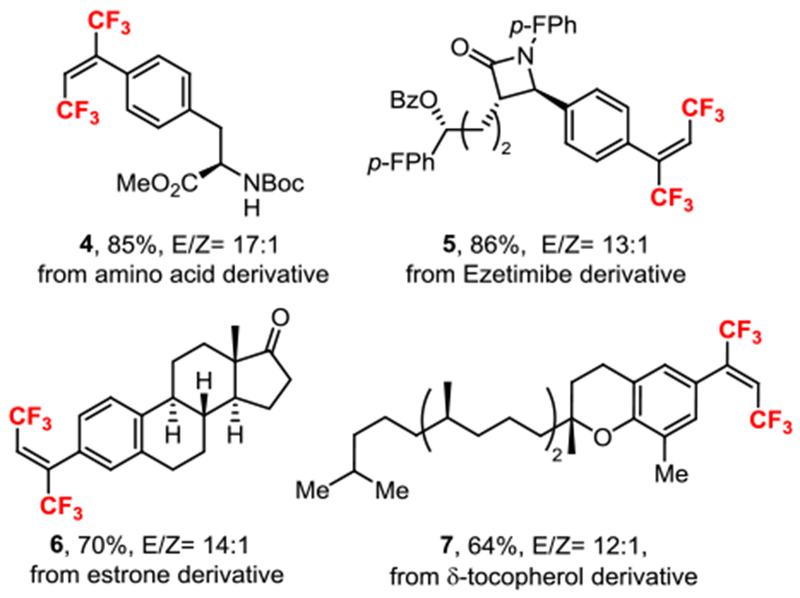
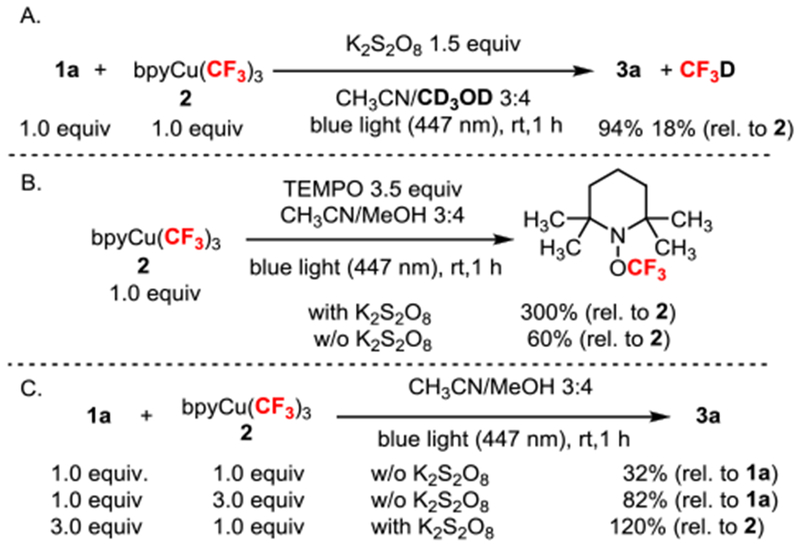
Modifying the electronic properties of olefins is the quintessential approach to tuning alkene reactivity. In this context, the exploration of trifluoromethyl groups as divergent electronic modifiers has not been considered. In this work, we describe a copper-mediated 1,2-(bis)trifluoromethylation of acetylenes to create E-hexafluorobutenes (E-HFBs) under blue light in a single step. The reaction proceeds with high yield and E/Z selectivity. Since the alkyne captures two trifluoromethyl groups from each molecule of bpyCu(CF3 )3 , mechanistic studies were conducted to illuminate the role of the reactants. Interestingly, E-HFBs exhibit remarkable stability to standard olefin functionalization reactions in spite of the pendant trifluoromethyl groups. This finding has significant implications for medicine, agroscience, and materials.
Keywords: alkynes; copper; difunctionalization; persulfate; trifluoromethylation.
© 2019 Wiley-VCH Verlag GmbH & Co. KGaA, Weinheim.
Conflict of interest statement
Conflicts of Interest
The authors declair no conflicts of interest.
Figures
References
-
- Muller K, Faeh C, Diederich F, Science 2007, 317, 1881–1886; - PubMed
- Hagmann WK, J. Med. Chem. 2008, 51, 4359–4369; - PubMed
- Ilardi EA, Vitaku E, Njardarson JT, J. Med. Chem. 2013, 57, 2832–2842; - PubMed
- Fujiwara T, O’Hagan D, J. Fluor. Chem. 2014, 167, 16–29;
- Gillis EP, Eastman KJ, Hill MD, Donnelly DJ, Meanwell NA, J. Med. Chem. 2015, 58, 8315–8359; - PubMed
- Zhou Y, Wang J, Gu Z, Wang S, Zhu W, Aceña JL, Soloshonok VA, Izawa K, Liu H, Chem. Rev. 2016, 116, 422–518; - PubMed
- Meanwell NA, J. Med. Chem. 2018, 61, 5822–5880. - PubMed
-
- Shimizu M, Hiyama T, Angew. Chem., Int. Ed. 2005, 44, 214–231; - PubMed
- Rivkin A, Chou T-C, Danishefsky SJ, Angew. Chem., Int. Ed. 2005, 44, 2838–2850; - PubMed
- Lu H, Silverman RB, J. Med. Chem. 2006, 49, 7404–7412; - PMC - PubMed
- Shimizu M, Takeda Y, Higashi M, Hiyama T, Angew. Chem., Int. Ed. 2009, 48, 3653–3656; - PubMed
- Innocenti P, Cheung K-MJ, Solanki S, Mas-Droux C, Rowan F, Yeoh S, Boxall K, Westlake M, Pickard L, Hardy T, Baxter JE, Aherne GW, Bayliss R, Fry AM, Hoelder S, J. Med. Chem 2012, 55, 3228–3241; - PMC - PubMed
- Ma J-J, Yi W-B, Lu G-P, Cai C, Adv. Synth. Catal. 2015, 357, 3447–3452.
-
- Chambers RD, Jones CGP, Silvester MJ, J. Fluor. Chem. 1986, 32, 309–317;
- MacNeil KJ, Burton DJ, J. Org. Chem. 1993, 58, 4411–4417;
- Yamamoto M, Burton DJ, Swenson DC, J. Fluor. Chem. 1995, 72, 49–54;
- Jia X, Zhou X, Quan H, Tamura M, Sekiya A, J. Fluor. Chem. 2011, 132, 1188–1193;
- Zhao B, Li Y, Tu D-H, Zhang W, Liu Z-T, Lu J, Tetrahedron Lett. 2016, 57, 4345–4347;
- Yamamoto M, Swenson DC, Burton DJ, J. Fluor. Chem. 2016, 185, 213–223.
-
- Duan J, Dolbier WR, Chen Q-Y, J. Org. Chem. 1998, 63, 9486–9489.
Publication types
MeSH terms
Substances
Grants and funding
LinkOut - more resources
Full Text Sources
Miscellaneous
