


Influence of Genetic and Non-Genetic Risk Factors for Serum Uric Acid Levels and Hyperuricemia in Mexicans
- PMID: 31207883
- PMCID: PMC6627998
- DOI: 10.3390/nu11061336
Influence of Genetic and Non-Genetic Risk Factors for Serum Uric Acid Levels and Hyperuricemia in Mexicans
Abstract
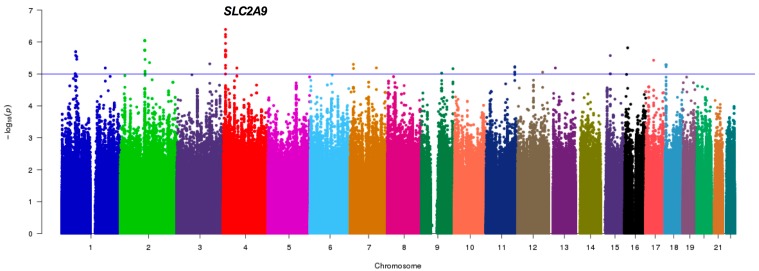
Risk of hyperuricemia is modified by genetic and environmental factors. Our aim was to identify factors associated with serum uric acid levels and hyperuricemia in Mexicans. A pilot Genome-wide association study GWAS was performed in a subgroup of participants (n = 411) from the Health Workers Cohort Study (HWCS). Single nucleotide polymorphisms (SNPs) associated with serum uric acid levels were validated in all the HWCS participants (n = 1939) and replicated in independent children (n = 1080) and adult (n = 1073) case-control studies. The meta-analysis of the whole HWCS and replication samples identified three SLC2A9 SNPs: rs1014290 (p = 2.3 × 10-64), rs3775948 (p = 8.2 × 10-64) and rs11722228 (p = 1.1 × 10⁻¹⁷); and an ABCG2 missense SNP, rs2231142 (p = 1.0 × 10⁻¹⁸). Among the non-genetic factors identified, the visceral adiposity index, smoking, the metabolic syndrome and its components (waist circumference, blood pressure, glucose and hyperlipidemia) were associated with increased serum uric acid levels and hyperuricemia (p < 0.05). Among the female HWCS participants, the odds ratio for hyperuricemia was 1.24 (95% CI, 1.01-1.53) per unit increase in soft drink consumption. As reported in other studies, our findings indicate that diet, adiposity and genetic variation contribute to the elevated prevalence of hyperuricemia in Mexico.
Keywords: ABCG2 gene; Genome-Wide Association Studies; Hyperuricemia; Mexican population; SLC2A9 gene; Uric Acid; polymorphisms single nucleotide.
Conflict of interest statement
The authors declare that they have no conflicts of interest.
Figures
References
MeSH terms
Substances
Grants and funding
LinkOut - more resources
Full Text Sources
Research Materials
