. 2019 Jun 14;20(12):2912.
doi: 10.3390/ijms20122912.

Cell-Free, Embryo-Specific sncRNA as a Molecular Biological Bridge between Patient Fertility and IVF Efficiency

Affiliations

Cell-Free, Embryo-Specific sncRNA as a Molecular Biological Bridge between Patient Fertility and IVF Efficiency

Angelika V Timofeeva et al. Int J Mol Sci. .

Abstract

Small noncoding RNAs (sncRNAs) are key regulators of the majority of human reproduction events. Understanding their function in the context of gametogenesis and embryogenesis will allow insight into the possible causes of in vitro fertilization (IVF) implantation failure. The aim of this study was to analyze the sncRNA expression profile of the spent culture media on day 4 after fertilization and to reveal a relationship with the morphofunctional characteristics of gametes and resultant embryos, in particular, with the embryo development and implantation potential. Thereto, cell-free, embryo-specific sncRNAs were identified by next generation sequencing (NGS) and quantified by reverse transcription coupled with polymerase chain reaction (RT-PCR) in real-time. Significant differences in the expression level of let-7b-5p, let-7i-5p, piR020401, piR16735, piR19675, piR20326, and piR17716 were revealed between embryo groups of various morphological gradings. Statistically significant correlations were found between the expression profiles of piR16735 and piR020401 with the oocyte-cumulus complex number, let-7b-5p and piR020401 with metaphase II oocyte and two pronuclei embryo numbers, let-7i-5p and piR20497 with the spermatozoid count per milliliter of ejaculate, piR19675 with the percentage of linearly motile spermatozoids, let-7b-5p with the embryo development grade, and let-7i-5p with embryo implantation. According to partial least squares discriminant analysis (PLS-DA), the expression levels of let-7i-5p (Variable Importance in Projection score (VIP) = 1.6262), piR020401 (VIP = 1.45281), and piR20497 (VIP = 1.42765) have the strongest influences on the implantation outcome.

Keywords: NGS; RT-PCR; embryo culture medium; miRNA; piRNA.


Conflict of interest statement

The authors declare no conflict of interest.

Figures
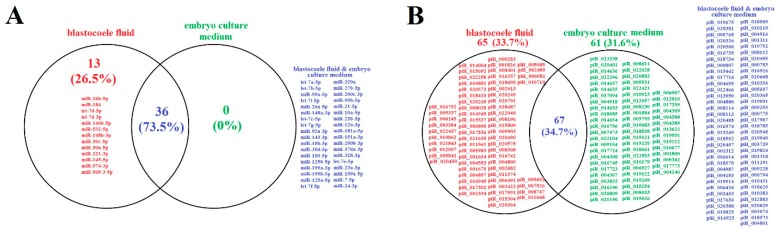
Figure 1
Figure 1
Venn diagrams for microRNA (miRNA) expression pattern (A) and piwi-interacting RNA (piRNA) expression pattern (B). The sncRNAs (miRNA and piRNA) unique to the blastocoele fluid are written in red; sncRNAs written in green are unique to the blastocyst spent culture medium by the fifth day after fertilization; sncRNAs are written in blue provided that they are detected both in the blastocoele fluid and in the blastocyst spent culture medium.
Figure 2
Figure 2
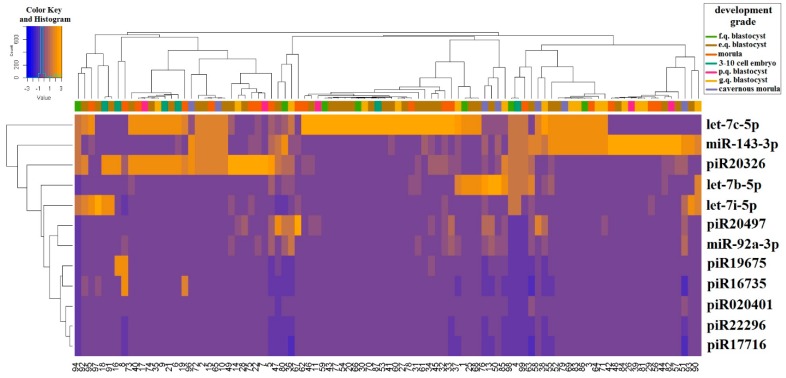
Two-dimensional hierarchical clustering of real-time RT-PCR data on sncRNAs from 87 embryo cultivation medium samples. E.q.—excellent quality, g.q.—good quality, f.q.—fair quality, p.q.—poor quality.
Figure 3
Figure 3
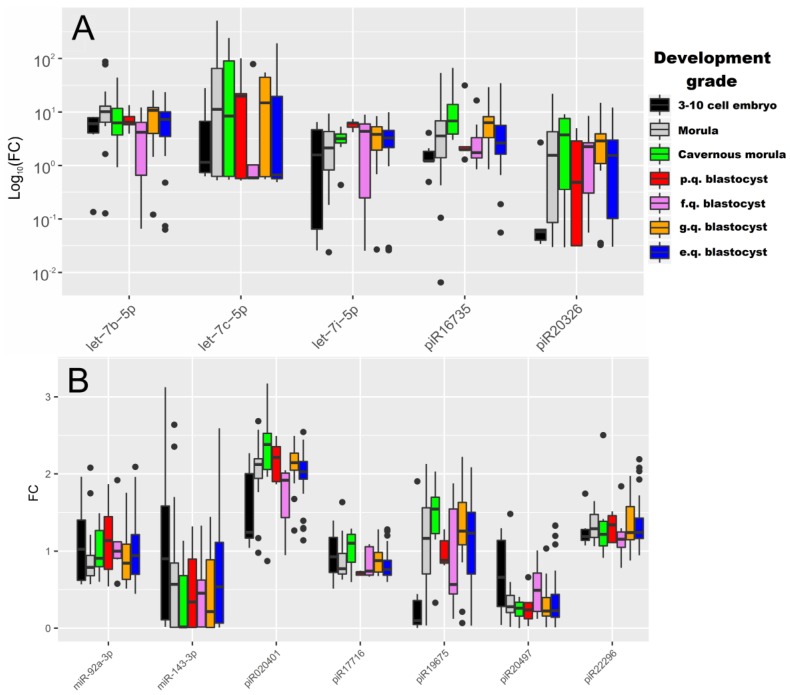
sncRNA expression level fold change in the culture medium of embryos of different development grade. (A) sncRNA expression level fold change (FC) with values varying from 0.01 to 400 (data are presented on a logarithmic scale). (B) sncRNA expression level FC with values varying from 0.1 to 3.5 (data are presented on a linear scale). E.q.—excellent quality, g.q.—good quality, f.q.—fair quality, p.q.—poor quality.
Figure 4
Figure 4
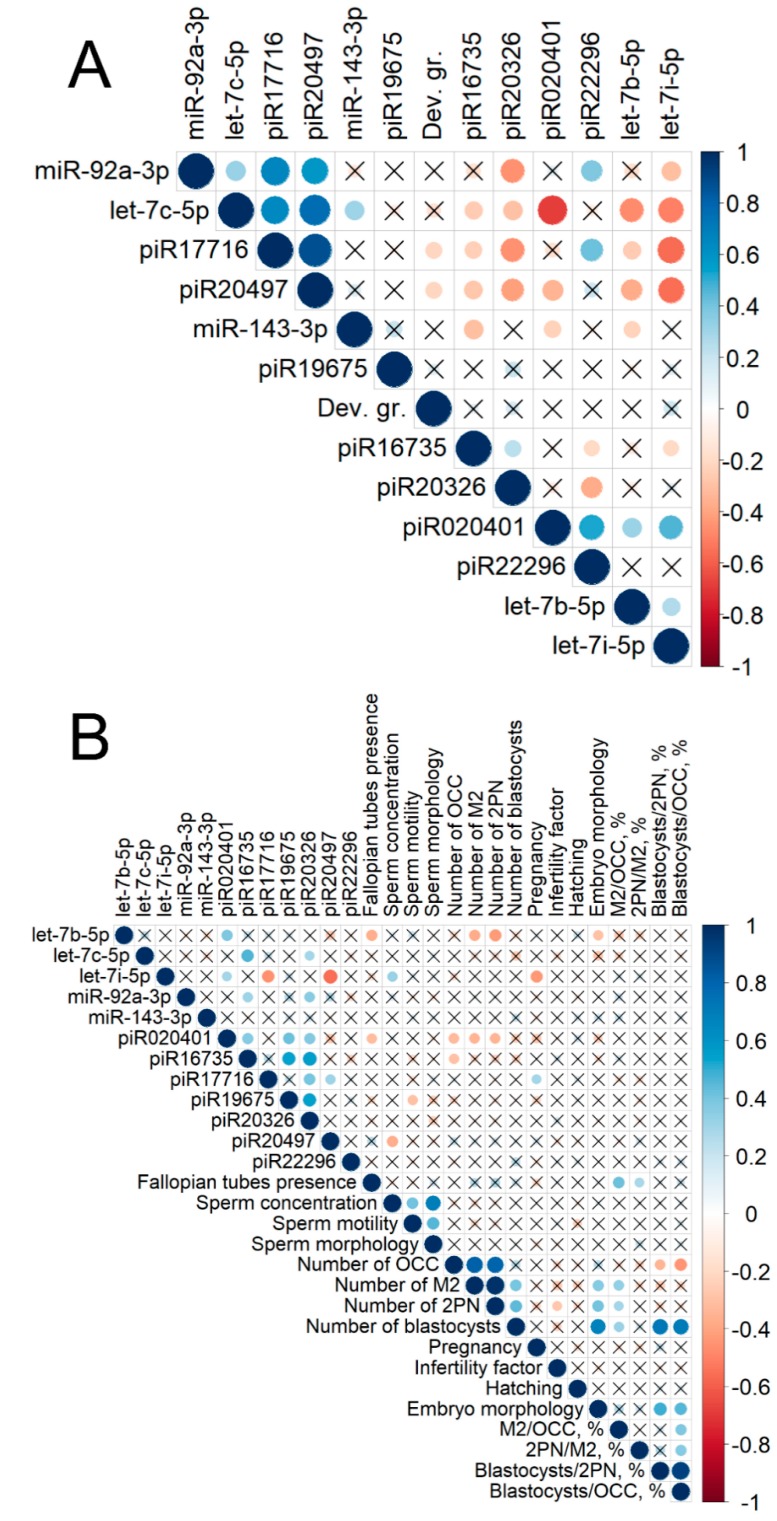
Correlation matrix based on the non-parametric Spearman rank correlation method. Significant (p < 0.05) correlations are indicated by a dot, non-significant correlations are indicated by a cross, positive correlations are marked in blue, and negative correlations in red—the more significant the correlation, the larger the dot size. (A) Correlation analysis of the sncRNA expression level in 87 embryo cultivation medium samples and the quality of embryos. (B) Correlation analysis of the sncRNA expression level in 48 cultivation medium samples of embryos transferred to the uterus and the following parameters: fallopian tube presence—the presence of fallopian tubes in the female of each couple; sperm concentration—spermatozoid count per milliliter of ejaculate from the male of each couple; sperm motility—percentage of linearly motile spermatozoids from the male of each couple; sperm morphology—percentage of morphologically normal spermatozoids from the male of each couple; number of OCC—the number of oocyte–cumulus complexes from the female of each couple; number of M2—metaphase II oocyte number from the female of each couple; number of 2PN—two pronuclei embryo numbers from each couple; number of blastocysts—blastocyst number of each couple; pregnancy—the development of pregnancy after embryo transfer into the uterus; infertility factor—primary or secondary infertility in the female of each couple; hatching—embryo hatching before transfer to the uterine cavity; dev. gr.—embryo development stage and quality according to the Gardner grading scale; embryo morphology—morphological parameters of embryos according to the Gardner grading scale; M2/OCC, %—metaphase II oocyte number as a percentage of OCC; 2PN/M2, %—number of two pronuclei embryos as a percentage of M2 oocyte; blastocysts/2PN, %—blastocyst number as a percentage of 2PN embryos; blastocysts/OCC, %—blastocyst number as a percentage of OCC.
Figure 5
Figure 5
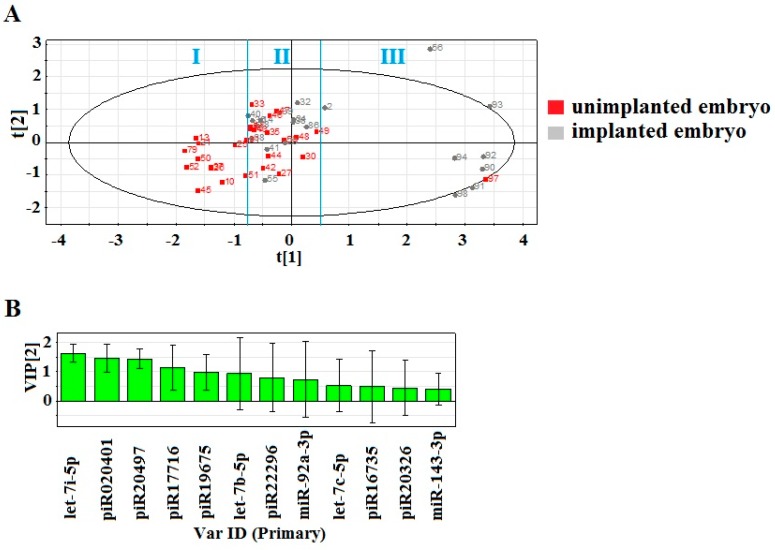
Partial least squares discriminant analysis (PLS-DA) of 2ΔΔCt RT-PCR data on the expression of sncRNAs in the 48-embryo culture medium samples. Arabic numerals denote the sample number. Roman numerals (I, II, III) denote the cluster of samples depending on the result of embryo transfer into the uterine cavity and the profile of RNA expression in the cultivation medium. (A) score plot with the imposition of information of the sncRNA expression level on the results of embryo transfer into the uterine cavity, (B) Variable Importance in Projection (VIP) score.
Figure 6
Figure 6
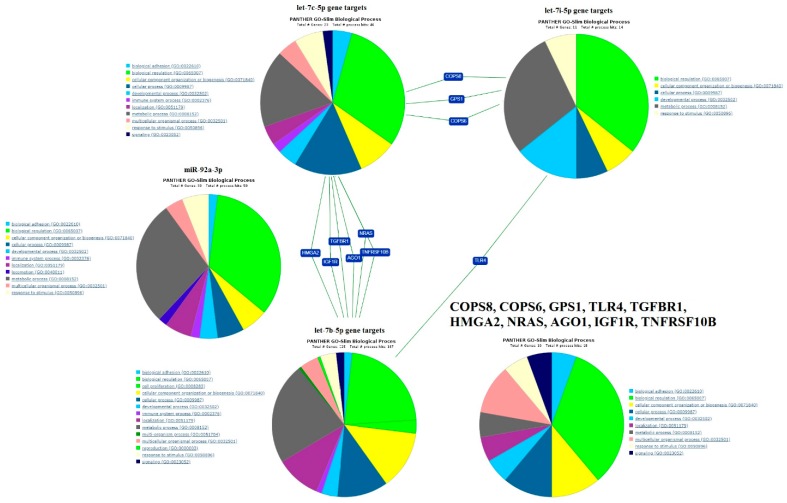
Functional classification of genes targeted by let-7b-5p, let-7c-5p, let-7i-5p, and miR-92a-3p from miRtargetlink and the PANTHER databases.

References

    1. Gardner D.K., Balaban B. Assessment of human embryo development using morphological criteria in an era of time-lapse, algorithms and ‘OMICS’: Is looking good still important? Mol. Hum. Reprod. 2016;22:704–718. doi: 10.1093/molehr/gaw057. - DOI - PubMed
    1. Gardner D.K., Schoolcraft W.B. Towards Reproductive Certainty: Infertility and Genetics Beyond 1999: The Plenary Proceedings of the 11th World Congress on In Vitro Fertilization and Human Reproductive Genetics. Parthenon Press; New York, NY, USA: 1999. In-vitro culture of human blastocysts; pp. 378–388.
    1. Gardner D.K., Lane M., Stevens J., Schoolcraft W.B. Noninvasive assessment of human embryo nutrient consumption as a measure of developmental potential. Fertil. Steril. 2001;76:1175–1180. doi: 10.1016/S0015-0282(01)02888-6. - DOI - PubMed
    1. Katz-Jaffe M.G., Linck D.W., Schoolcraft W.B., Gardner D.K. A proteomic analysis of mammalian preimplantation embryonic development. Reproduction. 2005;130:899–905. doi: 10.1530/rep.1.00854. - DOI - PubMed
    1. Poli M., Ori A., Child T., Jaroudi S., Spath K., Beck M., Wells D. Characterization and quantification of proteins secreted by single human embryos prior to implantation. EMBO Mol. Med. 2015;7:1465–1479. doi: 10.15252/emmm.201505344. - DOI - PMC - PubMed