


Trading Symmetry for Energy Cost During Walking in Healthy Adults and Persons Poststroke
- PMID: 31208276
- PMCID: PMC6688943
- DOI: 10.1177/1545968319855028
Trading Symmetry for Energy Cost During Walking in Healthy Adults and Persons Poststroke
Abstract
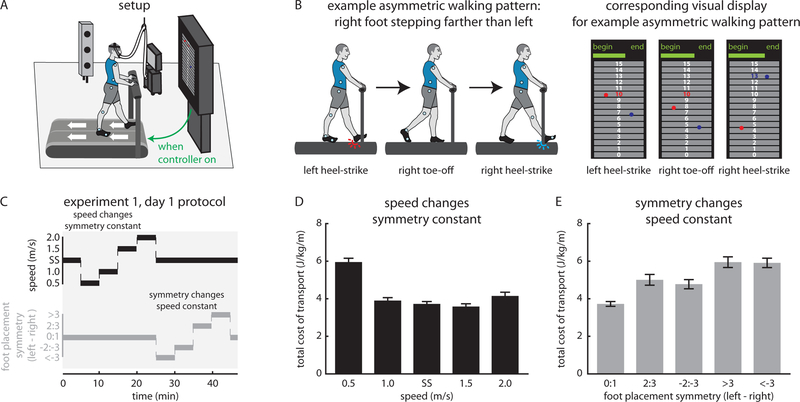
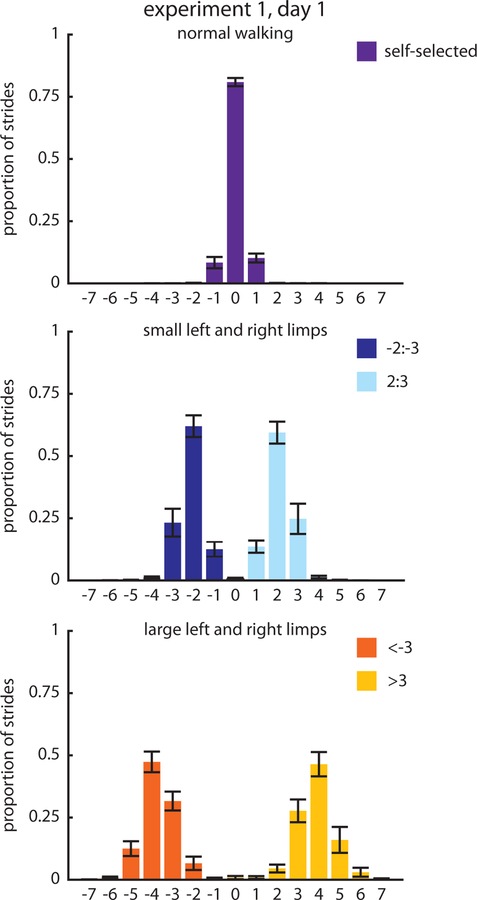
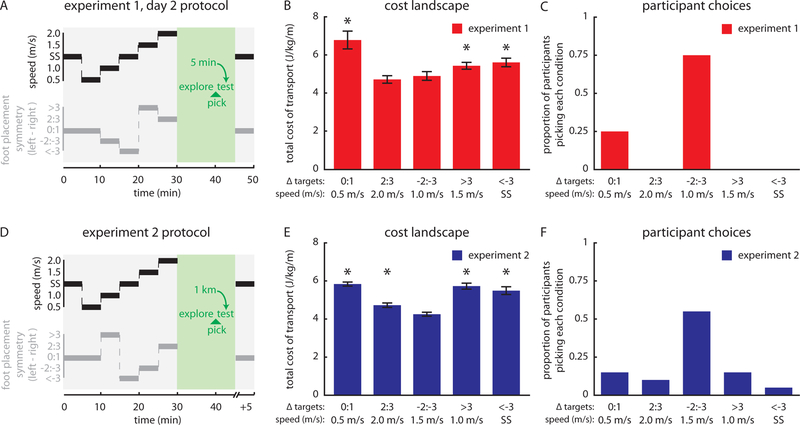
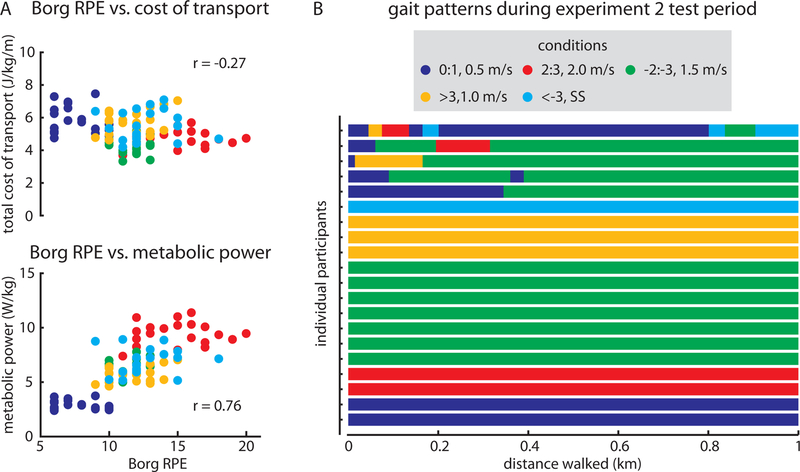
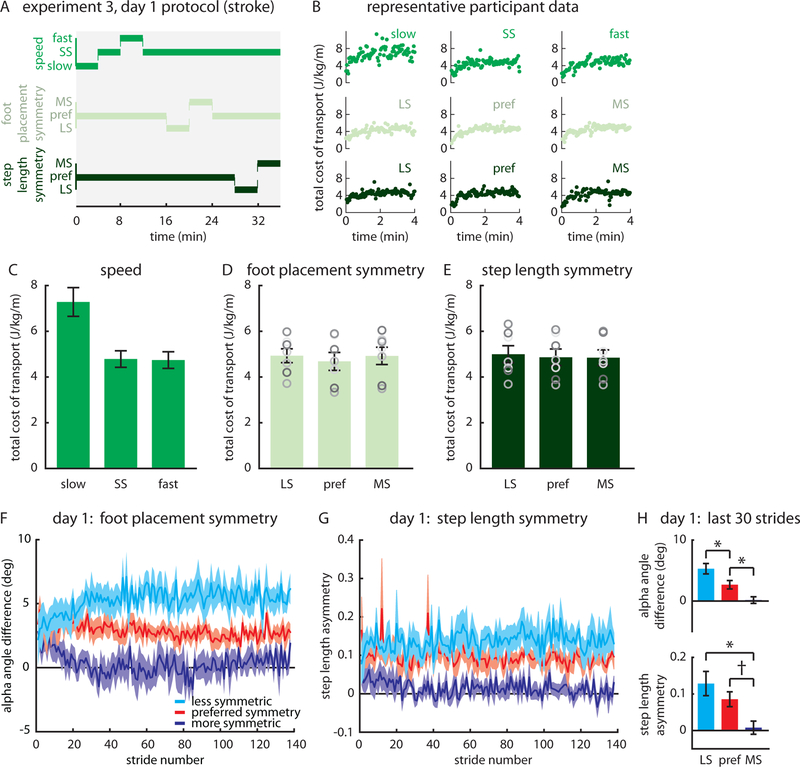
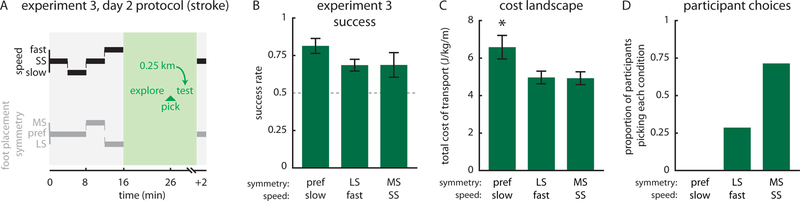
Background. Humans typically walk in ways that minimize energy cost. Recent work has found that healthy adults will even adopt new ways of walking when a new pattern costs less energy. This suggests potential for rehabilitation to drive changes in walking by altering the energy costs of walking patterns so that the desired pattern becomes energetically optimal (ie, costs least energy of all available patterns). Objective. We aimed to change gait symmetry in healthy adults and persons poststroke by creating environments where changing symmetry allowed the participants to save energy. Methods. Across 3 experiments, we tested healthy adults (n = 12 in experiment 1, n = 20 in experiment 2) and persons poststroke (n = 7 in experiment 3) in a novel treadmill environment that linked asymmetric stepping and gait speed-2 factors that influence energy cost-to create situations where walking with one's preferred gait symmetry (or asymmetry, in the case of the persons poststroke) was no longer the least energetically costly way to walk. Results. Across the 3 experiments, we found that most participants changed their gait when experiencing the new energy landscape. Healthy adults often adopted an asymmetric gait if it saved energy, and persons poststroke often began to step more symmetrically than they prefer to walk in daily life. Conclusions. We used a novel treadmill environment to show that people with and without stroke change clinically relevant features of walking to save energy. These findings suggest that rehabilitation approaches aimed at making symmetric walking energetically "easier" may promote gait symmetry after stroke.
Keywords: cost; feedback; gait; locomotion; rehabilitation; stroke.
Figures
References
-
- Cutting JE, Kozlowski LT. Recognizing friends by their walk: gait perception without familiarity clues. Bull Psychon Soc 1977;9(5):353–356.
-
- O’Neill MC. Gait-specific metabolic costs and preferred speeds in ring-tailed lemurs (Lemur catta), with implications for the scaling of locomotor costs. Am J Phys Anthropol 2012;149(3):356–64. - PubMed
-
- Langman VA et al. Moving cheaply: energetics of walking in the African elephant. J Exp Biol 1995;198(3):629–32. - PubMed
-
- Zani PA, Kram R. Low metabolic cost of locomotion in ornate box turtles, Terrapene ornata. J Exp Biol 2008;211(23):3671–6. - PubMed
Publication types
MeSH terms
Grants and funding
LinkOut - more resources
Full Text Sources
Medical
