


Risk factors for malnutrition among school-aged children: a cross-sectional study in rural Madagascar
- PMID: 31208397
- PMCID: PMC6580631
- DOI: 10.1186/s12889-019-7013-9
Risk factors for malnutrition among school-aged children: a cross-sectional study in rural Madagascar
Abstract
Background: For over 20 years, Madagascar has been challenged by continued high prevalence of stunting, underweight and wasting among children under 5 years of age. Yet, nutritional status of post-under-five age group has never been assessed in the country, despite its importance in relation not only to physical health but also to cognitive capacity and educational achievements of children. This study aims to estimate prevalence of malnutrition among schoolchildren aged 5-14 years in Madagascar. It further attempts to identify the possible risk factors for their malnutrition. This is the first study that estimates prevalence of malnutrition among school-aged children in Madagascar.
Methods: A cross-sectional household survey was conducted in Antananarivo-Avaradrano district, Analamanga region, Madagascar. The study targeted 393 first and second graders 5-14 years of age enrolled at 10 primary schools, where school-feeding was implemented. Data were collected from anthropometric measurements, their subsequent household structured interviews and observations. Bivariate (Chi-square test or Mann-Whitney's U test) and multivariable (logistic regression) analyses were performed, to identify the possible risk factors associated with malnutrition.
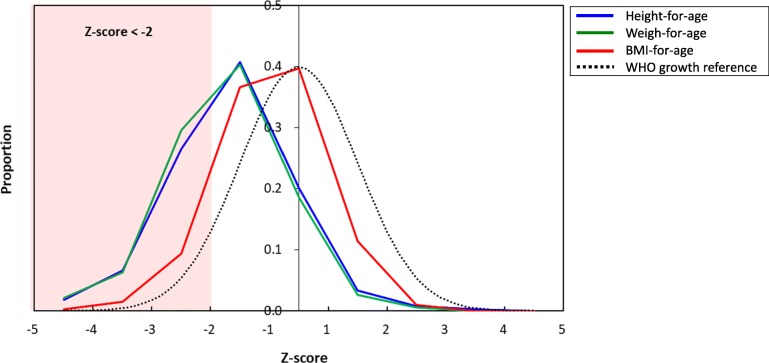
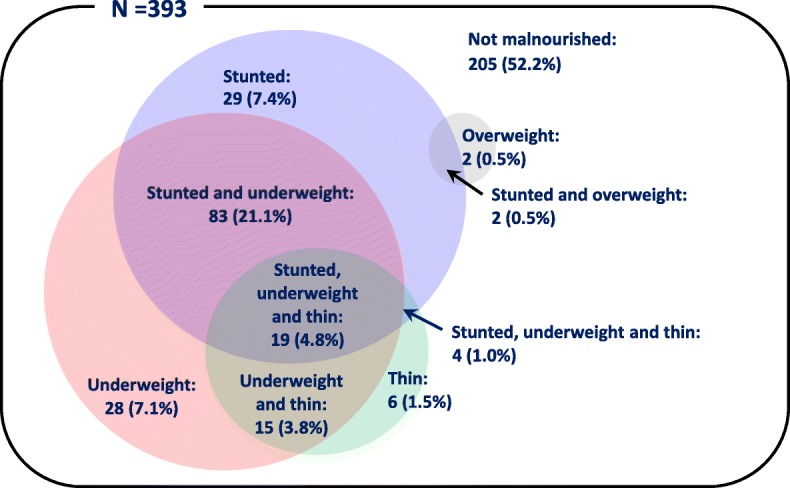
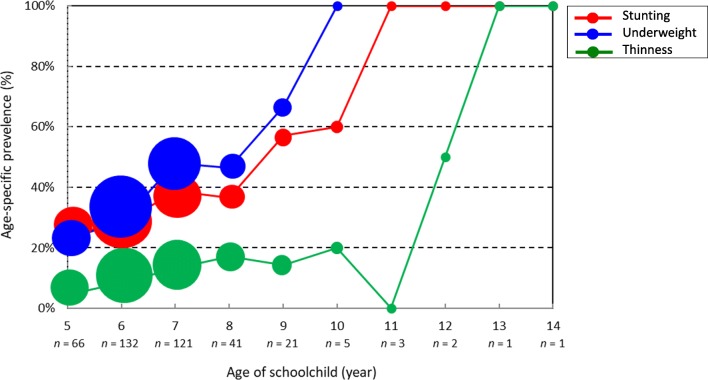
Results: The overall prevalence rates of stunting, underweight and thinness were 34.9%, 36.9% and 11.2%, respectively. Nineteen children (4.8%) suffered from all the three forms of undernutrition. Older schoolchildren had a significantly greater likelihood of being stunted, underweight and thin. The greater number of members a household had, the higher likelihood of being stunted and thin its schoolchild had. Children having lower Household Dietary Diversity Score were more likely to be underweight. Yet, 'Had lunch at school yesterday' was associated neither with being stunted nor with being underweight and thin. This implies room for improvement of the current school feeding program.
Conclusions: Prevalence rates of stunting and underweight among 393 children examined were as high as the national averages among children under 5 years of age. Adequate food availability and dietary diversity over a sufficient period (incl. 5-14 years of age) are necessary for increasing likelihood of catch-up in height-for-age and weight-for-age, which are expectable during adolescence. To supplement inadequate household dietary diversity practices, school-feeding program may need to use more animal-protein ingredients.
Keywords: Madagascar; Malnutrition; School feeding; School-aged children.
Conflict of interest statement
The authors declare that they have no competing interests.
Figures
References
-
- United Nations (UN) Sustainable development goal 2 - End hunger, achieve food security and improved nutrition, and promote sustainable agriculture. New York: UN; 2015.
-
- United Nations (UN) Millennium development goal 1 - Eradicate extreme poverty and hunger. New York: UN; 1990.
-
- Scaling up nutrition (SUN) SUN movement monitoring, evaluation, accountability, and learning. Geneva: SUN; 2017.
-
- World Bank . Human capital summit 2017 - Committing to Action to Drive Economic Growth. Washington DC: World Bank; 2017.
MeSH terms
LinkOut - more resources
Full Text Sources
Medical
