


Pilot Randomized Trial of a Self-Help Behavioral Activation Mobile App for Utilization in Primary Care
- PMID: 31208690
- PMCID: PMC6582985
- DOI: 10.1016/j.beth.2018.12.003
Pilot Randomized Trial of a Self-Help Behavioral Activation Mobile App for Utilization in Primary Care
Abstract
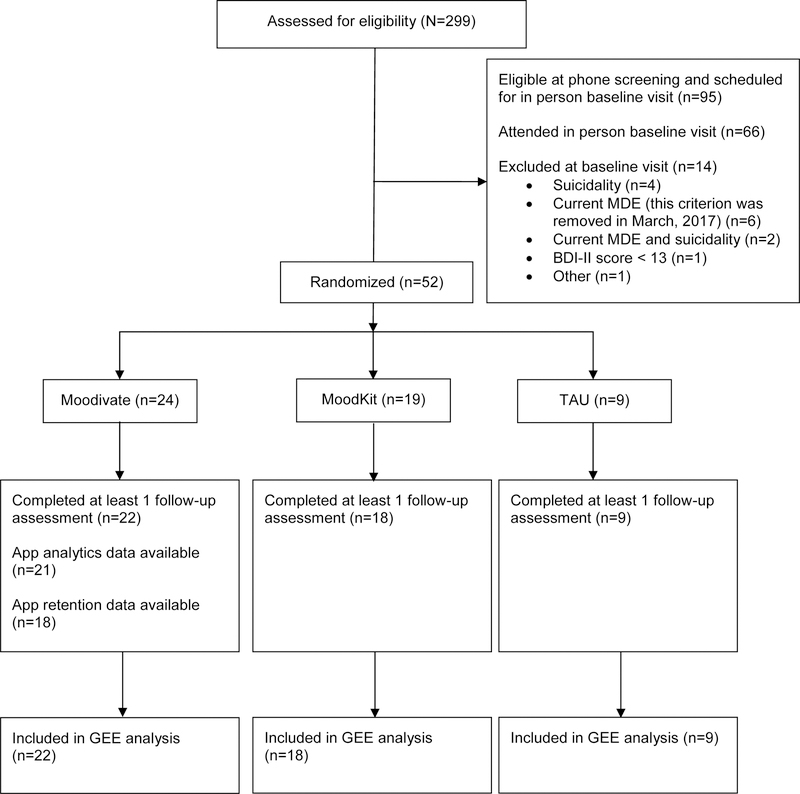
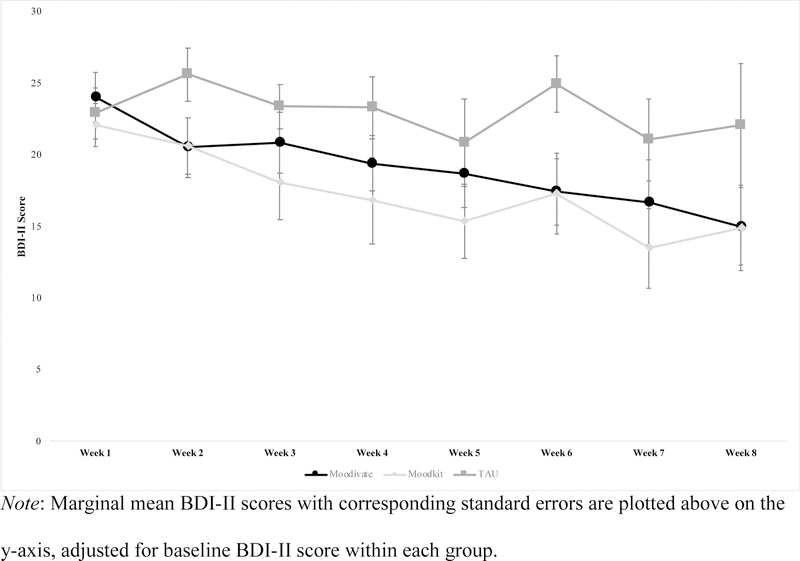
Mobile technologies can be leveraged to meet the need for evidence-based psychological depression treatment via primary care. The purpose of the present study was to preliminarily examine the feasibility and efficacy of a self-help brief behavioral activation mobile application (app; "Moodivate") for depressive symptoms among adults treated via primary care. Participants (N = 52) were recruited from primary care practices between January and December 2017 and were randomized 2:2:1 to receive (a) Moodivate, (b) an active control cognitive-behavioral therapy-based mobile app ("MoodKit"), or (c) treatment as usual (TAU; no app). Participants completed assessments of depressive symptoms weekly for 8 weeks. App analytics data were captured to examine Moodivate feasibility (analytics unavailable for control app). Moodivate participants on average had 46.76 (SD = 30.10) app sessions throughout the trial duration, spent 3.50 (2.76) minutes using the app per session, and spent 120.76 (101.02) minutes using the app in total throughout the trial. Nearly 70% of Moodivate participants continued to use the app 1 month after trial enrollment and 50% at the end of the 8-week follow-up period. A generalized estimating equation model examining change in depressive symptoms over time by treatment condition indicated a significant interaction between time and treatment condition (χ2 = 42.21, df = 14, p < .001). As compared to TAU, participants in both app conditions evidenced significant decreases in depressive symptoms over time, and these treatment gains were sustained across the trial period. These results preliminarily indicate feasibility of Moodivate as well as efficacy of both Moodivate and MoodKit for the treatment of depression among adults recruited via primary care. Future studies should focus on larger-scale examinations of treatment efficacy and effectiveness across primary care settings.
Keywords: depression; mobile health; primary care.
Copyright © 2019. Published by Elsevier Ltd.
Conflict of interest statement
The authors report no other actual or potential conflicts of interest that may bias the present work.
Figures
References
-
- Beck AT, Steer RA, & Brown GK (1996). Beck Depression Inventory-II (BDI-II) San Antonio, TX: Psychological Corporation.
Publication types
MeSH terms
Grants and funding
LinkOut - more resources
Full Text Sources
Medical
Research Materials
Miscellaneous
