


doi: 10.1016/j.trecan.2019.04.002.
Epub 2019 May 9.
Macropinocytosis in Cancer: A Complex Signaling Network
Affiliations
- PMID: 31208695
- PMCID: PMC7325493
- DOI: 10.1016/j.trecan.2019.04.002
Item in Clipboard
Macropinocytosis in Cancer: A Complex Signaling Network
Trends Cancer.
2019 Jun.
Abstract
Macropinocytosis is an important nutrient-scavenging pathway in numerous cancer types, including pancreatic, lung, prostate, and bladder. This Forum highlights recent work identifying the key regulators of macropinocytosis that support tumor cell fitness in different contexts, providing a unique framework for strategies to target macropinocytosis in the treatment of cancer.
Keywords: AMPK; PTEN; Ras; Wnt; integrin αvβ3; macropinocytosis; metabolism.
Copyright © 2019 Elsevier Inc. All rights reserved.
Figures
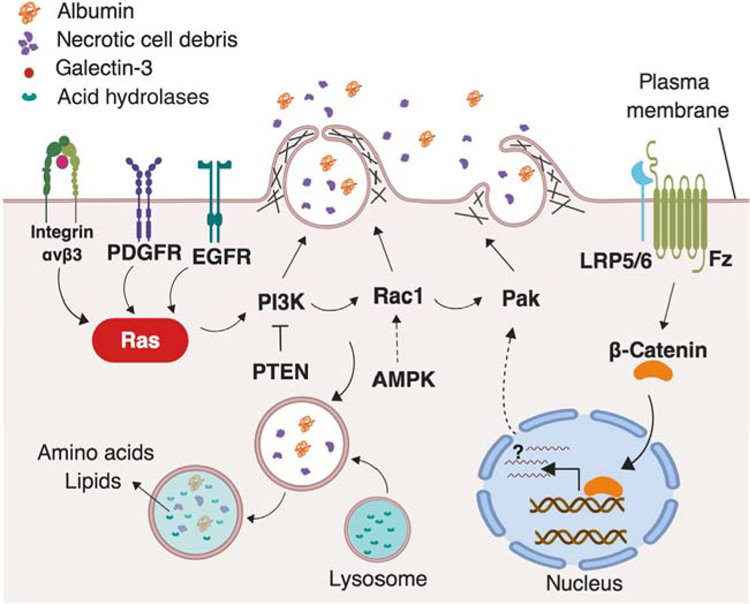
Context-specific key drivers of macropinocytosis have been identified in multiple cancer types. The activation of the Ras pathway, by oncogenic mutation, integrin nanoclustering, or receptor tyrosine kinases, including EGFR and PDGFR, activates downstream effectors such as PI3K, Rac1, and Pak, which are well-known modulators of macropinocytosis. PTEN loss and activation of AMPK can activate PI3K and Rac1 to trigger macropinocytosis in a KRas-independent manner. In addition, the activation of Frizzled (Fz) and LRP5/6 receptors activates the canonical Wnt pathway through inducing the accumulation and nuclear translocation of β-catenin, which in turn activates Pak in a transcription-dependent manner.
References
-
- Veithen A et al. (1996) v-Src induces constitutive macropinocytosis in rat fibroblasts. J. Cell Sci 109, 2005–2012 - PubMed
Publication types
MeSH terms
Substances
Grants and funding
LinkOut - more resources
Full Text Sources
Research Materials
