


A fully resolved backbone phylogeny reveals numerous dispersals and explosive diversifications throughout the history of Asteraceae
- PMID: 31209018
- PMCID: PMC6628808
- DOI: 10.1073/pnas.1903871116
A fully resolved backbone phylogeny reveals numerous dispersals and explosive diversifications throughout the history of Asteraceae
Abstract
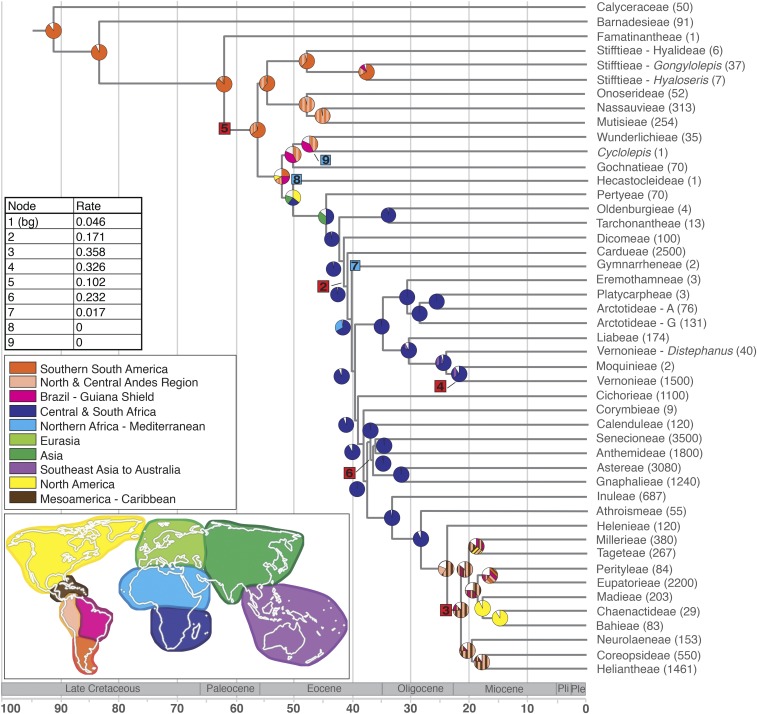
The sunflower family, Asteraceae, comprises 10% of all flowering plant species and displays an incredible diversity of form. Asteraceae are clearly monophyletic, yet resolving phylogenetic relationships within the family has proven difficult, hindering our ability to understand its origin and diversification. Recent molecular clock dating has suggested a Cretaceous origin, but the lack of deep sampling of many genes and representative taxa from across the family has impeded the resolution of migration routes and diversifications that led to its global distribution and tremendous diversity. Here we use genomic data from 256 terminals to estimate evolutionary relationships, timing of diversification(s), and biogeographic patterns. Our study places the origin of Asteraceae at ∼83 MYA in the late Cretaceous and reveals that the family underwent a series of explosive radiations during the Eocene which were accompanied by accelerations in diversification rates. The lineages that gave rise to nearly 95% of extant species originated and began diversifying during the middle Eocene, coincident with the ensuing marked cooling during this period. Phylogenetic and biogeographic analyses support a South American origin of the family with subsequent dispersals into North America and then to Asia and Africa, later followed by multiple worldwide dispersals in many directions. The rapid mid-Eocene diversification is aligned with the biogeographic range shift to Africa where many of the modern-day tribes appear to have originated. Our robust phylogeny provides a framework for future studies aimed at understanding the role of the macroevolutionary patterns and processes that generated the enormous species diversity of Asteraceae.
Keywords: Compositae; biogeography; molecular dating; phylogenomics.
Copyright © 2019 the Author(s). Published by PNAS.
Conflict of interest statement
The authors declare no conflict of interest.
Figures
References
-
- Lewis-Smith R. I., Richardson M., Fuegian plants in Antarctica: Natural or anthropogenically assisted immigrants? Biol. Invasions 13, 1–5 (2011).
-
- Carlquist S., Tribal interrelationships and phylogeny of the Asteraceae. Aliso 8, 465–492 (1976).
-
- Semple J. C., Watanabe K., “A review of chromosome numbers in Asteraceae with hypotheses on chromosomal base number evolution” in Systematics, Evolution, and Biogeography of Compositae, Funk V. A., Susanna A., Stussey T. F., Bayer R. J., Eds. (IAPT, Vienna, 2009), pp. 61–72.
-
- Barker M. S., et al. , Most Compositae (Asteraceae) are descendants of a paleohexaploid and all share a paleotetraploid ancestor with the Calyceraceae. Am. J. Bot. 103, 1203–1211 (2016). - PubMed
Publication types
MeSH terms
LinkOut - more resources
Full Text Sources
