. 2019 Aug;29(8):628-640.
doi: 10.1038/s41422-019-0192-1. Epub 2019 Jun 17.

Intragenic antagonistic roles of protein and circRNA in tumorigenesis

Affiliations

Intragenic antagonistic roles of protein and circRNA in tumorigenesis

Jlenia Guarnerio et al. Cell Res. 2019 Aug.

Erratum in

  • Author Correction: Intragenic antagonistic roles of protein and circRNA in tumorigenesis.
    Guarnerio J, Zhang Y, Cheloni G, Panella R, Katon JM, Simpson M, Matsumoto A, Papa A, Loretelli C, Petri A, Kauppinen S, Garbutt C, Nielsen GP, Deshpande V, Castillo-Martin M, Cordon-Cardo C, Spentzos D, Clohessy JG, Batish M, Pandolfi PP. Guarnerio J, et al. Cell Res. 2020 Feb;30(2):188. doi: 10.1038/s41422-019-0262-4. Cell Res. 2020. PMID: 31911670 Free PMC article.

Abstract

circRNAs arise from back splicing events during mRNA processing, and when deregulated can play an active role in cancer. Here we characterize a new circRNA (circPOK) encoded by the Zbtb7a gene (also kown as POKEMON, LRF) in the context of mesenchymal tumor progression. circPOK functions as a non-coding proto-oncogenic RNA independently and antithetically to its linear transcript counterpart, which acts as a tumor suppressor by encoding the Pokemon transcription factor. We find that circPOK regulates pro-proliferative and pro-angiogenic factors by co-activation of the ILF2/3 complex. Importantly, the expression of Pokemon protein and circRNA is aberrantly uncoupled in cancer through differential post-transcriptional regulation. Thus, we identify a novel type of genetic unit, the iRegulon, that yields biochemically distinct RNA products, circular and linear, with diverse and antithetical functions. Our findings further expand the cellular repertoire towards the control of normal biological outputs, while aberrant expression of such components may underlie disease pathogenesis including cancer.


Conflict of interest statement

The authors declare no competing interests.

Figures
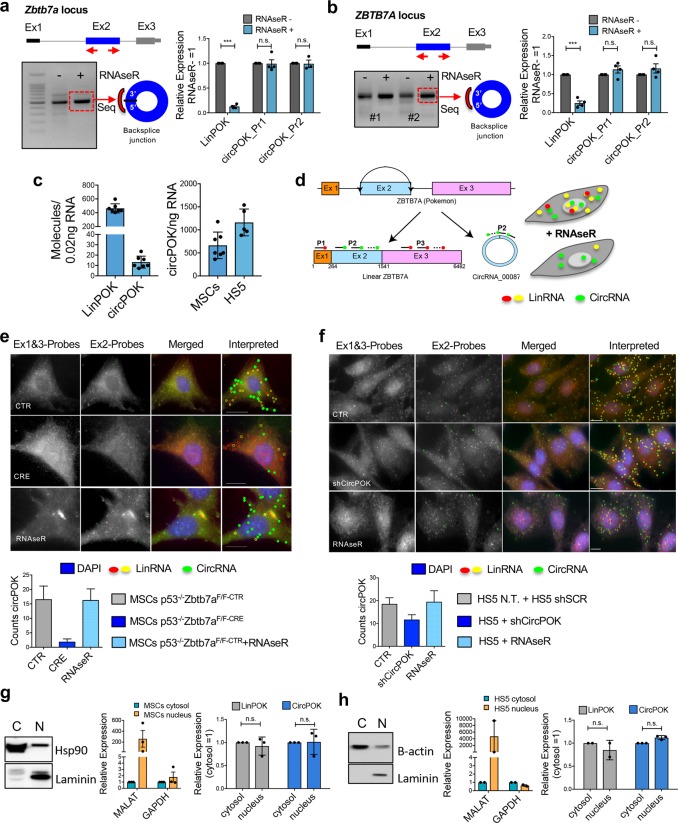
Fig. 1
Fig. 1
CircPOK is generated from the Zbtb7a genomic locus through back splicing of the Exon 2. a Analysis of the expression of mouse circPOK in primary p53−/− MSCs. circPOK was detected by PCR with divergent primers, and the amplicon was subjected to Sanger sequencing. RT-qPCR analysis of LinPOK and circPOK before and after treatment with RNase R is shown in the chart on the right. In the chart, circPOK_Pr1 and circPOK_Pr2 refer to independent divergent primer sets used to identify mouse circPOK (n ≥ 3 independent experiments). b Analysis of the expression of human circPOK in the HS5 mesenchymal cell line. circPOK was detected by PCR with divergent primers, and the amplicon was subjected to Sanger sequencing. RT-qPCR analysis of LinPOK and circPOK before and after treatment with RNase R is shown in the chart on the right. circPOK_Pr1 and circPOK_Pr2 refer to independent divergent primer sets used to identify human circPOK (n ≥ 3 independent experiments). c Absolute quantification of mouse LinPOK and circPOK in p53−/− MSCs is shown in the chart on the left (n = 7). Absolute quantification of mouse and human circPOK in p53−/− MSCs (mouse, n = 7) and HS5 cells (human, n = 5) is shown in the chart on the right. d Schematic representation of the circFISH assay. e circFISH analysis of mouse circPOK in primary p53−/−Zbtb7a_Ex2F/F MSCs, transduced with a CTR vector (upper panels), with a vector expressing CRE (panels in the middle), or CTR cells treated with the RNase R (bottom panels). The chart at the bottom represents the number of molecules of circPOK per cell in the three different conditions analyzed. (n = 100 cells accounted for each condition, and the mRNA copy numbers were obtained using average counts per cell with 95% confidence interval). f circFISH analysis of human circPOK in HS5 mesenchymal cell line, transduced with a CTR vector (shSCR, upper panels), with an shCircPOK (panels in the middle), or CTR cells treated with RNase R (bottom panels). The chart at the bottom represents the number of molecules of circPOK per cell in the three different conditions analyzed. (n = 100 cells accounted for each condition, and the mRNA copy numbers were obtained using average counts per cell with 95% confidence interval). g Nucleus/Cytosol fractionation experiments to identify LinPOK and circPOK in mouse p53−/− MSCs. Western blot (Hsp90 and Laminin) and RT-qPCR (Malat and Gapdh) to confirm the fractionation are shown on the left, while RT-qPCR analyses of the transcripts are shown with the charts on the right. h Nucleus/Cytosol fractionation experiments to identify LinPOK and circPOK in human HS5 cell line. Western blot (b-actin and Laminin) and RT-qPCR (Malat and Gapdh) to confirm the fractionation are shown on the left, while RT-qPCR analyses of the transcripts are shown with the charts on the right
Fig. 2
Fig. 2
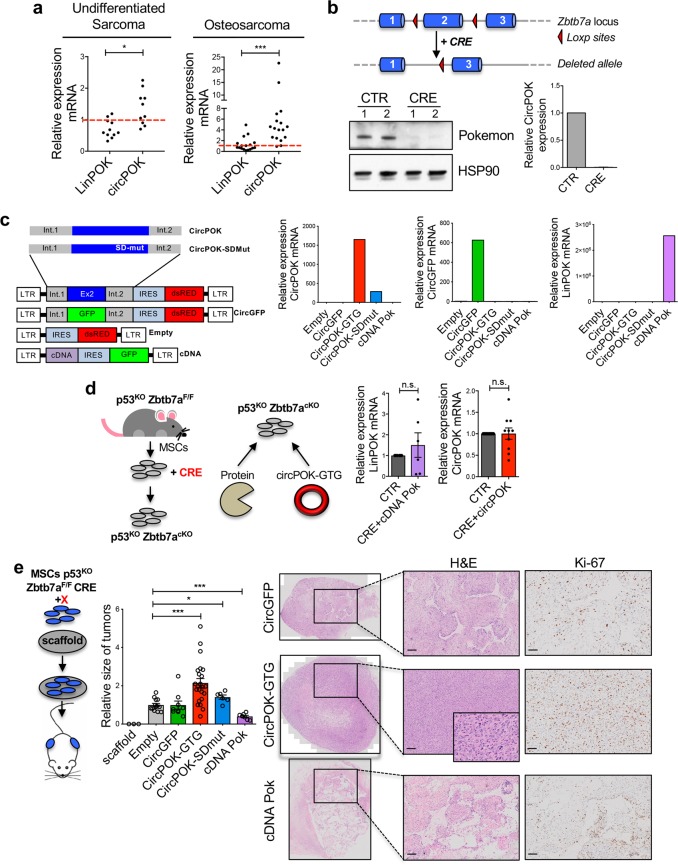
CircPOK and Pokemon protein play antithetical functions in mesenchymal tumors. a Expression of LinPOK and circPOK in human primary undifferentiated sarcoma samples (n = 10) compared to normal fibrous tissue (bar = 1, n = 6), and in human primary osteosarcoma (n = 17) compared to normal human osteoblasts (bar = 1, n = 1). b Schematic representation of the Zbtb7aF/F locus, and deletion of Pokemon protein and circPOK in the MSCs isolated from these mice, upon transduction with CRE-expressing vector. c Schematic representation of vectors used to express circPOK or cDNA-POK is shown on the left, along with the control vectors. Expression of circPOK-GFP, circGFP or LinPOK in all the conditions is shown in the charts on the right. d On the left, schematic representation of the strategy used to generate p53−/−Zbtb7a_Ex2F/F-CRE MSCs, which are null for the expression of both Pokemon-protein and circPOK, and to “add-back” specifically the protein or circPOK. The chart on the right show the expression of LinPOK or circPOK upon experiments of “adding-back” in null cells (CRE), compared to the endogenous expression of LinPOK and circPOK in wild-type MSCs (CTR). e Schematic representation of the in vivo tumorigenesis assays is depicted on the left; the chart in the middle represents the relative size of the tumors generated by p53−/−Zbtb7a_Ex2F/F-CRE MSCs expressing the following vectors: the empty vector, circGFP, cDNA POK-GFP, circPOK and circPOK-SDmut. Representative pictures of the tumor sections stained with H&E and Ki-67 are shown on the right
Fig. 3
Fig. 3
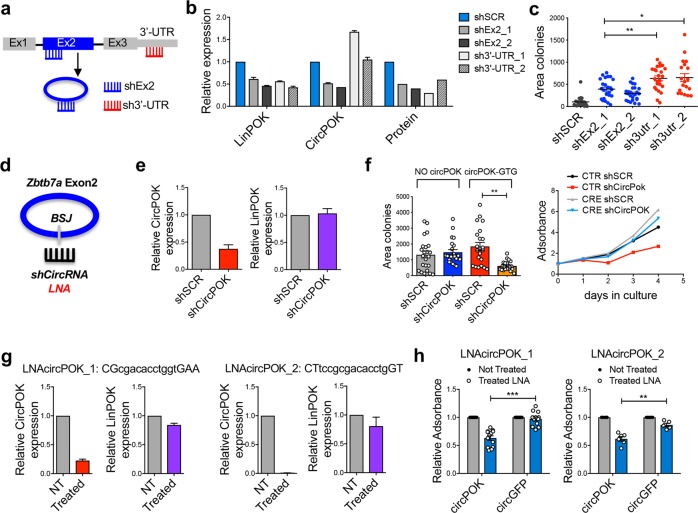
CircPOK plays proto-oncogenic functions in mesenchymal tumors. a Schematic representation of the experimental design used to selectively target circPOK or LinPOK. shRNAs targeting LinPOK transcript only are indicated as sh3′-UTR. ShRNAs targeting both linear and circular transcripts are indicated as shEx2. b Expression levels of LinPOK, circPOK or Pokemon protein upon the expression in p53−/− MSCs of the shRNAs targeting the 3’-UTR of the linear transcript (sh3′-UTR), or targeting Exon 2 (shEx2); two independent shRNAs for each conditions have been used. c Anchorage-independent proliferation, analyzed in soft-agar assays of p53−/−Zbtb7a_Ex2F/F-CTR MSCs transduced with shSCR, shEx2 or sh3′-UTR. One representative experiments out of 3 independent experiments. d Schematic overview of the strategy to block the expression of circPOK through shRNAs or LNAs directed at the back-splice junction of the circRNA. e Expression levels of circPOK and LinPOK upon knock-down of circPOK by shRNAs in mouse MSCs (shCircPOK). f Analysis of the proliferation of p53−/−Zbtb7a_Ex2F/F-CRE MSCs or p53−/−Zbtb7a_Ex2F/F-CTR MSCs, both silenced for the expression of circPOK is shown on the left. Measure of the anchorage-independent growth of p53−/−Zbtb7a_Ex2F/F-CRE MSCs expressing circGFP/circPOK or silenced for the expression of circPOK (shCircPOK) is shown on the right. g Expression levels of circPOK and LinPOK upon blocking of circPOK by 2 independent LNAs in mouse MSCs. LNAs’ sequence is shown. h Analysis of the proliferation of p53−/−Zbtb7a_Ex2F/F-CRE MSCs expressing either circGFP or circPOK and treated with LNAs targeting circPOK. Not treated cells were used as control. Each dot in the chart represents an independent experiment
Fig. 4
Fig. 4
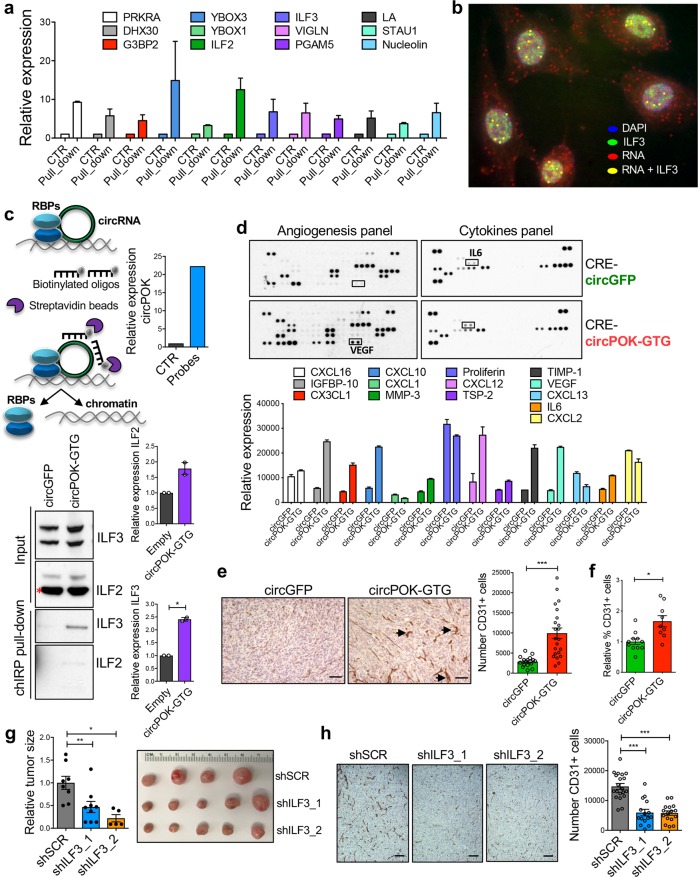
CircPOK interacts with ILF2/3, and it regulates the expression of several cytokines and angiogenesis-related factors. a Mass-spectrometry analysis of the RNA-binding proteins that interact with the Zbtb7a_Ex2, which was generated through assays of in vitro transcription. b Co-localization of Zbtb7a_Ex2 RNA and ILF3 visualized by coupling circFISH assay with ILF3 Immunofluorescence staining. RNase R untreated HS5 cells have been used in the experiments. c ChIRP experiments aimed at pulling down the endogenous circPOK and analyze its interactions with ILF2/3. The schematic representation of the ChIRP assay is shown in the upper left panel. The upper right chart shows the functionality of the assay, and the capacity to effectively isolate circPOK by using biotinylated probes (oligonucleotides). The lower part of the panel shows the interaction between circPOK, ILF2 and ILF3. Representative blots are shown in the lower left panel, while the quantification of two independent experiments is shown in the lower right panel. d Analysis of the “secretome” of p53−/−Zbtb7a_Ex2F/F-CRE MSCs expressing either circGFP or circPOK, assayed with ELISA arrays. Differentially expressed cytokines and soluble factors are shown in the chart at the bottom. e IHC detection of CD31+ endothelial cells within tumors expressing circGFP or circPOK. Representative pictures are shown on the left, while the quantification of CD31+ cells is shown in the chart on the right. Dots in the chart represent the independent sections analyzed. f Flow-cytometry analysis of CD31+ endothelial cells within tumors expressing circGFP or circPOK. Dots in the chart represent the independent tumors analyzed. g Knock-down of ILF3 in p53−/−Zbtb7a_Ex2F/F-CRE MSCs expressing circPOK, and measure of their in vivo sarcomagenesis. Two independent shRNAs were used to knock down ILF3. h IHC detection of CD31+ endothelial cells in tumors expressing circPOK, with or without ILF3 knock-down. Representative pictures are shown on the left, while the quantification of CD31+ cells is shown in the chart on the right. Dots in the chart represent the independent sections analyzed
Fig. 5
Fig. 5
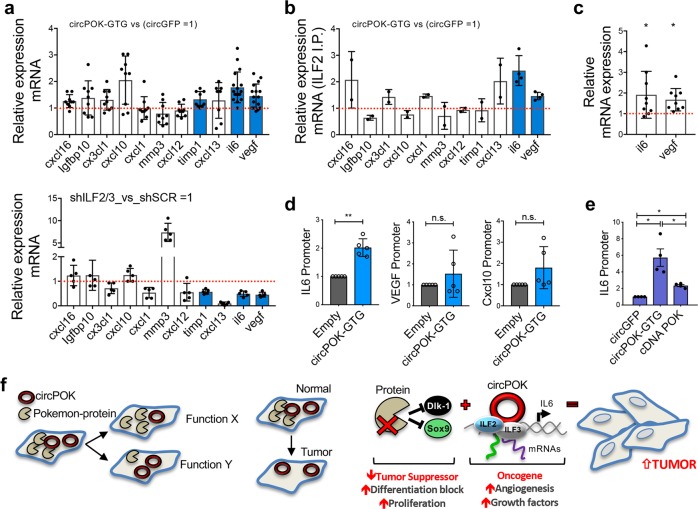
CircPOK is a co-activator of ILF2/3 in mesenchymal tumors. a Expression analysis of cytokines and angiogenic factors regulated by the expression of circPOK (compared to circGFP) (upper panel), and regulated by ILF2/3 (lower panel). Timp1, Il6 and Vegf were differentially expressed in the conditions analyzed, with statistical relevance. Dots show independent replicates of the experiment; blue bars identify cytokines that are significantly different than controls. b Relative expression of several mRNAs of cytokines and angiogenesis factors associated to ILF2 (pulled-down from MSCs expressing either circGFP or circPOK). Dots show independent replicates of the experiment; blue bars identify cytokines that are significantly different than controls. c Expression of Il6 and Vegf mRNA, measured upon treatment with Actinimyosin-D in cells expressing circGFP (control cells, represented as a bar = 1), or circPOK. Dots show independent replicates of the experiment. d ChIRP assays to measure the occupancy of the endogenous circPOK at the promoter regions of Il6, Vegf, and Cxcl10. Dots show independent replicates of the experiment. e ChIP assay to measure the binding of ILF2 at the promoter region of Il6 in cells expressing circGFP, circPOK-GFP or cDNA-POK. Dots show independent replicates of the experiment. f Schematic representation of the antithetical role of Pokemon protein and circPOK in normal conditions or within the process of tumorigenesis (on the left). Schematic representation of the functions played by Pokemon protein (tumor suppressor) and circPOK (proto-oncogene) in the process of mesenchymal tumorigenesis, with their relative mechanisms of action (on the right)

References

    1. Jeck WR, et al. Circular RNAs are abundant, conserved, and associated with ALU repeats. RNA. 2013;19:141–157. doi: 10.1261/rna.035667.112. - DOI - PMC - PubMed
    1. Zhang XO, et al. Complementary sequence-mediated exon circularization. Cell. 2014;159:134–147. doi: 10.1016/j.cell.2014.09.001. - DOI - PubMed
    1. Ashwal-Fluss R, et al. circRNA biogenesis competes with pre-mRNA splicing. Mol Cell. 2014;56:55–66. doi: 10.1016/j.molcel.2014.08.019. - DOI - PubMed
    1. Memczak S, et al. Circular RNAs are a large class of animal RNAs with regulatory potency. Nature. 2013;495:333–338. doi: 10.1038/nature11928. - DOI - PubMed
    1. Piwecka M, et al. Loss of a mammalian circular RNA locus causes miRNA deregulation and affects brain function. Science. 2017;357:eaam8526. doi: 10.1126/science.aam8526. - DOI - PubMed

Publication types

MeSH terms