. 2019 Oct;4(10):1627-1635.
doi: 10.1038/s41564-019-0480-z. Epub 2019 Jun 17.

Antibiotic combinations that exploit heteroresistance to multiple drugs effectively control infection

Affiliations

Antibiotic combinations that exploit heteroresistance to multiple drugs effectively control infection

Victor I Band et al. Nat Microbiol. 2019 Oct.

Abstract

Antibiotic-resistant bacteria are a significant threat to human health, with one estimate suggesting they will cause 10 million worldwide deaths per year by 2050, surpassing deaths due to cancer1. Because new antibiotic development can take a decade or longer, it is imperative to effectively use currently available drugs. Antibiotic combination therapy offers promise for treating highly resistant bacterial infections, but the factors governing the sporadic efficacy of such regimens have remained unclear. Dogma suggests that antibiotics ineffective as monotherapy can be effective in combination2. Here, using carbapenem-resistant Enterobacteriaceae (CRE) clinical isolates, we reveal the underlying basis for the majority of effective combinations to be heteroresistance. Heteroresistance is a poorly understood mechanism of resistance reported for different classes of antibiotics3-6 in which only a subset of cells are phenotypically resistant7. Within an isolate, the subpopulations resistant to different antibiotics were distinct, and over 88% of CRE isolates exhibited heteroresistance to multiple antibiotics ('multiple heteroresistance'). Combinations targeting multiple heteroresistance were efficacious, whereas those targeting homogenous resistance were ineffective. Two pan-resistant Klebsiella isolates were eradicated by combinations targeting multiple heteroresistance, highlighting a rational strategy to identify effective combinations that employs existing antibiotics and could be clinically implemented immediately.


Conflict of interest statement

Competing Interests

V.I.B., D.A.H., and D.S.W. are listed authors on a provisional patent that has been filed related to the work described here.

Figures
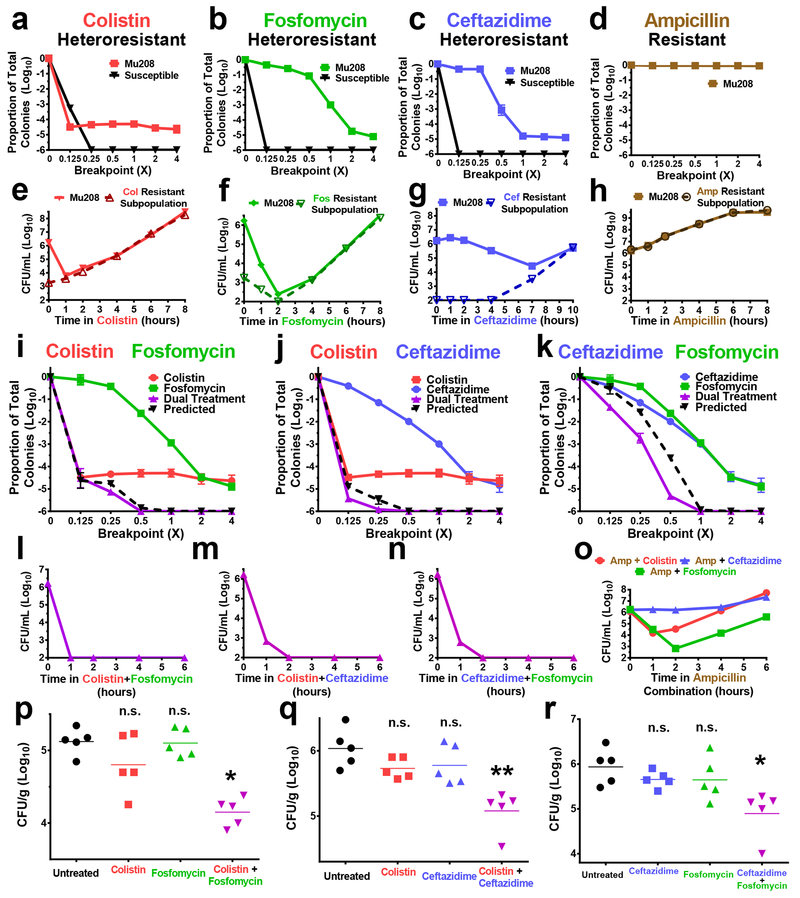
Figure 1.
Figure 1.. Enterobacter clinical isolate Mu208 is heteroresistant to multiple antibiotics but killed by their combinations.
a-d, Population analysis profiles (PAPs) of Mu208 and representative susceptible isolates plated on the indicated antibiotics at concentrations relative to their breakpoint. Resistance status of Mu208 to each antibiotic is indicated. Proportion of total colonies was calculated compared to growth on drug-free plates, e-h, Mu208 was treated with (e) colistin (16 μg/ml), (f) fosfomycin (256 μg/ml), (g) ceftazidime (128 μg/ml), or (h) ampicillin (128 μg/ml) at concentrations at or above their breakpoints to ensure killing of the antibiotic susceptible populations. Bacteria were plated at the indicated timepoints for enumeration of total (solid line) and resistant (dashed line) cells. i-k, PAPs of Mu208 plated on concentrations of the indicated single antibiotics or two-drug combinations (purple) relative to their breakpoints. The proportion of surviving colonies on single drug PAPs were multiplied to determine predicted additive killing (black dashed line), l-o, Mu208 was treated with (l) colistin+fosfomycin, (m) colistin+ceftazidime, (n) fosfomycin+ceftazidime, or (o) colistin, fosfomycin, or ceftazidime combinations with ampicillin (same concentrations of each drug as in e-h), and plated at the indicated timepoints to enumerate bacterial levels, p-r, Mice were infected with Mu208 intraperitoneally and treated with indicated drug combinations starting at 4 hours post infection. Peritoneal lavage was harvested at 24 hours post infection and CFU were quantified. Data shown as mean ± s.d. with n=3 (a-o) or as geometric mean with n=5 (p-r). n.s., not significant (p) p = 0.389, 0.802; (q) p = 0.087, 0.246; (r) p = 0.278, 0.286), * p < 0.05, ** p < 0.01, two-sided Mann-Whitney test.
Figure 2.
Figure 2.. Multiple heteroresistance is common in carbapenem-resistant Enterobacteriaceae (CRE).
a, One hundred and four CRE clinical isolates from a surveillance network in Georgia, USA were screened for heteroresistance to 16 antibiotics using the population analysis profile (PAP) method. Percentages of isolates heteroresistant to each antibiotic are listed, highest in red and lowest in green. Pip/Tazo; piperacillin/tazobactam, Trimeth/Sulfa; trimethoprim/sulfamethoxazole, b, Isolates classified by the number of antibiotics to which they are heteroresistant out of the 16 tested (none were heteroresistant to more than 7) with the percentage heteroresistant to more than one antibiotic indicated by central grey ring, c, Percentage of clinical susceptibility testing results (for 104 isolates and 16 antibiotics) classified as resistant (black) or susceptible (light grey). Those designated heteroresistant by PAP are indicated by central blue ring, d, Representation of all the PAPs of 104 isolates on 16 antibiotics, with lines indicating average bacterial survival at each concentration for all drug-isolate interactions, when segregated into 4 groupings: those classified as resistant by clinical testing and PAP (black circles, “Resistant (R)”), resistant by clinical testing and heteroresistant by PAP (black squares, “Heteroresistant (R)”), susceptible by clinical testing and heteroresistant by PAP (dark grey triangles, “Heteroresistant (S)”), and susceptible by clinical testing and PAP (light grey inverted triangles, “Susceptible (S)”). Data represented as mean ± SD. **** p < 1e-17 using two-tailed Welch’s t-test of average logs killing at 1x breakpoint concentration for Heteroresistant (R) vs. Heteroresistant (S) (t = 9.01).
Figure 3.
Figure 3.. Efficacy of antibiotic combinations is largely dependent on multiple heteroresistance.
a, Schematic of the antibiotic combination screen. Eight representative clinical isolates of CRE (4 K. pneumoniae, 3 E. cloacae, 1 E. coli) were treated with 16 antibiotics at the clinical breakpoint concentration alone, or in all 120 possible combinations. Amk, amikacin; Gen, gentamicin; Tob, tobramycin; Amp, ampicillin; Azt, aztreonam; Cfz, cefazolin; Cpm, cefepime; Cft, ceftazidime; Mer, meropenem; PTz, piperacillin/tazobactam; Cip, ciprofloxacin; Col, colistin; Fos, fosfomycin; Tet, tetracycline; Tig, tigecycline; SXT, trimethoprim/sulfamethoxazole, b, Graph of the number of antibiotic combination/isolate interactions resulting in the indicated number of logs of killing for the subset of cases in which an isolate was classified by clinical testing as resistant to both drugs (RxR)(n=313). c,e, Isolates classified as resistant by clinical testing, and designated by PAP as either resistant (RxR) or heteroresistant (HRxHR) to both drugs, categorized by the number of logs killing observed compared to antibiotic-free control (percentages are shown). In (e), only combinations including both an aminoglycoside and beta-lactam are shown. d,f, Antibiotic combinations designated as resistant by clinical testing, and either resistant (RxR; n=l 17) or heteroresistant (HRxHR; n=36) to both drugs by PAP, categorized by the number of logs of killing when compared to an antibiotic free control, expressed in number of total treatments. In (f), only combinations including both an aminoglycoside and beta-lactam are shown (RxR, n=22; HRxHR, n=10). **** p < 0.0001, two-sided Mann-Whitney U test of logs killing, binned in 1 log increments.
Figure 4.
Figure 4.. Eradication of pan-resistant Klebsiella by antibiotic combinations targeting multiple heteroresistance.
a, Antibiogram of Nevada-2016 as determined by clinical testing (left; using VITEK or E-test), as well as an updated representation of the antibiogram that includes heteroresistance as detected by PAP (right). aFosfomycin breakpoints are not established for Klebsiella isolates by CLSI, however we used the uropathogenic E. coli (UPEC) breakpoint (256μg/mL) for determining heteroresistance by PAP. b, PAPs of Nevada-2016 using fosfomycin (Fos; breakpoint 256 μg/mL), trimethoprim/sulfamethoxazole (SXT; breakpoint 4/76μg/mL), or their combination (“dual treatment”; purple). Predicted survival for an additive interaction (dashed black line) was determined by multiplying the survival after each single drug treatment, c, Nevada-2016 was treated with the indicated antibiotics at their breakpoint concentration and plated for enumeration of surviving bacteria at the indicated timepoints over a 48 hour period, d, Images and blanked optical densities (OD) of Nevada-2016 after 48 hour culture in the indicated single or combination antibiotic regimens (fosfomycin, Fos; trimethoprim/sulfamethoxazole, SXT). Media without bacteria (− Ctrl) and bacteria in media without antibiotics (+ Ctrl) are included as controls. Experiment was conducted twice with similar results, e-h, AR0040 was used in experiments mirroring those for Nevada-2016 (a-d). e, Antibiograms from clinical testing (left) and a modified version to indicate heteroresistance (right), f, PAPs of AR0040 using amikacin (Amk; breakpoint 64μg/mL), piperacillin/tazobactam (PTz; breakpoint 256/4 μg/mL), or their combination, g, h, AR0040 was treated as was Nevada-2016 in c and d, but with Amk, PTz, or Amk and PTz. i, Mice were infected intraperitoneally with AR0040 and then treated with PBS, amikacin (12.5 mg/kg), piperacillin/tazobactam (80/10 mg/kg), or their combination (dual treatment), every 12 hours beginning 30 minutes post infection. Survival was monitored for 150 hours. Data shown as mean ± s.d. with n=3 (b,c,f,g) or as survival with n=5 (i). ** p < 0.01, two-sided log-rank test.

References

    1. Review on Antimicrobial Resistance. Antimicrobial Resistance: Tackling a Crisis for the Health and Wealth of Nations, <https://amr-review.org/Publications.html> (2014).
    1. Micek ST et al. Empiric combination antibiotic therapy is associated with improved outcome against sepsis due to Gram-negative bacteria: a retrospective analysis. Antimicrob Agents Chemother 54, 1742–1748, doi: 10.1128/AAC.01365-09 (2010). - DOI - PMC - PubMed
    1. Alexander ΗE & Leidy G Mode of action of streptomycin on type B Hemophilis influenzae: Nature of resistant variants. JExp Med 85, 607–621 (1947). - PMC - PubMed
    1. Ott JL, Turner JR & Mahoney DF Lack of correlation between beta-lactamase production and susceptibility to cefamandole or cefoxitin among spontaneous mutants of Enterobacteriaceae. Antimicrob Agents Chemother 15, 14–19 (1979). - PMC - PubMed
    1. Sogaard P & Gahrn-Hansen B Population analysis of susceptibility to ciprofloxacin and nalidixic acid in Staphylococcus, Pseudomonas aeruginosa, and Enterobacteriaceae. Acta Pathol Microbiol Immunol ScandB 94, 351–356 (1986). - PubMed

Publication types

MeSH terms
