


Ten-year clinical and radiographic results of 1000 cementless Oxford unicompartmental knee replacements
- PMID: 31209540
- PMCID: PMC7176592
- DOI: 10.1007/s00167-019-05544-w
Ten-year clinical and radiographic results of 1000 cementless Oxford unicompartmental knee replacements
Abstract
Purpose: Unicompartmental knee replacement (UKR) has substantial benefits over total knee replacement (TKR) but has higher revision rates. The cementless Oxford UKR was introduced to address this but there are concerns about fixation and tibial plateau fractures. The first long-term study of the device with clinical and radiographic outcomes is reported.
Methods: The first 1000 medial cementless Oxford UKR were prospectively identified and followed up by independent physiotherapists. Survival was calculated using the endpoints reoperation, revision, revision to TKR, major revision requiring revision TKR components and patient mortality. The Oxford Knee Score (OKS), Tegner Activity Score and American Knee Society Score (AKSS) were recorded and radiographs analysed.
Results: The ten year survival was 96.6% (CI 94.8-97.8), 97.5% (CI 95.7-98.5), 98.9% (CI 97.7-99.4) and 99.6% (CI 98.8-99.9) using reoperation, revision, revision to TKR and major revision as the endpoint, respectively. Commonest causes for revision were bearing dislocation (n = 7, 0.7%), disease progression (n = 4, 0.4%) and pain (n = 2, 0.2%). There was one lateral tibial plateau fracture and one femoral component loosening. At 10 years, the mean OKS was 41.2 (SD 9.8), Tegner 2.8 (SD 1.3), AKSS-O 89.1 (SD 13.0) and AKSS-F 80.4 (SD 14.6). There were no pathological radiolucencies or complete radiolucent lines. There were no implant-related deaths.
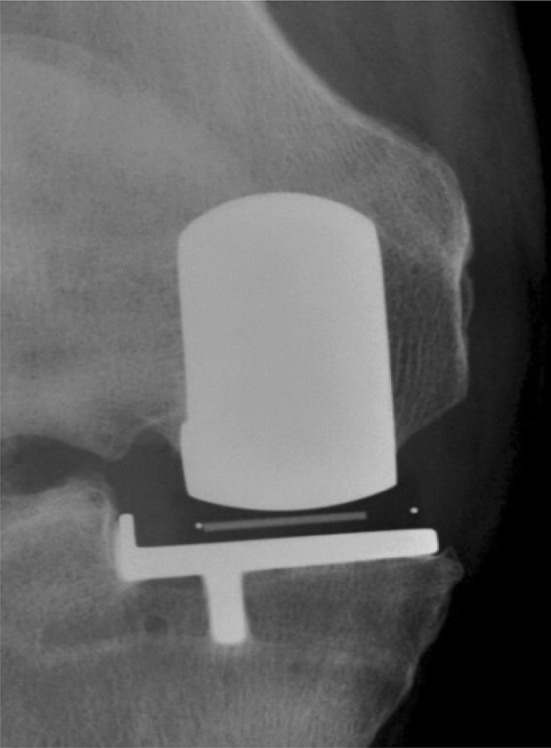
Conclusions: The cementless Oxford UKR is a safe procedure with excellent long-term clinical results. Our results suggest that reliable fixation was achieved with only one (0.1%) revision for loosening (femoral), no radiographic evidence of loosening in the remaining cases and no fractures related to implantation.
Level of evidence: III.
Keywords: Cementless fixation; Long-term outcomes; Unicompartmental knee replacement.
Conflict of interest statement
Hasan R Mohammad: Henni Mester Scholarship from University of Oxford and Institutional grant to University of Oxford from Zimmer Biomet; Christopher Dodd: Royalties, consultancy payments related to knee replacements—Zimmer Biomet; James Kennedy: Institutional grant—Grant to University of Oxford from Zimmer Biomet; David Murray: Royalties, consultancy payments related to knee replacements—Zimmer Biomet and Institutional grant—To University of Oxford from Zimmer Biomet. Andrew Judge and Stephen Mellon have no potential conflict of interest.
Figures


References
-
- Australian Orthopaedic Association (2018) Australian Orthopaedic Association: National Joint Replacement Registry (AOANJRR). 2018 Annual Report. Hip, Knee and Shoulder Arthroplasty September 1999–December 2017. https://aoanjrr.sahmri.com/documents/10180/576950/Hip%2C%20Knee%20%26%20.... Accessed 14 June 2019
-
- Campi S, Pandit H, Hooper G, Snell D, Jenkins C, Dodd C, et al. Ten-year survival and seven-year functional results of cementless Oxford unicompartmental knee replacement: a prospective consecutive series of our first 1000 cases. Knee. 2018;25(6):1231–1237. doi: 10.1016/j.knee.2018.07.012. - DOI - PubMed
MeSH terms
LinkOut - more resources
Full Text Sources
Medical
Research Materials
