


Cerebral Vascular Toxicity of Antiretroviral Therapy
- PMID: 31209776
- PMCID: PMC7952282
- DOI: 10.1007/s11481-019-09858-x
Cerebral Vascular Toxicity of Antiretroviral Therapy
Abstract
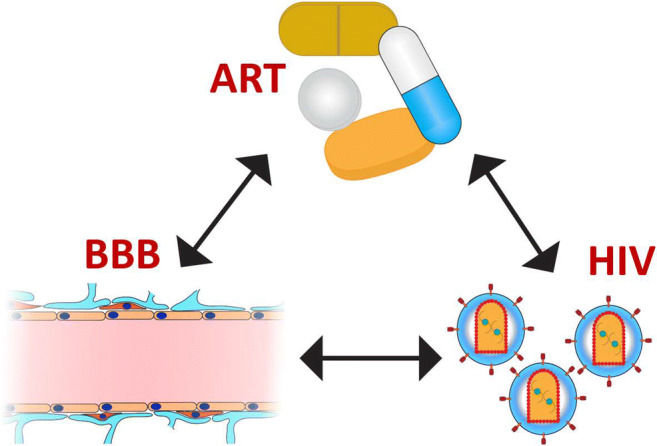
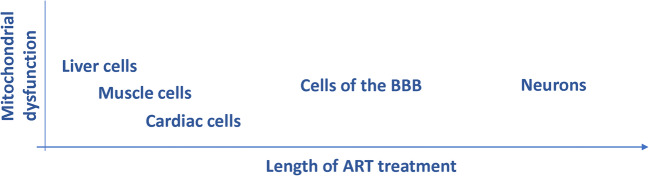
HIV infection is associated with comorbidities that are likely to be driven not only by HIV itself, but also by the toxicity of long-term use of antiretroviral therapy (ART). Indeed, increasing evidence demonstrates that the antiretroviral drugs used for HIV treatment have toxic effects resulting in various cellular and tissue pathologies. The blood-brain barrier (BBB) is a modulated anatomophysiological interface which separates and controls substance exchange between the blood and the brain parenchyma; therefore, it is particularly exposed to ART-induced toxicity. Balancing the health risks and gains of ART has to be considered in order to maximize the positive effects of therapy. The current review discusses the cerebrovascular toxicity of ART, with the focus on mitochondrial dysfunction. Graphical Abstract Graphical representation of the interactions between HIV, antiretroviral therapy (ART), and the blood-brain barrier (BBB).
Keywords: Antiretroviral therapy; Blood-brain barrier; Cerebrovascular toxicity; Mitochondria; Neurotoxicity.
Conflict of interest statement
The authors declare no conflict of interest.
Figures
References
-
- Aging USSSCo (2013) The changing face of HIV/AIDS in America. In: Hearing: older Americans. Washington, D.C.: One Hundred Thirteenth Congress
-
- Alakkas A, Ellis RJ, Watson CW-M, Umlauf A, Heaton RK, Letendre S, Collier A, Marra C, Clifford DB, Gelman B, Sacktor N, Morgello S, Simpson D, McCutchan JA, Kallianpur A, Gianella S, Marcotte T, Grant I, Fennema-Notestine C (2018) White matter damage, neuroinflammation, and neuronal integrity in HAND. J Neurovirol - PMC - PubMed
Publication types
MeSH terms
Substances
Grants and funding
- MH098891/MH/NIMH NIH HHS/United States
- R01 MH128022/MH/NIMH NIH HHS/United States
- R01 HL126559/HL/NHLBI NIH HHS/United States
- R01 DA039576/DA/NIDA NIH HHS/United States
- R01 DA050528/DA/NIDA NIH HHS/United States
- R01 MH098891/MH/NIMH NIH HHS/United States
- DA044579/DA/NIDA NIH HHS/United States
- MH072567/MH/NIMH NIH HHS/United States
- R01 DA044579/DA/NIDA NIH HHS/United States
- DA039576/DA/NIDA NIH HHS/United States
- DA040537/DA/NIDA NIH HHS/United States
- R21 MH122235/MH/NIMH NIH HHS/United States
- HL126559/HL/NHLBI NIH HHS/United States
- R01 MH072567/MH/NIMH NIH HHS/United States
LinkOut - more resources
Full Text Sources
Medical
