


Numerical and Experimental Analysis of Radiofrequency-Induced Heating Versus Lead Conductivity During EEG-MRI at 3 T
- PMID: 31210669
- PMCID: PMC6579539
- DOI: 10.1109/TEMC.2018.2840050
Numerical and Experimental Analysis of Radiofrequency-Induced Heating Versus Lead Conductivity During EEG-MRI at 3 T
Abstract
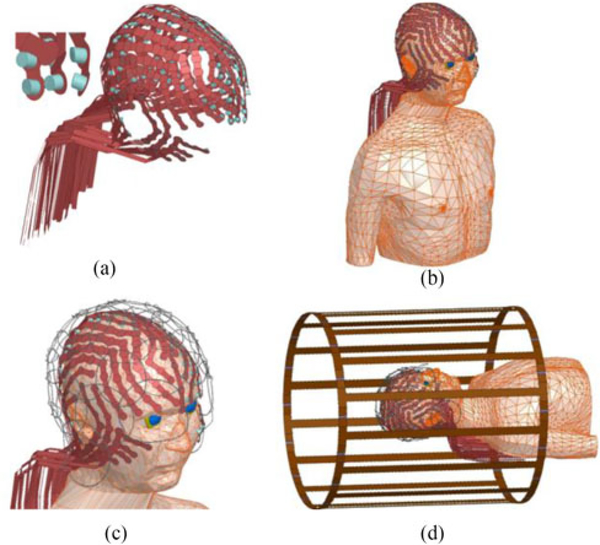
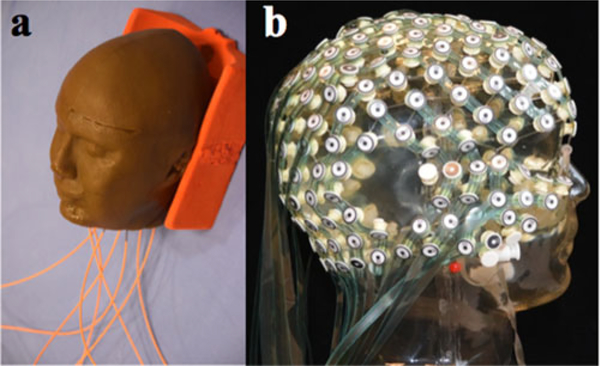
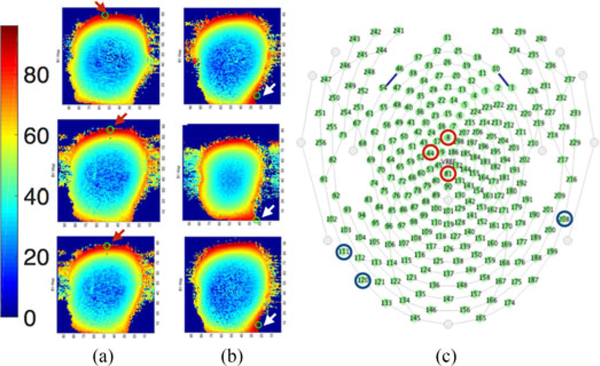
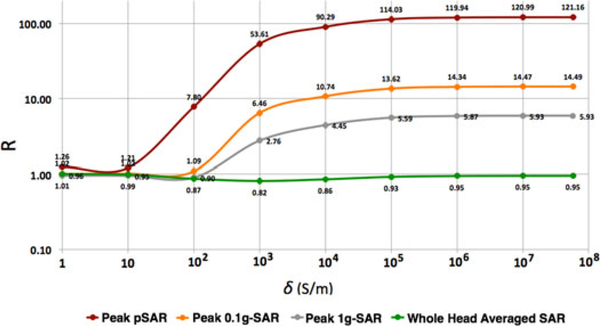
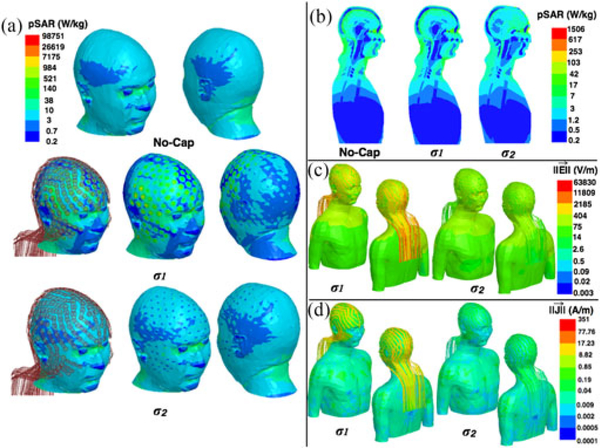
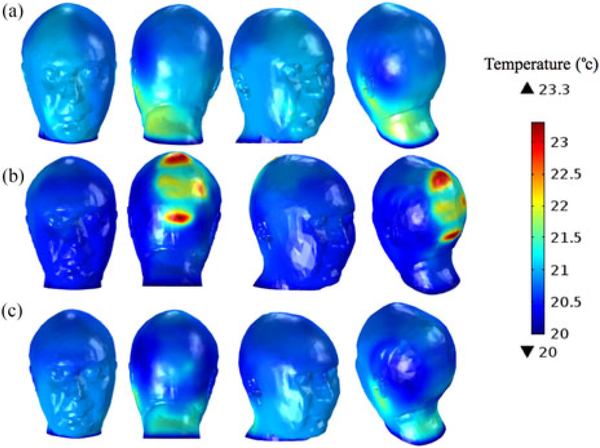
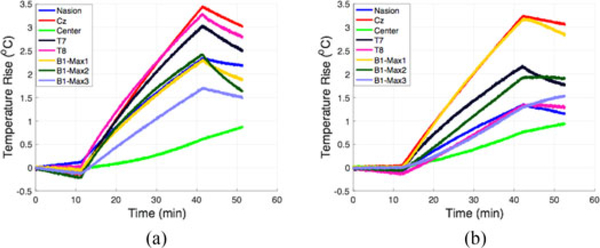
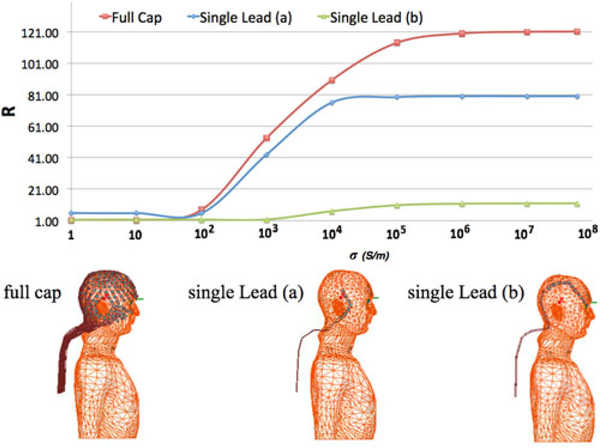
This study investigates radiofrequency (RF)-induced heating in a head model with a 256-channel electroencephalogram (EEG) cap during magnetic resonance imaging (MRI). Nine computational models were implemented each with different EEG lead electrical conductivity, ranging from 1 to 5.8 × 10⁷ S/m. The peak values of specific absorption rate (SAR) averaged over different volumes were calculated for each lead conductivity. Experimental measurements were also performed at 3-T MRI with a Gracilaria Lichenoides (GL) phantom with and without a low-conductive EEG lead cap ("InkNet"). The simulation results showed that SAR was a nonlinear function of the EEG lead conductivity. The experimental results were in line with the numerical simulations. Specifically, there was a ΔT of 1.7 °C in the GL phantom without leads compared to ΔT of 1.8 °C calculated with the simulations. Additionally, there was a ΔT of 1.5 °C in the GL phantom with the InkNet compared to a ΔT of 1.7 °C in the simulations with a cap of similar conductivity. The results showed that SAR is affected by specific location, number of electrodes, and the volume of tissue considered. As such, SAR averaged over the whole head, or even SAR averaged over volumes of 1 or 0.1 g, may conceal significant heating effects and local analysis of RF heating (in terms of peak SAR and temperature) is needed.
Keywords: Anatomical models; computational electromagnetic modeling; finite-element method (FEM); specific absorption rate (SAR).
Figures
References
-
- Gabriel C, Compilation of the Dielectric Properties of Body Tissues at RF and Microwave Frequencies. London, U.K.: King’s College London, 1996. [Online]. Available: http://niremf.ifac.cnr.it/docs/DIELECTRIC/Report.html
-
- Herrmann CS and Debener S, “Simultaneous recording of EEG and BOLD responses: A historical perspective,” Int. Psychophysiol, vol. 67, pp. 161–168, 2008. - PubMed
-
- Mullinger K and Bowtell R, “Combining EEG and fMRI,” in Magnetic Resonance Neuroimaging: Methods and Protocols, Modo M and Bulte WMJ, Eds. Totowa, NJ, USA: Humana Press, 2011, pp. 303–326. - PubMed
-
- Laufs H, “Functional imaging of seizures and epilepsy: evolution from zones to networks,” Curr. Opin. Neurol, vol. 25, pp. 194–200, 2012. - PubMed
-
- Lemieux L, Allen PJ, Franconi F, Symms MR, and Fish DK, “Recording of EEG during fMRI experiments: patient safety,” Magn. Reson. Med, vol. 38, pp. 943–952, 1997. - PubMed
Grants and funding
LinkOut - more resources
Full Text Sources
Research Materials
Miscellaneous