Observational Study
. 2019 May 1;6(6):1046-1052.
doi: 10.1002/acn3.781. eCollection 2019 Jun.

Phenotype-genotype discrepancies in the prospective Huntington at-risk observational study

Affiliations
Observational Study

Phenotype-genotype discrepancies in the prospective Huntington at-risk observational study

Ira Shoulson et al. Ann Clin Transl Neurol. .

Abstract

Objective: To examine phenotype-genotype discrepancies (PGDs) wherein genotype-concealed and prospective judgments of the motor onset of Huntington disease (HD) occurred among at-risk adults who had nonexpanded (<37) cytosine-adenine-guanine (CAG) trinucleotide DNA repeats.

Methods: We examined the prospective clinical assessments of investigators who were kept unaware of individual CAG lengths in the Prospective Huntington At-Risk Observational Study (PHAROS) who enrolled and followed undiagnosed adults at risk for HD who chose not to learn their gene status. Subjects (n = 1001) at 43 Huntington Study Group research sites in the US and Canada were evaluated prospectively and systematically between 1999 and 2009. At each site, an investigator was designated to perform comprehensive clinic assessments and another investigator to rate only the motor examination. Phenoconversion from a "premanifest" status to a confidently "manifest" status was based on investigator judgment (diagnostic confidence level) of the extrapyramidal motor features of HD.

Results: There were 20 PGDs that over time had less severe motor scores than the 101 phenoconversions with CAG ≥37, but more severe motor scores than nonconversions. Following conversion, subjects with CAG ≥37 expansions worsened more motorically and cognitively than PGD subjects in the < 37 group. PGDs were concentrated among three sites and a few investigators, especially raters who only assessed the motor examination.

Interpretation: The ability to detect the clinical onset of HD in a timely and reliable fashion remains the key for developing experimental treatments aimed at postponing the clinical onset of HD. Comprehensive clinical evaluation is a more accurate and reliable basis for determining HD clinical onset than sole reliance on judging the extrapyramidal features of HD.


Conflict of interest statement

None of the authors report conflicts of interest related to the conduct or reporting of PHAROS.

Figures
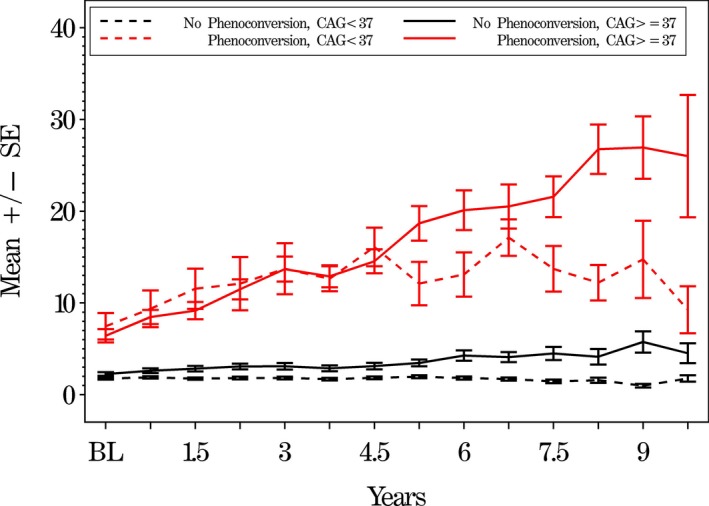
Figure 1
Figure 1
Mean independent rater (IR) total motor UHDRS scores comparing subjects by motor phenoconversion and CAG status. Mean UHDRS motor scores (higher scores are worse) on the y‐axis versus time in years on the x‐axis of those who phenoconverted with ≥ 37 repeats (solid red line) and those PGDs who phenoconverted with < 37 repeats (dotted red line). Black lines show subjects who have not phenoconverted and have ≥ 37 repeats or < 37 repeats, respectively. The error bars show the standard error of the mean.
Figure 2
Figure 2
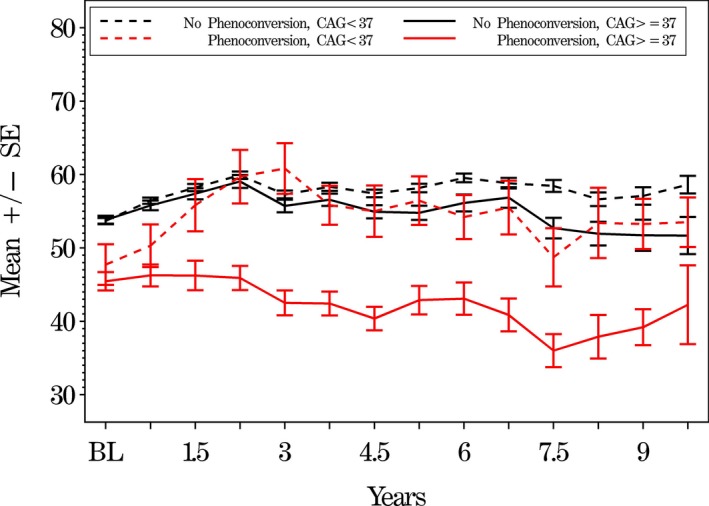
Mean Symbol digit cognitive scores comparing subjects by IR‐judged motor phenoconversion and CAG status. Mean symbol digit scores (lower scores are worse) on the y‐axis versus time in years on the x‐axis of those who phenoconverted with ≥ 37 repeats (solid red line) and those PGDs who phenoconverted with < 37 repeats (dotted red line). Black lines show subjects who have not phenoconverted and have ≥ 37 repeats or < 37 repeats, respectively. The error bars show the standard error of the mean.
Figure 3
Figure 3
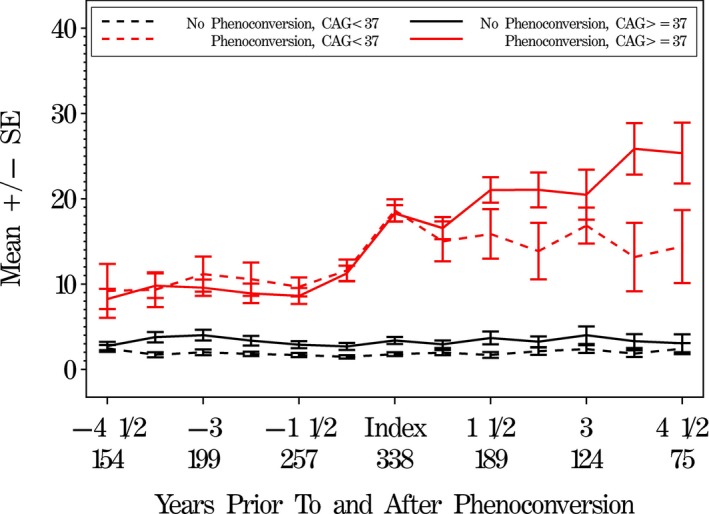
Mean independent rater (IR) total motor UHDRS scores comparing prior to and after motor phenoconversion. IR total motor scores (higher scores are worse) prior to and after phenoconversion, by phenoconversion and CAG status (matched subjects). The phenoconversion visit is designated as the index visit. For each of the four conversion/CAG groups, we look both backwards from phenoconversion and forward after phenoconversion. Numbers on the x‐axis represent years prior to and after the index visit, along with total sample size for each time point.
Figure 4
Figure 4
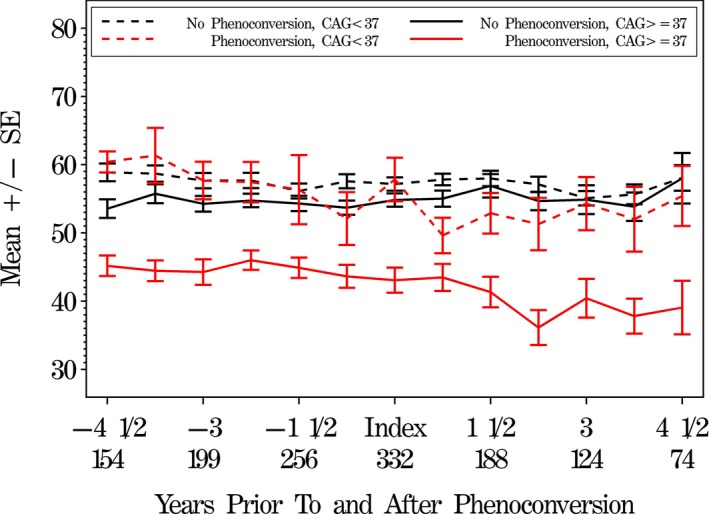
Mean symbol digit cognitive scores comparing prior to and after IR‐judged motor phenoconversion. Symbol digit scores (lower scores are worse) prior to and after phenoconversion, by phenoconversion and CAG status (matched subjects). The phenoconversion visit is designated as the index visit. For each of the four conversion/CAG groups, we look both backward from phenoconversion, and forward after phenoconversion. Numbers on the x‐axis represent years prior to and after the index visit, along with total sample size for each time point.

References

    1. Shoulson I, Young AB. Milestones in huntington disease. Mov Disord 2011;26:1127–1133. 10.1002/mds.23685. - DOI - PubMed
    1. Killoran A, Biglan KM, Jankovic J, et al. Characterization of the Huntington intermediate CAG repeat expansion phenotype in PHAROS. Neurology 2013;80:2022–2027. 10.1212/WNL.0b013e318294b304. - DOI - PMC - PubMed
    1. Huntington Study Group PI . At risk for Huntington disease: the PHAROS (Prospective Huntington At Risk Observational Study) cohort enrolled. Arch Neurol 2006;63:991–996. 10.1001/archneur.63.7.991. - DOI - PubMed
    1. Huntington Study Group PI ; Biglan KM, Shoulson I, Kieburtz K, et al. Clinical‐genetic associations in the Prospective Huntington at Risk Observational Study (PHAROS): implications for clinical trials. JAMA Neurol 2016;73:102–110. 10.1001/jamaneurol.2015.2736. - DOI - PubMed
    1. Investigators HSGP . Unified Huntington's disease rating scale: reliability and consistency. Huntington Study Group. Mov Disord 1996;11:136–142. 10.1002/mds.870110204. - DOI - PubMed

Publication types