


Association Between Transcatheter Aortic Valve Replacement and Early Postprocedural Stroke
- PMID: 31211345
- PMCID: PMC6582268
- DOI: 10.1001/jama.2019.7525
Association Between Transcatheter Aortic Valve Replacement and Early Postprocedural Stroke
Abstract
Importance: Reducing postprocedural stroke is important to improve the safety of transcatheter aortic valve replacement (TAVR).
Objective: This study evaluated the trends of stroke occurring within 30 days after the procedure during the first 5 years TAVR was used in the United States, the association of stroke with 30-day mortality, and the association of medical therapy with 30-day stroke risk.
Design, setting, and participants: Retrospective cohort study including 101 430 patients who were treated with femoral and nonfemoral TAVR at 521 US hospitals in the Society of Thoracic Surgeons/American College of Cardiology Transcatheter Valve Therapies Registry from November 9, 2011, through May 31, 2017. Thirty-day follow-up ended June 30, 2017.
Exposures: TAVR.
Main outcomes and measures: The rates of 30-day transient ischemic attack and stroke were assessed. Association of stroke with 30-day mortality and association of antithrombotic medical therapies with postdischarge 30-day stroke were assessed with a Cox proportional hazards model and propensity-score matching, respectively.
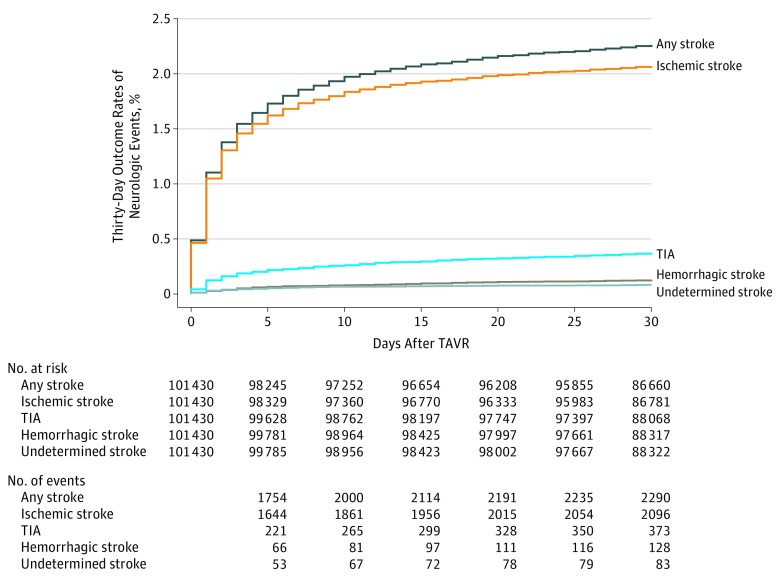
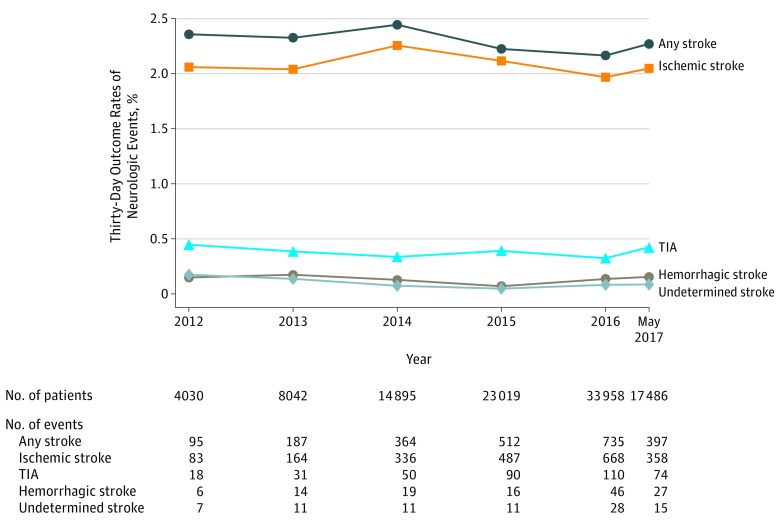
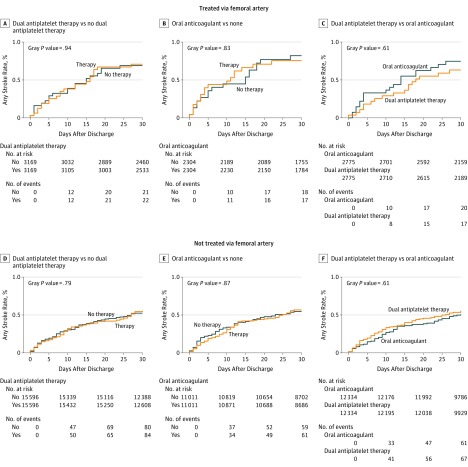
Results: Among 101 430 patients included in the study (median age, 83 years [interquartile range {IQR}, 76-87 years]; 47 797 women [47.1%]; and 85 147 patients [83.9%] treated via femoral access), 30-day postprocedure follow-up data was assessed in all patients. At day 30, there were 2290 patients (2.3%) with a stroke of any kind (95% CI, 2.2%-2.4%), and 373 patients (0.4%) with transient ischemic attacks (95% CI, 0.3%-0.4%) . During the study period, 30-day stroke rates were stable without an increasing or decreasing trend in all patients (P for trend = .22) and in the large femoral access subgroup (P trend = .47). Among cases of stroke within 30 days, 1119 strokes (48.9%) occurred within the first day and 1567 (68.4%) within 3 days following TAVR. The occurrence of stroke was associated with a significant increase in 30-day mortality: 383 patients (16.7%) of 2290 who had a stroke vs 3662 patients (3.7%) of 99 140 who did not have a stroke died (P < .001; risk-adjusted hazard ratio [HR], 6.1 [95% CI, 5.4-6.8]; P < .001). After propensity-score matching, 30-day stroke risk was not associated with whether patients in the femoral cohort were (0.55%) or were not (0.52%) treated with dual antiplatelet therapy at hospital discharge (HR, 1.04; 95% CI, 0.74-1.46) nor was it associated with whether patients in the nonfemoral cohort were (0.71%) or were not (0.69%) treated with dual antiplatelet therapy (HR, 1.02; 95% CI, 0.54-1.95). Similarly, 30-day stroke risk was not associated with whether patients in the femoral cohort were (0.57%) or were not (0.55) treated with oral anticoagulant therapy at hospital discharge (HR, 1.03; 95% CI, 0.73-1.46) nor was it associated with whether patients in the nonfemoral cohort were (0.75%) or were not (0.82%) treated with an oral anticoagulant (HR, 0.93; 95% CI, 0.47-1.83).
Conclusions and relevance: Between 2011 and 2017, the rate of 30-day stroke following transcatheter aortic valve replacement in a US registry population remained stable.
Conflict of interest statement
Figures
Comment in
-
Stroke After Transcatheter Aortic Valve Replacement: An Important but Underreported Outcome in Clinical Practice.JAMA. 2019 Jun 18;321(23):2287-2289. doi: 10.1001/jama.2019.8613. JAMA. 2019. PMID: 31211329 No abstract available.
References
Publication types
MeSH terms
LinkOut - more resources
Full Text Sources
Medical
