Review
. 2019 May 27:12:59-73.
doi: 10.2147/PGPM.S167886. eCollection 2019.

Personalized medicine in breast cancer: pharmacogenomics approaches

Affiliations
Review

Personalized medicine in breast cancer: pharmacogenomics approaches

Shabnam Jeibouei et al. Pharmgenomics Pers Med. .

Abstract

Breast cancer is the fifth cause of cancer death among women worldwide and represents a global health concern due to the lack of effective therapeutic regimens that could be applied to all disease groups. Nowadays, strategies based on pharmacogenomics constitute novel approaches that minimize toxicity while maximizing drug efficacy; this being of high importance in the oncology setting. Besides, genetic profiling of malignant tumors can lead to the development of targeted therapies to be included in effective drug regimens. Advances in molecular diagnostics have revealed that breast cancer is a multifaceted disease, characterized by inter-tumoral and intra-tumoral heterogeneity and, unlike the past, molecular classifications based on the expression of individual biomarkers have led to devising novel therapeutic strategies that improve patient survival. In this review, we report and discuss the molecular classification of breast cancer subtypes, the heterogeneity resource, and the advantages and disadvantages of current drug regimens with consideration of pharmacogenomics in response and resistance to treatment.

Keywords: biomarker; breast cancer; personalized medicine; pharmacogenomics.


Conflict of interest statement

The authors report no conflicts of interest in this work.

Figures
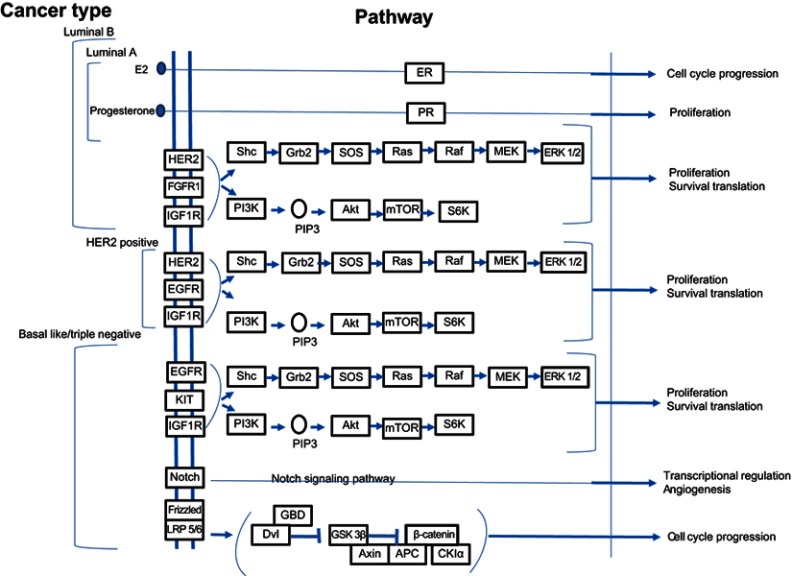
Figure 1
Figure 1
Signaling pathways implicated in different categories of breast cancer. Notes: Adapted with permission from Kanehisa M, Goto S. KEGG: Breast cancer - Reference pathway; 2018. Available at:  https://www.genome.jp/kegg-bin/show_pathway?map05224. Accessed May 15, 2019. Copyright Kanehisa Laboratories.
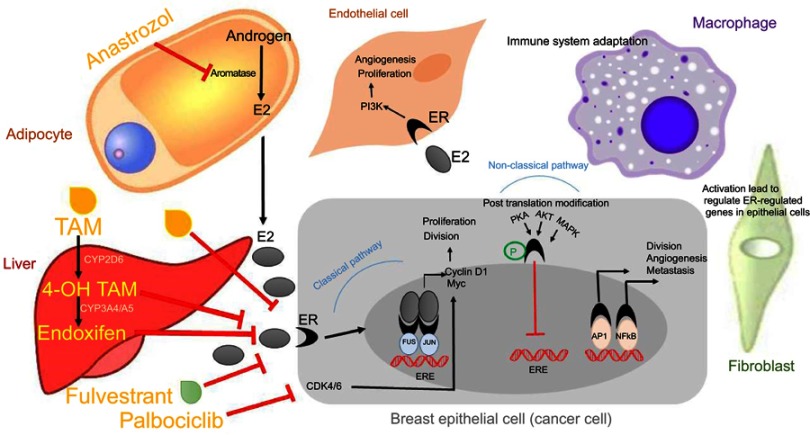
Figure 2
Figure 2
The interaction between tumor microenvironment components, including stromal cells, and tumor cells leads to enhanced cell growth, proliferation, angiogenesis and invasion. Breast cancer epithelial cells increase tumor cell proliferation and invasion while inhibiting apoptosis through either of these following pathways: (1) classical pathway in which estrogen binds to its receptor, ER, or (2) non-classical pathway that involves post-translational modifications of ER by activation kinases, and transcription factors. Anti-cancer agents including tamoxifen (TAM), whose metabolites, 4-OH TAM and endoxifen, have higher affinity for ER when compared with TAM, exert their effects by modulating signaling pathways that regulate tumor cells.Note: Data adapted from Russell and Barone et al.

References

    1. Wang C, Machiraju R, Huang K. Breast cancer patient stratification using a molecular regularized consensus clustering method. Methods. 2014;67(3):304–312. doi:10.1016/j.ymeth.2014.03.005 - DOI - PMC - PubMed
    1. Chen X, Shachter RD, Kurian AW, Rubin DL. Dynamic strategy for personalized medicine: an application to metastatic breast cancer. J Biomed Inform. 2017;68:50–57. doi:10.1016/j.jbi.2017.02.012 - DOI - PubMed
    1. Nerenz RD. Pharmacogenomics and personalized medicine in the treatment of human diseases. In: Coleman WB, Tsongalis GJ, editors. Molecular pathology. 2nd ed. Elsevier; New York: Chapel Hill; 2018;731–743.
    1. Li H, Jia W. Cometabolism of microbes and host: implications for drug metabolism and drug‐induced toxicity. Clin Pharmacol Ther. 2013;94(5):574–581. doi:10.1038/clpt.2013.157 - DOI - PubMed
    1. Nandy A, Gangopadhyay S, Mukhopadhyay A. Individualizing breast cancer treatment—the dawn of personalized medicine. Exp Cell Res. 2014;320(1):1–11. doi:10.1016/j.yexcr.2013.09.002 - DOI - PubMed