Review
. 2019 May 28:10:314.
doi: 10.3389/fpsyt.2019.00314. eCollection 2019.

Hypofunctional Dopamine Uptake and Antipsychotic Treatment-Resistant Schizophrenia

Affiliations
Review

Hypofunctional Dopamine Uptake and Antipsychotic Treatment-Resistant Schizophrenia

Davide Amato et al. Front Psychiatry. .

Abstract

Antipsychotic treatment resistance in schizophrenia remains a major issue in psychiatry. Nearly 30% of patients with schizophrenia do not respond to antipsychotic treatment, yet the underlying neurobiological causes are unknown. All effective antipsychotic medications are thought to achieve their efficacy by targeting the dopaminergic system. Here we review early literature describing the fundamental mechanisms of antipsychotic drug efficacy, highlighting mechanistic concepts that have persisted over time. We then reconsider the original framework for understanding antipsychotic efficacy in light of recent advances in our scientific understanding of the dopaminergic effects of antipsychotics. Based on these new insights, we describe a role for the dopamine transporter in the genesis of both antipsychotic therapeutic response and primary resistance. We believe that this discussion will help delineate the dopaminergic nature of antipsychotic treatment-resistant schizophrenia.

Keywords: antipsychotic efficacy; antipsychotic-resistant schizophrenia; dopamine release; dopamine synthesis; dopamine transporter; drug addiction; schizophrenia.


Figures
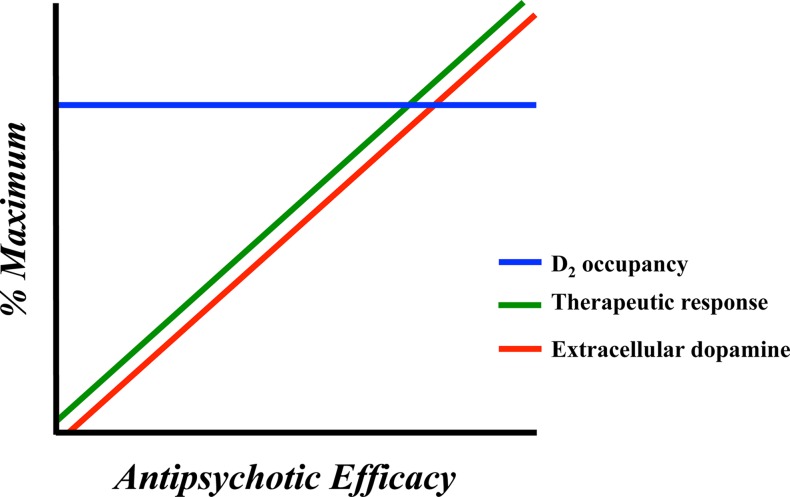
Figure 1
Figure 1
Representation of the neurochemical factors affecting antipsychotic response in humans and animal models. Antipsychotic response is optimal in concert with elevated extracellular dopamine levels. D2 receptor occupancy is less dynamic and appears stable during time periods characterized by both therapeutic efficacy and antipsychotic failure.
Figure 2
Figure 2
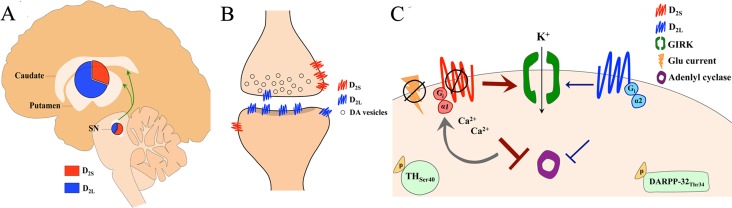
(A) Uneven expression of dopamine D2 receptor isoforms (short, D2S and long, D2L) in the human midbrain (substantia nigra, SN) and striatum (caudate nucleus and putamen). D2L is predominant in the striatum, while D2S is prevalently expressed in the midbrain. This unbalanced D2L/D2S ratio is observed across species. (B) Schematic of a synaptic contact between a dopaminergic terminal projecting from SN and a somatodendritic spine in the striatum shows the unbalanced D2L/D2S ratio on midbrain and striatal neurons. (C) Distinct physiological effects are mediated by the two D2 receptor isoforms. Both D2S and D2L receptors inhibit adenylyl cyclase, though D2L-mediated inhibition is weaker, via Giα1and Giα2, respectively. D2S stimulation leads to phosphorylation of tyrosine hydroxylase (TH) at serine 40 in nigrostriatal dopaminergic neurons, whereas D2L stimulation leads to phosphorylation of dopamine and cAMP-regulated phosphoprotein of 32 kDa (DARPP-32) at threonine 34, in medium spiny neurons. D2S, but not D2L, activates G protein-gated inwardly rectifying potassium (GIRK) conductance, which is Ca2+ sensitive. D2S, but not D2L, inhibits excitation in response to glutamate (Glu) currents.
Figure 3
Figure 3
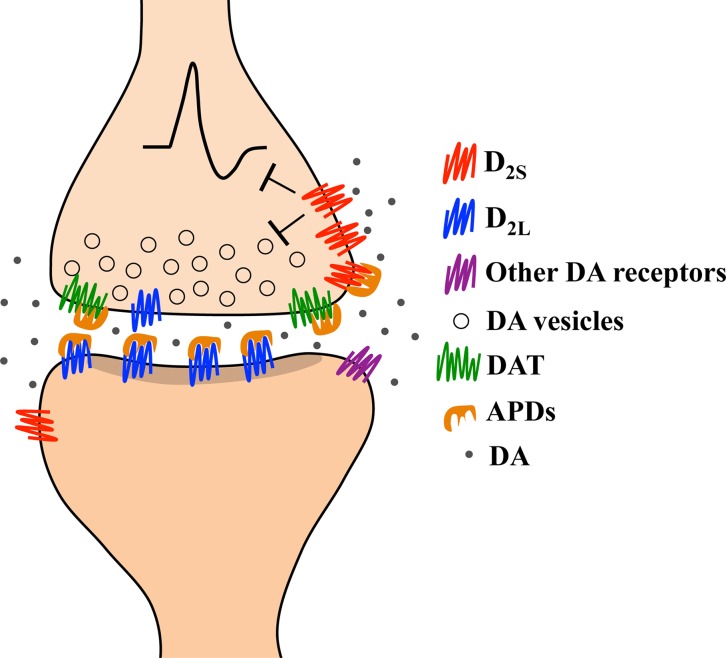
Representation of the hypothesized pharmacological mechanism underlying a therapeutic response in schizophrenia based on human and animal studies. Therapeutic doses of antipsychotic drugs (APDs) block about 70% of striatal D2 receptors. APDs mostly block heteroreceptors, which are more often D2L than D2S, as well as a smaller proportion of autoreceptors (which are more often D2S than D2L). APDs also block the dopamine transporter (DAT). The combined blockade of D2L heteroreceptors and DAT causes synaptic accumulation of dopamine that allows stimulation of spare D2S receptors. Phasic release of dopamine in response to environmental changes will trigger an enduring autoinhibition since extracellular dopamine levels are already elevated. We hypothesize that the autoinhibition triggered by a phasic discharge of dopamine during antipsychotic treatment is the mechanism underlying a therapeutic antipsychotic response.
Figure 4
Figure 4
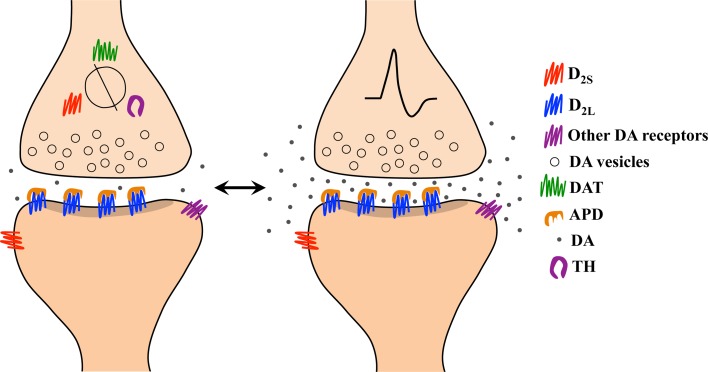
Representation of the pharmacological mechanism underlying the absence of therapeutic response in antipsychotic-resistant schizophrenia based on our model. (Left) Aging and/or addictive drugs consumed before antipsychotic treatment begins (i.e., in first episode psychosis) lead to reduced expression of the dopamine transporter (DAT), D2 autoreceptors, and tyrosine hydroxylase (TH), as these proteins appear to be co-regulated, at least in rodents. (Right) During environmentally evoked phasic dopamine release, impaired capacity for autoinhibition results from low levels of DAT and D2 autoreceptors. The resulting post-synaptic stimulation contributes to psychosis despite a significant blockade of D2 receptors by antipsychotic drugs (APDs).

References

    1. Schizophrenia Working Group of the Psychiatric Genomics C Biological insights from 108 schizophrenia-associated genetic loci. Nature (2014) 511(7510):421–7. 10.1038/nature13595 - DOI - PMC - PubMed
    1. Sekar A, Bialas AR, de Rivera H, Davis A, Hammond TR, Kamitaki N, et al. Schizophrenia risk from complex variation of complement component 4. Nature (2016) 530(7589):177–83. 10.1038/nature16549 - DOI - PMC - PubMed
    1. Avramopoulos D. Recent advances in the genetics of schizophrenia. Mol Neuropsychiatry (2018) 4(1):35–51. 10.1159/000488679 - DOI - PMC - PubMed
    1. van Os J, Kenis G, Rutten BP. The environment and schizophrenia. Nature (2010) 468(7321):203–12. 10.1038/nature09563 - DOI - PubMed
    1. Awad AG, Voruganti LN, Heslegrave RJ. A conceptual model of quality of life in schizophrenia: description and preliminary clinical validation. Qual Life Res (1997) 6(1):21–6. - PubMed

LinkOut - more resources