Comparative Study
. 2019 May 31:10:1218.
doi: 10.3389/fimmu.2019.01218. eCollection 2019.

Improving Clinical Manufacturing of IL-15 Activated Cytokine-Induced Killer (CIK) Cells

Affiliations
Comparative Study

Improving Clinical Manufacturing of IL-15 Activated Cytokine-Induced Killer (CIK) Cells

Melanie Bremm et al. Front Immunol. .

Abstract

Cytokine-induced killer (CIK) cells are an immunotherapeutic approach to combat relapse following allogeneic hematopoietic stem cell transplantation (HSCT) in acute leukemia or myelodysplastic syndrome (MDS) patients. Prompt and sequential administration of escalating cell doses improves the efficacy of CIK cell therapy without exacerbating graft vs. host disease (GVHD). This study addresses manufacturing-related issues and aimed to develop a time-, personal- and cost-saving good manufacturing process (GMP)-compliant protocol for the generation of ready-for-use therapeutic CIK cell doses starting from one unstimulated donor-derived peripheral blood (PB) or leukocytapheresis (LP) products. Culture medium with or without the addition of either AB serum, fresh frozen plasma (FFP) or platelet lysate (PL) was used for culture. Fresh and cryopreserved CIK cells were compared regarding expansion rate, viability, phenotype, and ability to inhibit leukemia growth. Cell numbers increased by a median factor of 10-fold in the presence of FFP, PL, or AB serum, whereas cultivation in FFP/PL-free or AB serum-free medium failed to promote adequate CIK cell proliferation (p < 0.01) needed to provide clinical doses of 1 × 10⁶ T cells/kG, 5 × 10⁶ T cells/kG, 1 × 10⁷ T cells/kG, and 1 × 10⁸ T cells/kG recipient body weight. CIK cells consisting of T cells, T- natural killer (T-NK) cells and a minor fraction of NK cells were not significantly modified by different medium supplements. Moreover, neither cytotoxic potential against leukemic THP-1 cells nor cell activation shown by CD25 expression were significantly influenced. Moreover, overnight and long-term cryopreservation had no significant effect on the composition of CIK cells, their phenotype or cytotoxic potential. A viability of almost 93% (range: 89-96) and 89.3% (range: 84-94) was obtained after freeze-thawing procedure and long-term storage, respectively, whereas viability was 96% (range: 90-97) in fresh CIK cells. Altogether, GMP-complaint CIK cell generation from an unstimulated donor-derived PB or LP products was feasible. Introducing FFP, which is easily accessible, into CIK cell cultures was time- and cost-saving without loss of viability and potency in a 10-12 day batch culture. The feasibility of cryopreservation enabled storage and delivery of sequential highly effective ready-for-use CIK cell doses and therefore reduced the number of manufacturing cycles.

Keywords: AB-serum; CIK cells; allogeneic stem cell transplantation; cryopreservation; fresh frozen plasma; immunotherapy; platelet lysate.


Figures
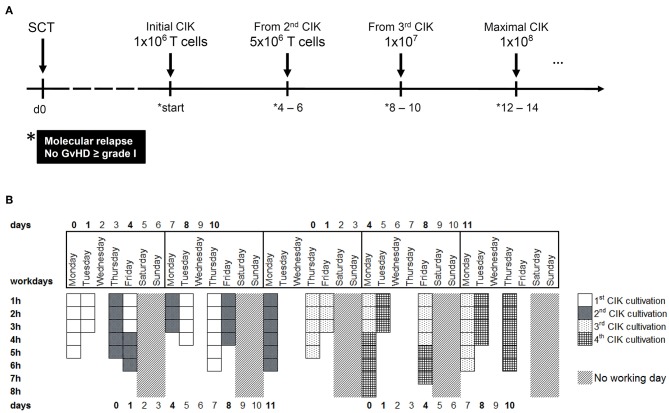
Figure 1
Figure 1
CIK cell generation within the clinical phase I/II study. (A) CIK cells are administered to patients with molecular relapse defined as mixed chimerism ≥1% of recipient (autologous) signals; detectable MRD ≥10−6 or BCR-ABL/ABL ≥10−4. According to ATMP § 4b license, repeated CIK cell applications with escalating doses may be provided to patients suffering from prolonged molecular relapse in intervals of 4–6 weeks under the condition that no GVHD ≥ grade I occurred. (B) Within a time-frame of 5 weeks, four different batches of CIK cells can be manufactured. The working days and the estimated time for tasks like initiation, cytokine stimulation or harvest are shown.
Figure 2
Figure 2
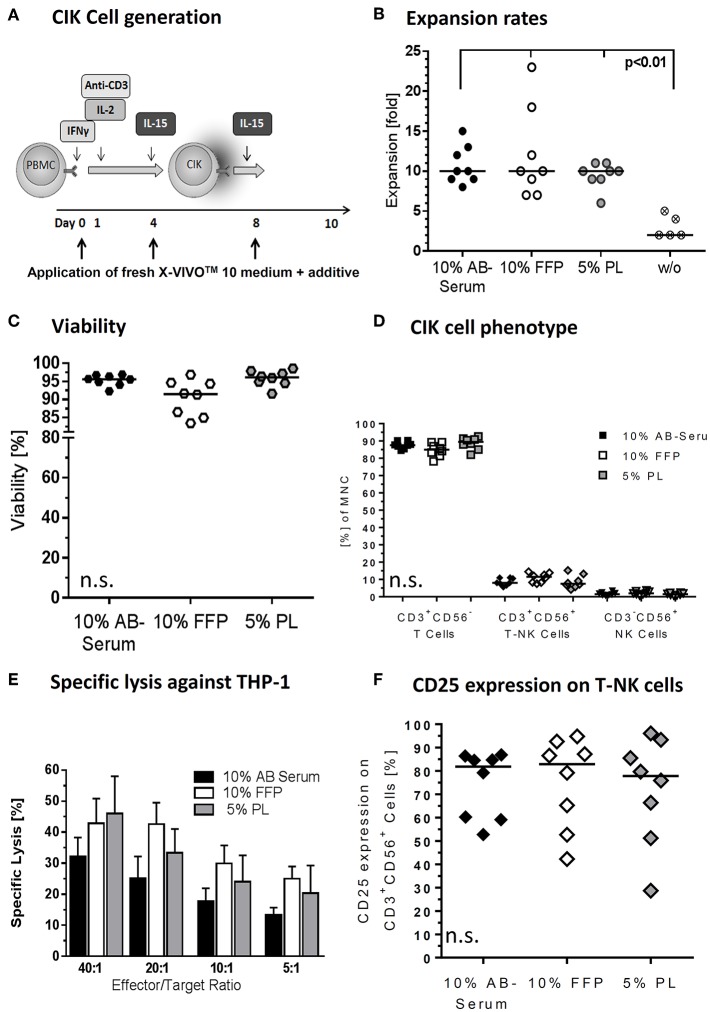
Medium supplements for CIK cell cultivation. (A) CIK cells are supplemented with fresh media including different additives on days 0, 4, and 8 of culture. We tested different additives including fresh frozen plasma (FFP) and platelet lysate (PL) in different concentrations to substitute AB serum in the cultivation process. (B) With median 10-fold expansion rates, CIK cell cultivation with 10% AB serum, 10% FFP and 5% PL was similar. CIK cell expansion without additive was significantly lower compared to cultivation with medium supplement. (C) With 91.5% viability was minimal lower when CIK cells were cultured with FFP compared to AB serum (95.6%) or PL (96.1%), but not statistically relevant. (D) The composition of CIK cells consisting of T-, T-NK-, and NK-cells was not significantly influenced by the different cultivation variants. (E) CIK cell cytotoxicity was tested against the leukemic cell line THP-1. In the effector/target ratio of 40:1 mean specific lysis was with 46.0% highest for PL-CIK cells, closely followed by FFP-CIK cells with 42.9%. In the effector/target ratios 20:1, 10:1, and 5:1, CIK cells generated with FFP as additive showed the highest cytotoxicity. (F) CD25 expression on T-NK cells was highest on CIK cells cultivated with FFP. Comparable results were obtained for CIK cells cultured with AB serum. CIK cells cultivated with PL as medium additive showed a slightly lower CD25 expression and a wider range of expression. n = 8 experiments, except cultivation without medium supplement (n = 5) and cytotoxicity analysis (n = 3).
Figure 3
Figure 3
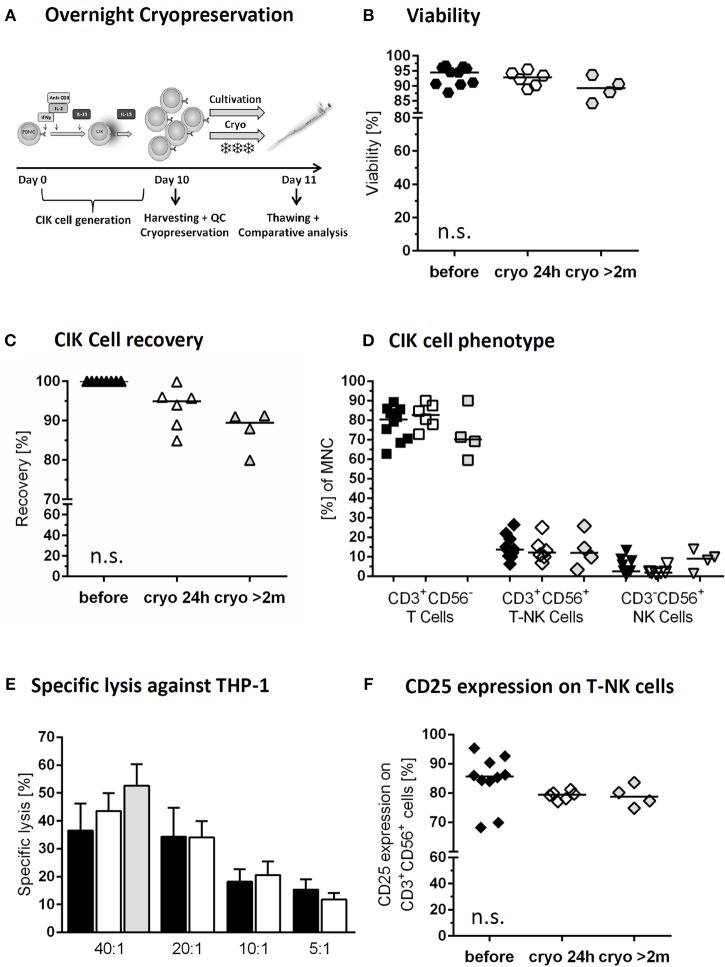
Cryopreservation of CIK cells. Comparison of freshly harvested CIK cells (black) and CIK cells following overnight cryopreservation of the same donor (white). In addition long time storage of at least 2months (median 2 years) was investigated (gray; differing donors) (A) On day 10, one part of the freshly harvested CIK cells was cryopreserved overnight, whereas a second part was further cultivated overnight. (B) Viability was slightly, but not significantly, reduced due to overnight and long-term cryopreservation. (C) CIK cell recovery was 94.9% after thawing following overnight cryopreservation an 89.5% after long-term storage. (D) The composition of CIK cells consisting of T-, T-NK- and NK-cells was not significantly influenced by overnight and long-term cryopreservation. (E) Cytotoxicity against THP-1 of CIK cells before and after cryopreservation was comparable in the tested effector/target ratios 40:1, 20:1, 10:1, and 5:1 for overnight (n = 6) and long-term cryopreservation (n = 3). (F) Independent of storage time CD25 expression on CD3+CD56+ cells minimally decreased following cryopreservation, but not statistically relevant. n = 6 experiments.
Figure 4
Figure 4
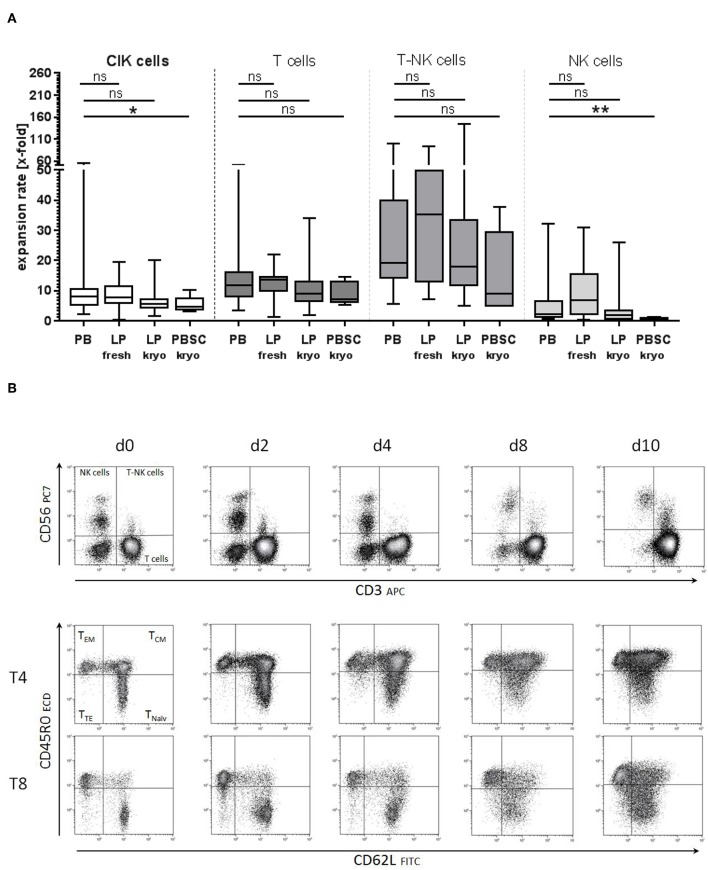
Starting material of CIK cell generation. (A) CIK cell generation on the basis of different starting materials showed comparable expansion rates for peripheral blood (PB) and unstimulated leukapheresis products (LP, fresh, and cryopreserved). Significantly lower proliferation was observed when CIK cells were generated from cryopreserved G-CSF stimulated PBSC (n = 5). (B) No significant differences in the composition of naïve and memory T cells were detected between CIK cells generated from the different starting materials. Exemplarily shown for PB are the subgroups of naïve, central- and effector-memory T cells for cytotoxic and helper T cells on days 0, 2, 4, 8, and 10 generated from PB. T, T cells, EM- effector memory; CM, central memory; TE, terminally differentiated. *p < 0.05, **p < 0.01.

References

    1. Introna M, Borleri G, Conti E, Franceschetti M, Barbui AM, Broady R, et al. . Repeated infusions of donor-derived cytokine-induced killer cells in patients relapsing after allogeneic stem cell transplantation: a phase I study. Haematologica. (2007) 92:952–9. 10.3324/haematol.11132 - DOI - PubMed
    1. Linn YC, Lau LC, Hui KM. Generation of cytokine-induced killer cells from leukaemic samples with in vitro cytotoxicity against autologous and allogeneic leukaemic blasts. Br J Haematol. (2002) 116:78–86. 10.1046/j.1365-2141.2002.03247.x - DOI - PubMed
    1. Lu PH, Negrin RS. A novel population of expanded human CD3+CD56+ cells derived from T cells with potent in vivo antitumor activity in mice with severe combined immunodeficiency. J Immunol. (1994) 153:1687–96. - PubMed
    1. Schmidt-Wolf IG, Lefterova P, Johnston V, Scheffold C, Csipai M, Mehta BA, et al. . Sensitivity of multidrug-resistant tumor cell lines to immunologic effector cells. Cell Immunol. (1996) 169:85–90. - PubMed
    1. Schmidt-Wolf IG, Negrin RS, Kiem HP, Blume KG, Weissman IL. Use of a SCID mouse/human lymphoma model to evaluate cytokine-induced killer cells with potent antitumor cell activity. J Exp Med. (1991) 174:139–49. - PMC - PubMed

Publication types

MeSH terms