


Prognostic Significance of Pulse Pressure and Other Blood Pressure Components for Coronary Artery Disease in Type 1 Diabetes
- PMID: 31214692
- PMCID: PMC6794945
- DOI: 10.1093/ajh/hpz099
Prognostic Significance of Pulse Pressure and Other Blood Pressure Components for Coronary Artery Disease in Type 1 Diabetes
Abstract
Background: To compare in individuals with type 1 diabetes the prediction of incident coronary artery disease (CAD) by components of resting blood pressure-systolic, diastolic, pulse pressure, and mean arterial pressure.
Methods: In 605 participants without known CAD at baseline and followed sequentially for 25 years, we used Cox modeling built for each blood pressure component associated with incident CAD, overall and stratified by age (<35 and ≥35 years) or hemoglobin A1c (HbA1c) (<9% and ≥9%).
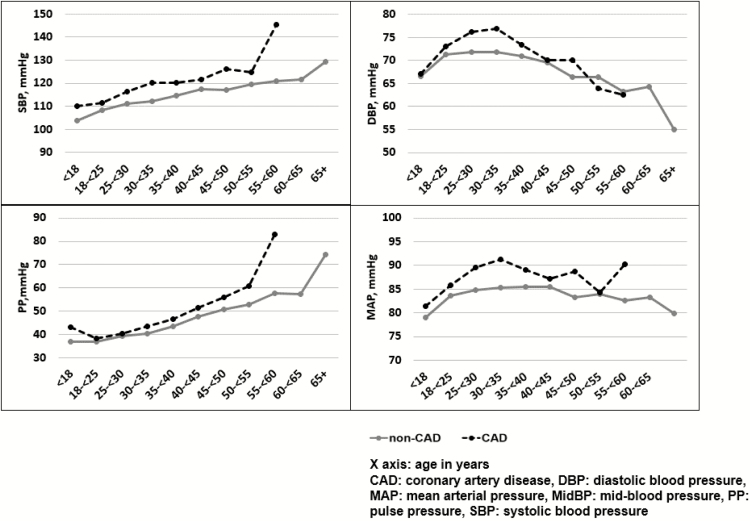
Results: Baseline mean age and diabetes duration were 27 and 19 years, respectively. We observed an early asymptote and then fall in diastolic blood pressure in their late 30s and early 40s in this group of type 1 diabetes individuals, followed by an early rise of pulse pressure. Adjusted hazard ratios (HR) (95% con) for CAD associated with 1 SD pressure increase were 1.35 (1.17, 1.56) for systolic pressure; 1.30 (1.12, 1.51) for diastolic pressure; 1.20 (1.03, 1.39) for pulse pressure; and 1.35 (1.17, 1.56) for mean arterial pressure. Pulse pressure emerged as a strong predictor of CAD at age ≥ 35 years (HR: 1.49 [1.15, 1.94]) and for HbA1c ≥ 9% (HR: 1.32 [1.01, 1.72]).
Conclusions: Individuals with type 1 diabetes may manifest early vascular aging by an early decline in diastolic blood pressure and rise in pulse pressure, the latter parameter becoming a comparable to systolic blood pressure in predictor incident CAD in those aged over 35 years and those with poor glycemic control.
Keywords: arterial stiffness; blood pressure; coronary artery disease; hypertension; pulse pressure; type 1 diabetes.
© American Journal of Hypertension, Ltd 2019. All rights reserved. For Permissions, please email: journals.permissions@oup.com.
Figures
Comment in
-
Hemodynamic Stress, Pulse Pressure, and Blood Pressure Variability May Be Strong Triggers of Cardiovascular Events in Diabetes.Am J Hypertens. 2019 Oct 16;32(11):1045-1047. doi: 10.1093/ajh/hpz131. Am J Hypertens. 2019. PMID: 31407770 No abstract available.
References
-
- Gordin D, Rönnback M, Forsblom C, Heikkilä O, Saraheimo M, Groop PH. Acute hyperglycaemia rapidly increases arterial stiffness in young patients with type 1 diabetes. Diabetologia 2007; 50:1808–1814. - PubMed
-
- Lewington S, Clarke R, Qizilbash N, Peto R, Collins R; Prospective Studies Collaboration . Age-specific relevance of usual blood pressure to vascular mortality: a meta-analysis of individual data for one million adults in 61 prospective studies. Lancet 2002; 360:1903–1913. - PubMed
Publication types
MeSH terms
Substances
Grants and funding
LinkOut - more resources
Full Text Sources
Medical
Miscellaneous
