


Current Trends and Opportunities for Competency Assessment in Pharmacy Education-A Literature Review
- PMID: 31216731
- PMCID: PMC6630227
- DOI: 10.3390/pharmacy7020067
Current Trends and Opportunities for Competency Assessment in Pharmacy Education-A Literature Review
Abstract
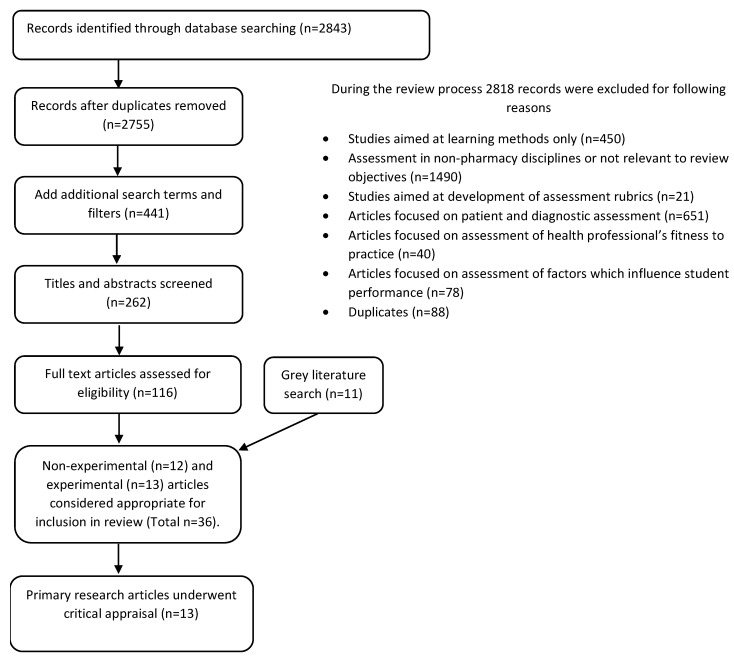
An increasing emphasis on health professional competency in recent times has been matched by an increased prevalence of competency-based education models. Assessments can generate information on competence, and authentic, practice-based assessment methods are critical. Assessment reform has emerged as an academic response to the demands of the pharmacy profession and the need to equip graduates with the necessary knowledge, skills and attributes to face the challenges of the modern workforce. The objective of this review was to identify and appraise the range of assessment methods used in entry-level pharmacy education and examine current trends in health professional assessment. The initial search located 2854 articles. After screening, 36 sources were included in the review, 13 primary research studies, 12 non-experimental pharmacy research papers, and 11 standards and guidelines from the grey literature. Primary research studies were critically appraised using the Medical Education Research Study Quality Instrument (MERSQI). This review identified three areas in pharmacy practice assessment which provide opportunities for expansion and improvement of assessment approaches: (1) integrated approaches to performance assessment; (2) simulation-based assessment approaches, and; (3) collection of validity evidence to support assessment decisions. Competency-based assessment shows great potential for expanded use in pharmacy, but there is a need for further research and development to ensure its appropriate and effective use.
Keywords: Entrustable Professional Activities (EPAs); Objective Structured Clinical Examination (OSCE); assessment; competency-based education; health professionals; pharmacist; pharmacy; pharmacy student; simulation.
Conflict of interest statement
The authors declare no conflicts of interest.
Figures
References
-
- Lambert Schuwirth W.T., van der Vleuten C. How to design a useful test: The principles of assessment. In: Swanwick T., editor. Understanding Medical Education: Evidence, Theory and Practice. The Association for the Study of Medical Education; Edinburgh, UK: 2010.
-
- Anderson H., Anaya G., Bird E., Moore D. Review of Educational Assessment. Am. J. Pharm. Educ. 2005;69:84–100.
-
- Huba M., Freed J. Shifting the Focus from Teaching to Learning. Volume 8 Allyn and Bacon; Boston, MA, USA: 2000. Learner-Centered Assessment on College Campus.
-
- Australian Qualifications Framework Council . Australian Qualifications Framework. Department of Industry, Science, Research and Tertiary Education Adelaide; Adelaide, Australia: 2013.
Publication types
LinkOut - more resources
Full Text Sources
