. 2020 Jan;14(1):135-150.
doi: 10.1177/1932296819855670. Epub 2019 Jun 19.

Benefits and Limitations of MARD as a Performance Parameter for Continuous Glucose Monitoring in the Interstitial Space

Affiliations

Benefits and Limitations of MARD as a Performance Parameter for Continuous Glucose Monitoring in the Interstitial Space

Lutz Heinemann et al. J Diabetes Sci Technol. 2020 Jan.

Abstract

High-quality performance of medical devices for glucose monitoring is important for a safe and efficient usage of this diagnostic option by patients with diabetes. The mean absolute relative difference (MARD) parameter is used most often to characterize the measurement performance of systems for continuous glucose monitoring (CGM). Calculation of this parameter is relatively easy and comparison of the MARD numbers between different CGM systems appears to be straightforward on the first glance. However, a closer look reveals that a number of complex aspects make interpretation of the MARD numbers provided by the manufacturer for their CGM systems difficult. In this review, these aspects are discussed and considerations are made for a systematic and appropriate evaluation of the MARD in clinical trials. The MARD should not be used as the sole parameter to characterize CGM systems, especially when it comes to nonadjunctive usage of such systems.

Keywords: blood glucose; continuous glucose monitoring; diabetes therapy; glucose measurement; quality of measurement.


Conflict of interest statement

Declaration of Conflicting Interests: The author(s) declared the following potential conflicts of interest with respect to the research, authorship, and/or publication of this article: LH and GF support a number of companies in the development of novel diagnostic and therapeutic options for diabetes treatment. MS, GSR, RH, and AK are employees of Roche Diabetes Care. FR and LDR have nothing to disclose.

Figures

Figure 1.
Figure 1.
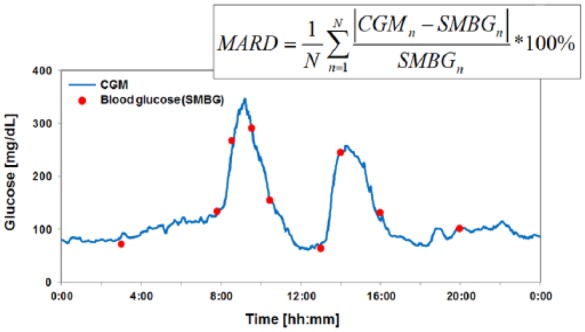
Glucose values continuously monitored (CGM) over 24 hours and corresponding BG values measured by a comparison method in certain time intervals. Based on the absolute differences between the CGM and BG glucose (in this case SMBG, but can also be a different comparison method) the MARD is calculated according to the formula given.
Figure 2.
Figure 2.
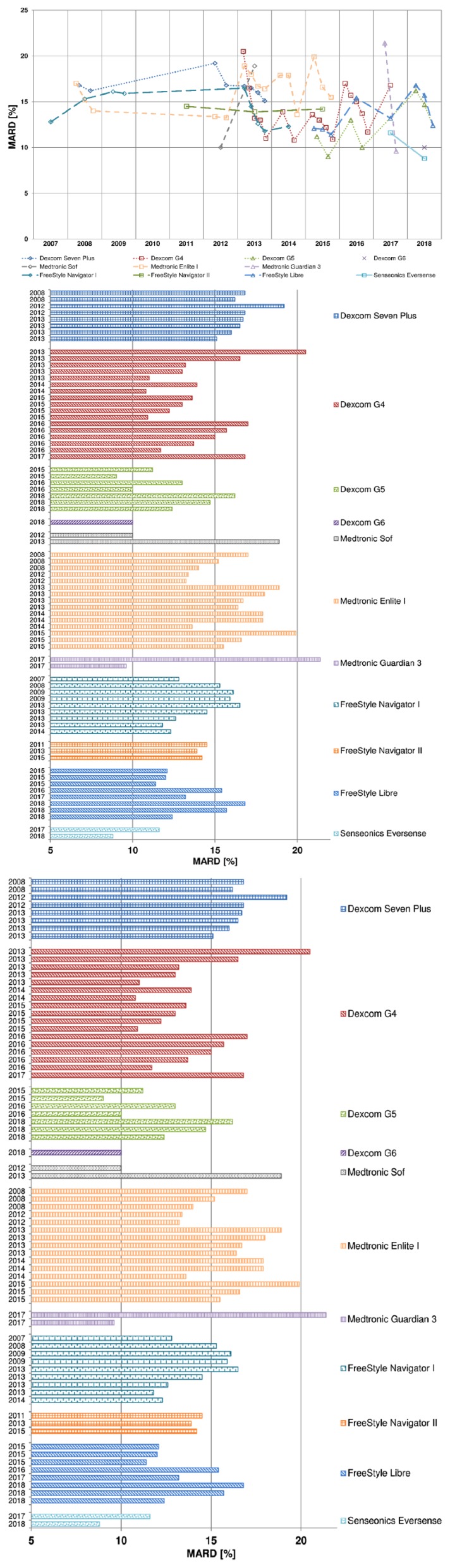
Graphical representation of the MARD values obtained in the different studies listed in Table 3. (a) MARD values separated for the different CGM systems and year the respective studies were published. (b) MARD values sorted by CGM manufacturer / CGM system and year the respective studies were published.
Figure 3.
Figure 3.
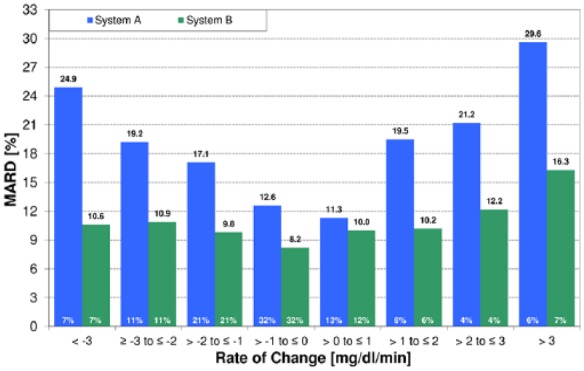
MARD during glucose swings (= periods of rapid glucose changes) for two different CGM systems as a function of the rate of change.

References

    1. Danne T, Nimri R, Battelino T, et al. International consensus on use of continuous glucose monitoring. Diabetes Care. 2017;40:1631-1640. - PMC - PubMed
    1. Wilmoth DR. The relationships between common measures of glucose meter performance. J Diabetes Sci Technol. 2012;6:1087-1093. - PMC - PubMed
    1. Schmelzeisen-Redeker G, Schoemaker M, Kirchsteiger H, Freckmann G, Heinemann L, Del Re L. Time delay of CGM sensors: relevance, causes, and countermeasures. J Diabetes Sci Technol. 2015;9:1006-1015. - PMC - PubMed
    1. Kirchsteiger H, Heinemann L, Freckmann G, et al. Performance comparison of CGM systems: MARD values are not always a reliable indicator of CGM system accuracy. J Diabetes Sci Technol. 2015;9:1030-1040. - PMC - PubMed
    1. Obermaier K, Schmelzeisen-Redeker G, Schoemaker M, et al. Performance evaluations of continuous glucose monitoring systems: precision absolute relative deviation is part of the assessment. J Diabetes Sci Technol. 2013;7:824-832. - PMC - PubMed

Publication types

MeSH terms