. 2019 Jul 9;9(7):2039-2049.
doi: 10.1534/g3.119.400083.

A Reference Genome Sequence for the European Silver Fir (Abies alba Mill.): A Community-Generated Genomic Resource

Affiliations

A Reference Genome Sequence for the European Silver Fir (Abies alba Mill.): A Community-Generated Genomic Resource

Elena Mosca et al. G3 (Bethesda). .

Abstract

Silver fir (Abies alba Mill.) is a keystone conifer of European montane forest ecosystems that has experienced large fluctuations in population size during during the Quaternary and, more recently, due to land-use change. To forecast the species' future distribution and survival, it is important to investigate the genetic basis of adaptation to environmental change, notably to extreme events. For this purpose, we here provide a first draft genome assembly and annotation of the silver fir genome, established through a community-based initiative. DNA obtained from haploid megagametophyte and diploid needle tissue was used to construct and sequence Illumina paired-end and mate-pair libraries, respectively, to high depth. The assembled A. alba genome sequence accounted for over 37 million scaffolds corresponding to 18.16 Gb, with a scaffold N50 of 14,051 bp. Despite the fragmented nature of the assembly, a total of 50,757 full-length genes were functionally annotated in the nuclear genome. The chloroplast genome was also assembled into a single scaffold (120,908 bp) that shows a high collinearity with both the A. koreana and A. sibirica complete chloroplast genomes. This first genome assembly of silver fir is an important genomic resource that is now publicly available in support of a new generation of research. By genome-enabling this important conifer, this resource will open the gate for new research and more precise genetic monitoring of European silver fir forests.

Keywords: Abies alba; annotation; chloroplast genome; conifer genome; genome assembly.


Figures

Figure 1
Figure 1
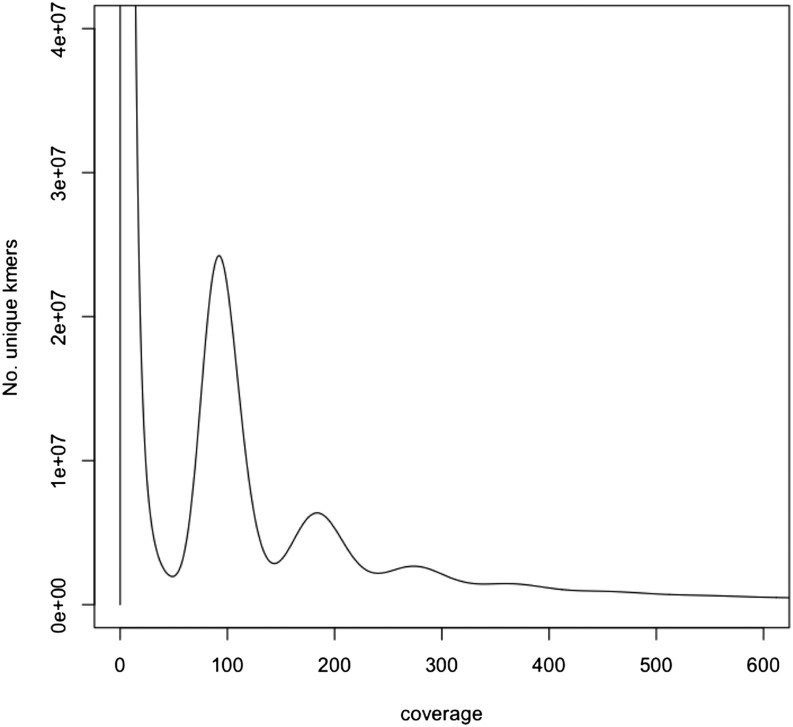
Distribution of 17-mers in the whole-genome sequence of Abies alba using raw paired-end (PE) 2 × 151 bp reads generated from the PE300 library with 300 bp long fragment inserts and estimated with Jellyfish 2.2.0 (Marçais and Kingsford 2011). The high peak at very low depths is caused by sequencing errors.
Figure 2
Figure 2
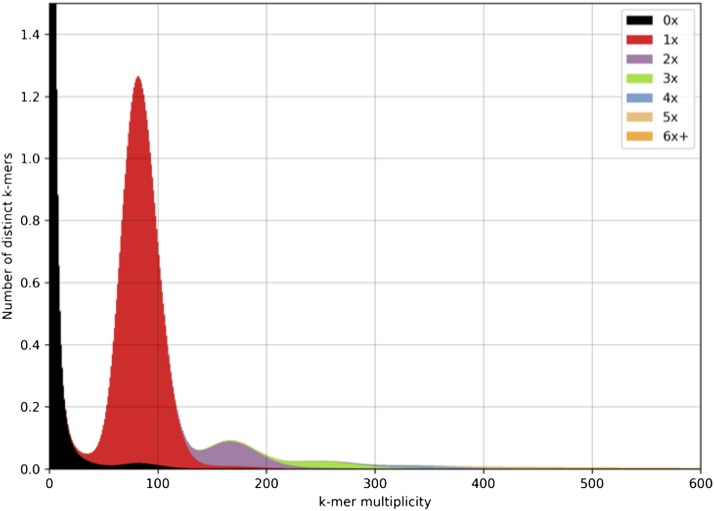
Spectra copy number in the Abies alba genome ABAL 1.1. Comparison between the k-mer (k = 27) spectra of paired-end (PE) 300 2 × 151 bp reads generated from the PE300 library with 300 bp long fragment inserts and the ABAL 1.1 assembly. This stacked histogram was produced with KAT (Mapleson et al. 2016) that shows the spectra copy number classes along the assembly.
Figure 3
Figure 3
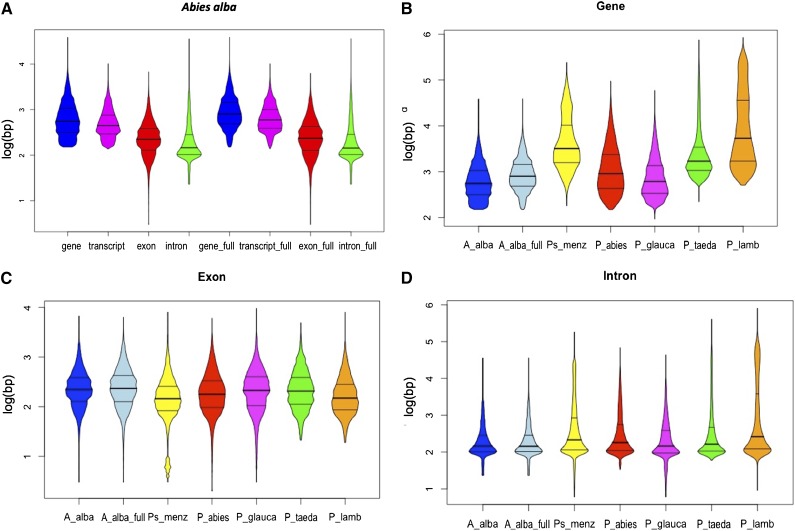
Violin plot of the distribution length of the genes, transcripts, exons and introns across the Abies alba (Abies_al) high-quality genes and full-length genes (indicated as “full”; A). The length was log10 transformed. Violin plot of the distribution lengths of genes (B), exons (C) and introns (D) across the Abies alba (A_alba) high-quality genes and full-length genes, Pseudotsuga menziesii (Ps_menz), Picea abies (P_abies), Picea glauca (P_glauca), Pinus taeda (P_taeda), Pinus lambertiana (P_lamb).

References

    1. Altschul S. F., Gish W., Miller W., Myers E. W., Lipman D. J., 1990. Basic local alignment search tool. Molecular Biology Journal 215: 403–410. 10.1016/S0022-2836(05)80360-2 - DOI - PubMed
    1. Bankevich A., Nurk S., Antipov D., Gurevich A. A., Dvorkin M., et al. , 2012. SPAdes: a new genome assembly algorithm and its applications to single-cell sequencing. J. Comput. Biol. 19: 455–477. 10.1089/cmb.2012.0021 - DOI - PMC - PubMed
    1. Bennett M. D., Leitch I. J., 2011. Nuclear DNA amounts in angiosperms: targets, trends and tomorrow. Ann. Bot. (Lond.) 107: 467–590. 10.1093/aob/mcq258 - DOI - PMC - PubMed
    1. Bennetzen J. L., Wang H., 2014. The contributions of transposable elements to the 618 structure, function, and evolution of plant genomes. Annu. Rev. Plant Biol. 65: 505–530. 10.1146/annurev-arplant-050213-035811 - DOI - PubMed
    1. Boetzer M., Pirovano W., 2012. Toward almost closed genomes with GapFiller. Genome Biol. 13: R56 10.1186/gb-2012-13-6-r56 - DOI - PMC - PubMed

Publication types