


The incidence and relative risk of adverse events in patients treated with bisphosphonate therapy for breast cancer: a systematic review and meta-analysis
- PMID: 31217825
- PMCID: PMC6558551
- DOI: 10.1177/1758835919855235
The incidence and relative risk of adverse events in patients treated with bisphosphonate therapy for breast cancer: a systematic review and meta-analysis
Abstract
Background: Adjuvant bisphosphonates reduce the rate of breast cancer recurrence in the bone and improve breast cancer survival. However, the risk of adverse events associated with bisphosphonate therapy for breast cancer remains poorly defined.
Methods: A literature search was conducted using the PubMed, EMBASE, Cochrane and Web of Science libraries. Risk ratio (RR) was calculated to evaluate the adverse events of the meta-analytic results. Osteonecrosis of the jaw (ONJ) incidence was calculated using the random effect model (D+L pooled) for meta-analysis.
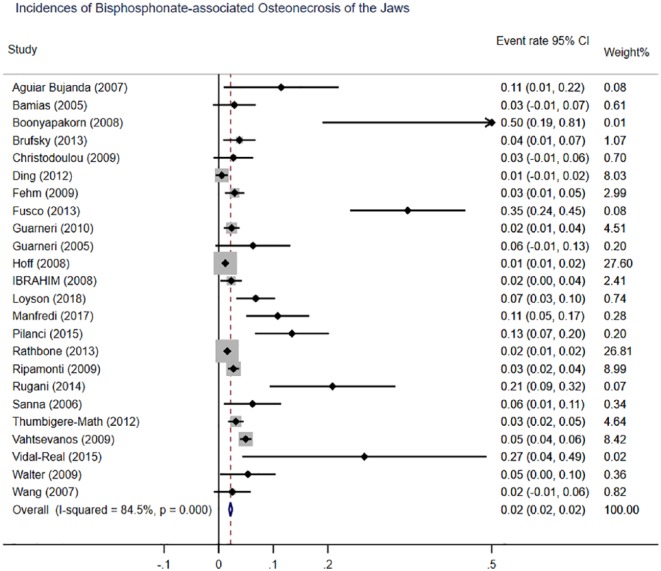
Results: A total of 47 studies comprising 20,607 patients were included; 23 randomized controlled studies (RCTs) provided data of adverse events for bisphosphonate therapy versus without bisphosphonates. Bisphosphonates were significantly associated with influenza-like illness (RR = 4.52), fatigue (RR = 1.08), fever (RR = 1.82), dyspepsia (RR = 1.25), anorexia (RR = 1.29), and urinary tract infection (RR = 1.32). No differences were observed in other adverse events. We combined the incidence of ONJ in 24 retrospective studies to analyze the incidence of ONJ using bisphosphonates. The pooled probability of ONJ toxicity in the bisphosphonates group was 2%.
Conclusions: Bisphosphonates were significantly associated with influenza-like illness, fatigue, fever, dyspepsia, anorexia, and urinary tract infection. Furthermore, bisphosphonates increase the risk of ONJ toxicity.
Keywords: adverse events; bisphosphonates; breast cancer; neoadjuvant therapy; osteonecrosis of the jaw.
Conflict of interest statement
Conflict of interest statement: The authors declare that there is no conflict of interest.
Figures



References
-
- Palmieri C, Fullarton JR, Brown J. Comparative efficacy of bisphosphonates in metastatic breast and prostate cancer and multiple myeloma: a mixed-treatment meta-analysis. Clin Cancer Res 2013; 19: 6863–6872. - PubMed
-
- Clement-Demange L, Clezardin P. Emerging therapies in bone metastasis. Curr Opin Pharmacol 2015; 22: 79–86. - PubMed
-
- Saad F, Lipton A, Cook R, et al. Pathologic fractures correlate with reduced survival in patients with malignant bone disease. Cancer 2007; 110: 1860–1867. - PubMed
-
- Van Poznak CH, Temin S, Yee GC, et al. American society of clinical oncology executive summary of the clinical practice guideline update on the role of bone-modifying agents in metastatic breast cancer. J Clin Oncol 2011; 29: 1221–1227. - PubMed
-
- Landesberg R, Eisig S, Fennoy I, et al. Alternative indications for bisphosphonate therapy. J Oral Maxillofac Surg 2009; 67: 27–34. - PubMed
LinkOut - more resources
Full Text Sources
