Outcomes of cardiac resynchronisation therapy in patients with heart failure with atrial fibrillation: a systematic review and meta-analysis of observational studies
- PMID: 31217991
- PMCID: PMC6546263
- DOI: 10.1136/openhrt-2018-000937
Outcomes of cardiac resynchronisation therapy in patients with heart failure with atrial fibrillation: a systematic review and meta-analysis of observational studies
Abstract
Background: Cardiac resynchronisation therapy (CRT) is beneficial in selected patients with heart failure (HF) in normal sinus rhythm (NSR). We sought to evaluate the impact of CRT with or without atrioventricular junction (AVJ) ablation in patients with HF with concomitant atrial fibrillation (AF).
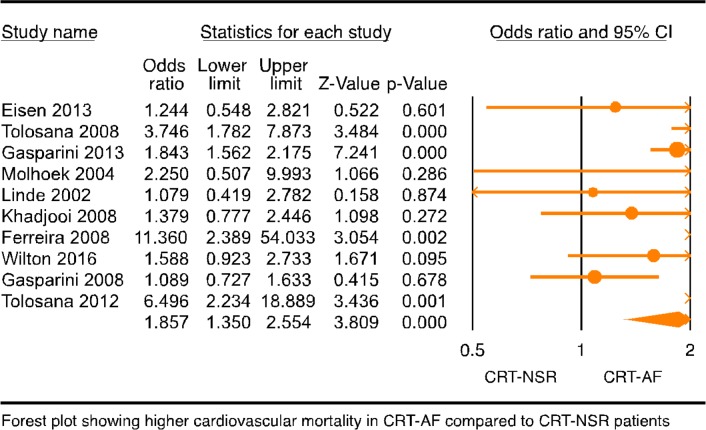
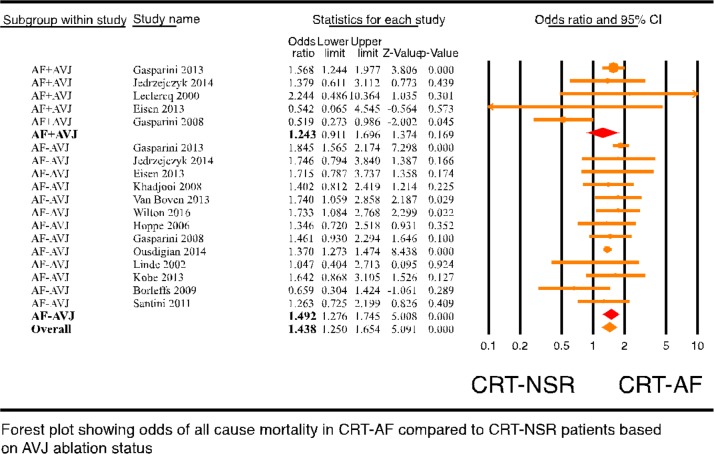
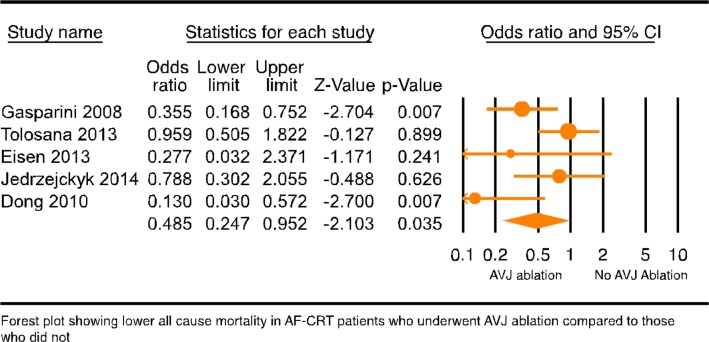
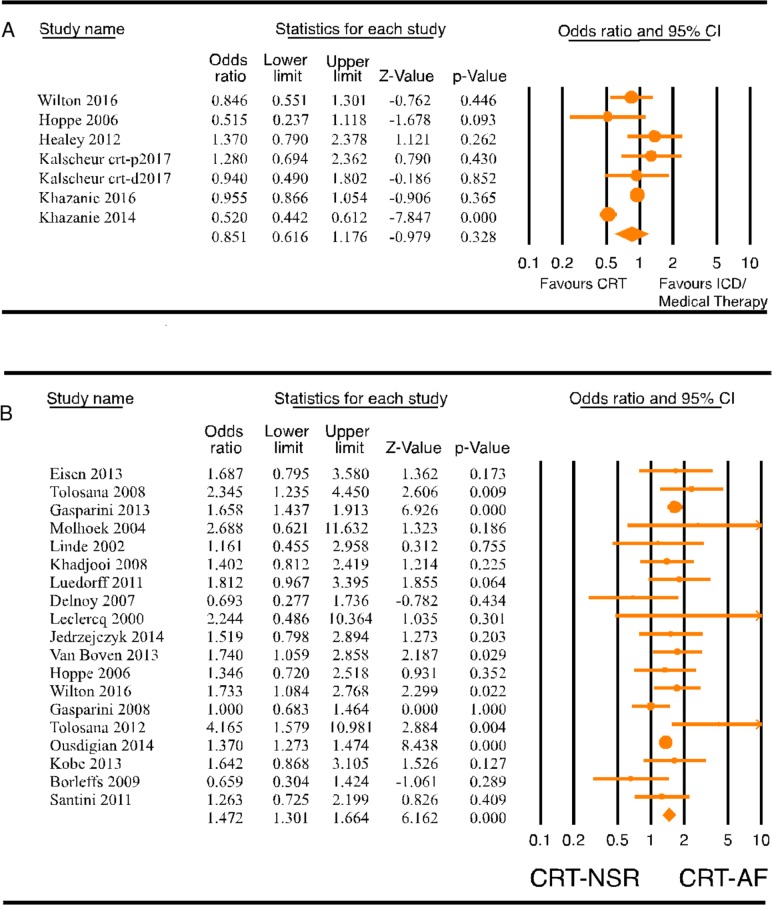
Methods and results: Literature was searched (inception through 30 August 2017) for observational studies that reported outcomes in patients with HF with CRT and AF that reported all-cause and cardiovascular mortality. Thirty-one studies with 83, 571 patients were included. CRT did not decrease mortality compared with internal cardioverter defibrillator or medical therapy alone in patients with HF and AF with indications for CRT (OR: 0.851, 95% CI 0.616 to 1.176, p=0.328, I2=86.954). CRT-AF patients had significantly higher all-cause and cardiovascular mortality than CRT-NSR patients ([OR: 1.472, 95% CI 1.301 to 1.664, p=0.000] and [OR: 1.857, 95% CI 1.350 to 2.554, p=0.000] respectively). Change in left ventricular ejection fraction was not different between CRT patients with and without AF (p=0.705). AVJ ablation, however, improved all-cause mortality in CRT-AF patients when compared with CRT-AF patients without AVJ ablation (OR: 0.485, 95% CI 0.247 to 0.952, p=0.035). With AVJ ablation, there was no difference in all-cause mortality in CRT-AF patients compared with CRT-NSR patients (OR: 1.245, 95% CI 0.914 to 1.696, p=0.165).
Conclusion: The results of our meta-analysis suggest that AF was associated with decreased CRT benefits in patients with HF. CRT, however, benefits patients with AF with AVJ ablation.
Keywords: atrioventricular junction ablation; biventricular pacing; ejection fraction; implanted cardioverter defibrillator.
Conflict of interest statement
Competing interests: None declared.
Figures
Similar articles
-
Benefit of cardiac resynchronization therapy in atrial fibrillation patients vs. patients in sinus rhythm: the role of atrioventricular junction ablation.Europace. 2008 Jul;10(7):809-15. doi: 10.1093/europace/eun135. Epub 2008 May 28. Europace. 2008. PMID: 18511438
-
Long-term survival in patients undergoing cardiac resynchronization therapy: the importance of performing atrio-ventricular junction ablation in patients with permanent atrial fibrillation.Eur Heart J. 2008 Jul;29(13):1644-52. doi: 10.1093/eurheartj/ehn133. Epub 2008 Apr 4. Eur Heart J. 2008. PMID: 18390869 Free PMC article.
-
Cardiac resynchronization therapy after atrioventricular junction ablation for symptomatic atrial fibrillation: a meta-analysis.Europace. 2012 Oct;14(10):1490-7. doi: 10.1093/europace/eus193. Epub 2012 Jun 13. Europace. 2012. PMID: 22696519
-
Cardiac Resynchronization Therapy and Atrial Fibrillation.J Atr Fibrillation. 2011 Sep 30;4(3):334. doi: 10.4022/jafib.334. eCollection 2011 Sep-Nov. J Atr Fibrillation. 2011. PMID: 28496698 Free PMC article. Review.
-
Role of Atrio-Ventricular Junction Ablation in Symptomatic Atrial Fibrillation for Optimization of Cardiac Resynchronization Therapy.J Atr Fibrillation. 2013 Apr 6;5(6):787. doi: 10.4022/jafib.787. eCollection 2013 Apr-May. J Atr Fibrillation. 2013. PMID: 28496831 Free PMC article. Review.
Cited by
-
Rate or Rhythm Control in CRT (RHYTHMIC): Study rationale and protocol.Heart Rhythm O2. 2022 Sep 13;3(6Part A):681-687. doi: 10.1016/j.hroo.2022.09.001. eCollection 2022 Dec. Heart Rhythm O2. 2022. PMID: 36589918 Free PMC article.
-
2023 ACC/AHA/ACCP/HRS Guideline for the Diagnosis and Management of Atrial Fibrillation: A Report of the American College of Cardiology/American Heart Association Joint Committee on Clinical Practice Guidelines.Circulation. 2024 Jan 2;149(1):e1-e156. doi: 10.1161/CIR.0000000000001193. Epub 2023 Nov 30. Circulation. 2024. PMID: 38033089 Free PMC article.
-
Predictors of Higher Frequency of Atrial Fibrillation in Patients with Cardiac Resynchronization Therapy.Medicina (Kaunas). 2023 Dec 15;59(12):2178. doi: 10.3390/medicina59122178. Medicina (Kaunas). 2023. PMID: 38138281 Free PMC article.
-
Determinants of Response to Cardiac Resynchronization Therapy.J Innov Card Rhythm Manag. 2022 May 15;13(5):4994-5003. doi: 10.19102/icrm.2022.130503. eCollection 2022 May. J Innov Card Rhythm Manag. 2022. PMID: 35655810 Free PMC article.
-
Pacemaker and Atrioventricular Junction Ablation in Patients With Atrial Fibrillation-A Systematic Review of Systematic Review and Meta-Analysis.Front Cardiovasc Med. 2022 Jan 20;8:587297. doi: 10.3389/fcvm.2021.587297. eCollection 2021. Front Cardiovasc Med. 2022. PMID: 35127840 Free PMC article.
References
-
- Tolosana JM, Hernandez Madrid A, Brugada J, et al. . Comparison of benefits and mortality in cardiac resynchronization therapy in patients with atrial fibrillation versus patients in sinus rhythm (Results of the Spanish Atrial Fibrillation and Resynchronization [SPARE] Study). Am J Cardiol 2008;102:444–9. 10.1016/j.amjcard.2008.04.008 - DOI - PubMed
Publication types
Grants and funding
LinkOut - more resources
Full Text Sources
Research Materials
Miscellaneous